Carbondale planners start scoping parking study; consultant urges inventory-first approach
January 23, 2026 | Carbondale, Garfield County, Colorado
This article was created by AI summarizing key points discussed. AI makes mistakes, so for full details and context, please refer to the video of the full meeting. Please report any errors so we can fix them. Report an error »
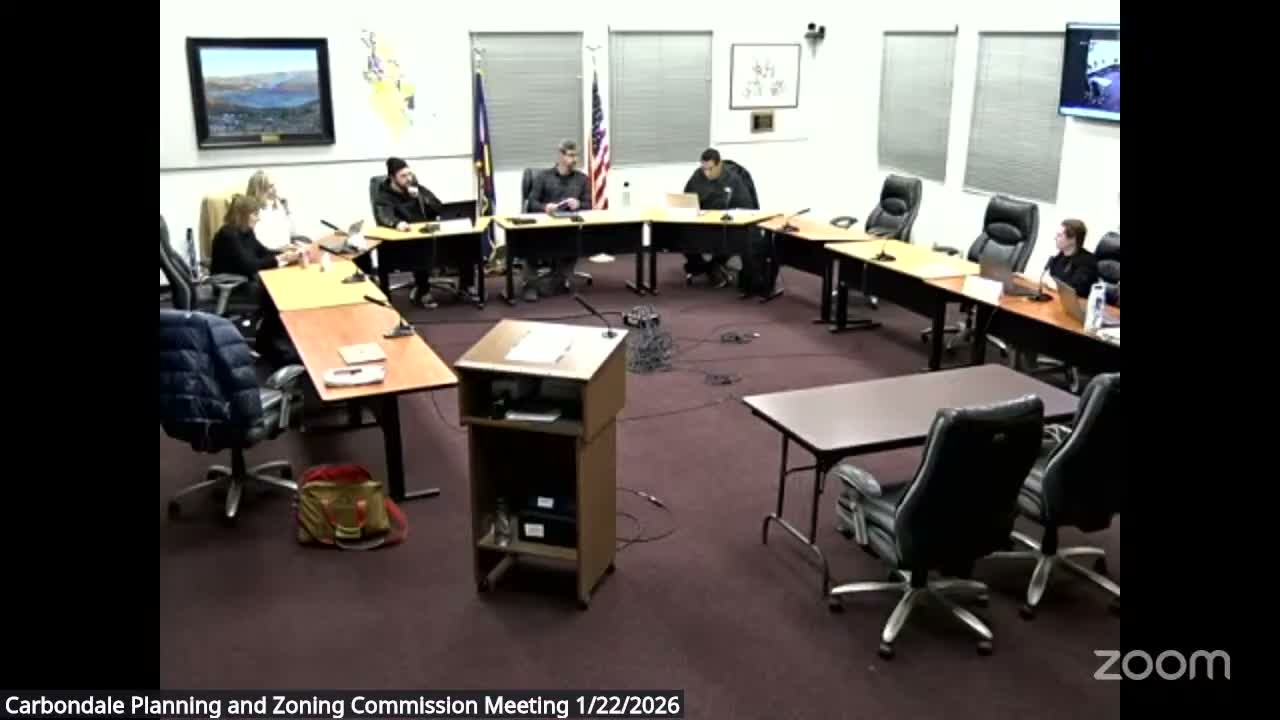
The Carbondale Planning and Zoning Commission on Jan. 22 opened work on a townwide parking study and request-for-proposals after trustees asked the commission to review downtown parking ratios and the impact of a recent land gift.
Consultant Vanessa Solsby of Dixon Resources Unlimited told commissioners the first priority is a clear inventory and baseline data. “The very, very first thing, get an understanding of your inventory,” she said, describing counts of on‑ and off‑street spaces, who is parking (residents, employees, visitors), how long they stay and where turnover occurs. Solsby said that evidence is essential before recommending regulations or paid parking.
Why it matters: commissioners worried that current bedroom‑based code ratios (e.g., 1.25 for efficiencies, 1.5 for one‑bedroom units) and rounding rules can produce outcomes that do not match how spaces are actually used in the downtown historic core. Commissioners described apparent surpluses at some commercial lots versus shortages near Main Street and residential infill areas.
What the consultant recommended: Solsby outlined a two‑part work plan for the RFP. The preliminary phase is an inventory and documentation exercise — counts, occupancy and turnover sampling using methods such as manual counts, license‑plate recognition, Google Earth imagery and drone validation. "If you're parking in a certain area is utilized over 85% — so it's 85% occupied for several days — you need that," she said, identifying persistent occupancy above that threshold as industry guidance to consider active management.
Timing and engagement: Solsby suggested the inventory phase could be completed in roughly 90 days, while a fuller community engagement and recommendation process commonly takes six to nine months. She advised commissioners to design the RFP so a consultant can deliver actionable recommendations and implementation steps (ordinance text, enforcement options, costs, phasing), not only general advice.
Local fit and trade‑offs: Solsby stressed there is no single solution for every community and warned of unintended consequences — changes in regulation can push demand into adjacent neighborhoods, affect traffic flow and influence local businesses. She urged the commission to consider Colorado mountain comparators (Estes Park, Manitou Springs) and to identify an internal owner or champion to shepherd the program.
Next steps: Commissioners agreed staff and a selection subgroup will draft an RFP that emphasizes a clear inventory and defined deliverables. A draft RFP review was discussed for a future meeting, with commissioners noting Feb. 26 as a likely date for continued RFP work. No formal vote on the study RFP was taken at this meeting; the only recorded action was approval of the Jan. 8 minutes (moved by Jarrett Moore and seconded by Kim McGee). The commission expects consultant resources and sample deliverables from Dixon to inform the RFP language.
The meeting closed after brief staff updates and commissioner comments; the commission adjourned at the end of the evening.
Consultant Vanessa Solsby of Dixon Resources Unlimited told commissioners the first priority is a clear inventory and baseline data. “The very, very first thing, get an understanding of your inventory,” she said, describing counts of on‑ and off‑street spaces, who is parking (residents, employees, visitors), how long they stay and where turnover occurs. Solsby said that evidence is essential before recommending regulations or paid parking.
Why it matters: commissioners worried that current bedroom‑based code ratios (e.g., 1.25 for efficiencies, 1.5 for one‑bedroom units) and rounding rules can produce outcomes that do not match how spaces are actually used in the downtown historic core. Commissioners described apparent surpluses at some commercial lots versus shortages near Main Street and residential infill areas.
What the consultant recommended: Solsby outlined a two‑part work plan for the RFP. The preliminary phase is an inventory and documentation exercise — counts, occupancy and turnover sampling using methods such as manual counts, license‑plate recognition, Google Earth imagery and drone validation. "If you're parking in a certain area is utilized over 85% — so it's 85% occupied for several days — you need that," she said, identifying persistent occupancy above that threshold as industry guidance to consider active management.
Timing and engagement: Solsby suggested the inventory phase could be completed in roughly 90 days, while a fuller community engagement and recommendation process commonly takes six to nine months. She advised commissioners to design the RFP so a consultant can deliver actionable recommendations and implementation steps (ordinance text, enforcement options, costs, phasing), not only general advice.
Local fit and trade‑offs: Solsby stressed there is no single solution for every community and warned of unintended consequences — changes in regulation can push demand into adjacent neighborhoods, affect traffic flow and influence local businesses. She urged the commission to consider Colorado mountain comparators (Estes Park, Manitou Springs) and to identify an internal owner or champion to shepherd the program.
Next steps: Commissioners agreed staff and a selection subgroup will draft an RFP that emphasizes a clear inventory and defined deliverables. A draft RFP review was discussed for a future meeting, with commissioners noting Feb. 26 as a likely date for continued RFP work. No formal vote on the study RFP was taken at this meeting; the only recorded action was approval of the Jan. 8 minutes (moved by Jarrett Moore and seconded by Kim McGee). The commission expects consultant resources and sample deliverables from Dixon to inform the RFP language.
The meeting closed after brief staff updates and commissioner comments; the commission adjourned at the end of the evening.
View the Full Meeting & All Its Details
This article offers just a summary. Unlock complete video, transcripts, and insights as a Founder Member.
✓
Watch full, unedited meeting videos
✓
Search every word spoken in unlimited transcripts
✓
AI summaries & real-time alerts (all government levels)
✓
Permanent access to expanding government content
30-day money-back guarantee
