House committee advances HJR 203 after hours of debate and broad local opposition
January 22, 2026 | 2026 Legislature FL, Florida
This article was created by AI summarizing key points discussed. AI makes mistakes, so for full details and context, please refer to the video of the full meeting. Please report any errors so we can fix them. Report an error »
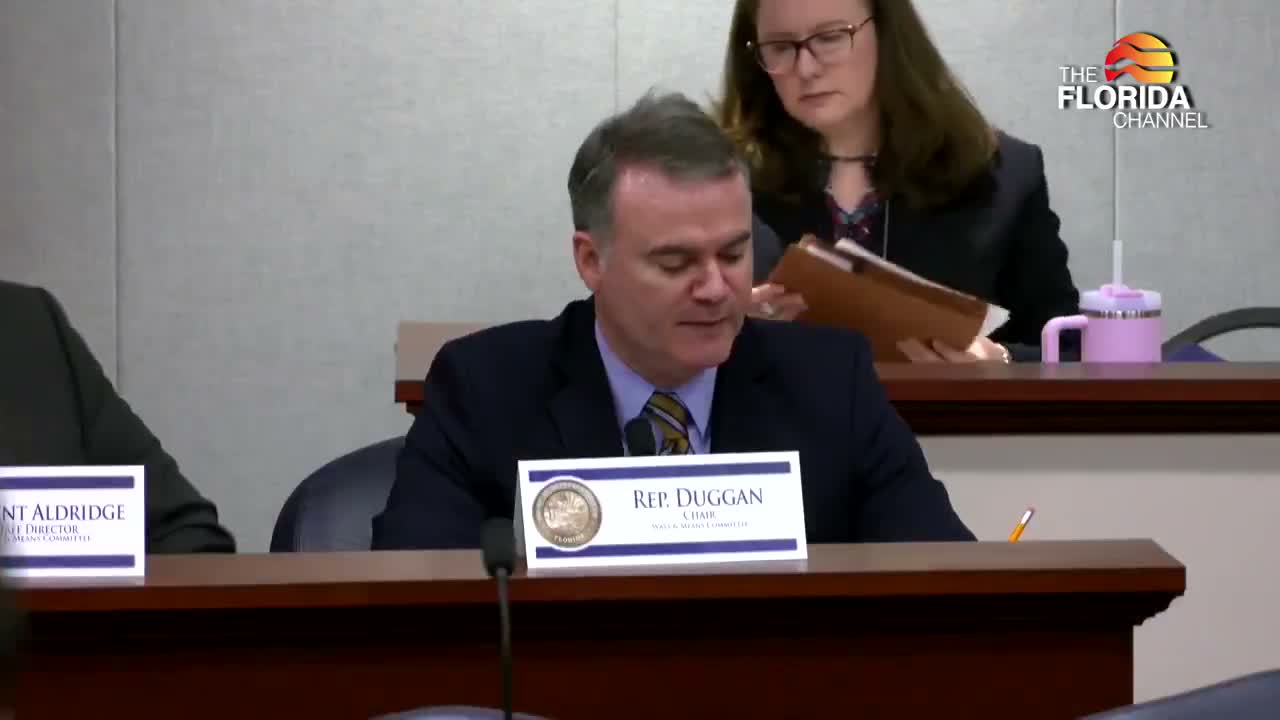
The Florida House Ways and Means Committee on Jan. 22 voted 10–6 to report favorably on House Joint Resolution 203, a proposed constitutional amendment that would phase out non‑school ad valorem property taxes for homesteads over a 10‑year period.
Sponsor Rep. Miller framed the measure as a measured, phased approach designed to return money to homeowners while preserving essential public safety funding. She told the committee the first‑year statewide impact would be about $4 billion and said the proposal provides local governments time to adjust. "The first year's impact of this bill is about $4,000,000,000 out of the total $55,200,000,000 that we pay in overall property taxes in the state of Florida today," she said during questioning.
Opponents — including a long list of county managers, commissioners and municipal representatives — warned of severe fiscal consequences for fiscally constrained counties and special districts that rely heavily on ad valorem revenue. Charles Chapman of the Florida League of Cities told the committee municipalities "do not have fiscal autonomy" and that 79% of municipal general‑fund tax revenue comes from property taxes; he said cities may need to raise fees or cut services. Jeff Scala of the Florida Association of Counties characterized the proposal as "a fiscal crisis by design." Several county managers gave locality‑specific dollar impacts and warned that small counties with low tax bases could be unable to maintain services.
Members pressed the sponsor on implementation details. Rep. Bartleman and others asked whether market changes to home values would accelerate phase‑out in some localities; Rep. Miller said the intent is a consistent 10‑year glide path but acknowledged that some places could reach elimination sooner because of property‑value dynamics. Representatives also asked whether other joint resolutions or ballot measures could conflict; the sponsor said a measure with an immediate removal would take precedence in the implementation year.
The committee heard requests to exclude water management and hospital districts from the resolution; Eric Draper representing water management districts said those districts rely almost entirely on ad valorem revenue and estimated impacts in the low hundreds of millions. Multiple members urged additional economic study; one witness cited staff estimates of $4.8 billion in lost local services the first year and $14.7 billion recurring (per staff summary quoted in testimony).
After nearly two hours of public testimony and member debate that ranged from philosophical defenses of homeowners to warnings about undermining home rule, the committee recorded roll call votes that yielded 10 yeas and 6 nays and reported the resolution favorably. The measure will proceed to further House consideration and, if enacted later in the process, would go to voters as a constitutional amendment.
Sponsor Rep. Miller framed the measure as a measured, phased approach designed to return money to homeowners while preserving essential public safety funding. She told the committee the first‑year statewide impact would be about $4 billion and said the proposal provides local governments time to adjust. "The first year's impact of this bill is about $4,000,000,000 out of the total $55,200,000,000 that we pay in overall property taxes in the state of Florida today," she said during questioning.
Opponents — including a long list of county managers, commissioners and municipal representatives — warned of severe fiscal consequences for fiscally constrained counties and special districts that rely heavily on ad valorem revenue. Charles Chapman of the Florida League of Cities told the committee municipalities "do not have fiscal autonomy" and that 79% of municipal general‑fund tax revenue comes from property taxes; he said cities may need to raise fees or cut services. Jeff Scala of the Florida Association of Counties characterized the proposal as "a fiscal crisis by design." Several county managers gave locality‑specific dollar impacts and warned that small counties with low tax bases could be unable to maintain services.
Members pressed the sponsor on implementation details. Rep. Bartleman and others asked whether market changes to home values would accelerate phase‑out in some localities; Rep. Miller said the intent is a consistent 10‑year glide path but acknowledged that some places could reach elimination sooner because of property‑value dynamics. Representatives also asked whether other joint resolutions or ballot measures could conflict; the sponsor said a measure with an immediate removal would take precedence in the implementation year.
The committee heard requests to exclude water management and hospital districts from the resolution; Eric Draper representing water management districts said those districts rely almost entirely on ad valorem revenue and estimated impacts in the low hundreds of millions. Multiple members urged additional economic study; one witness cited staff estimates of $4.8 billion in lost local services the first year and $14.7 billion recurring (per staff summary quoted in testimony).
After nearly two hours of public testimony and member debate that ranged from philosophical defenses of homeowners to warnings about undermining home rule, the committee recorded roll call votes that yielded 10 yeas and 6 nays and reported the resolution favorably. The measure will proceed to further House consideration and, if enacted later in the process, would go to voters as a constitutional amendment.
View the Full Meeting & All Its Details
This article offers just a summary. Unlock complete video, transcripts, and insights as a Founder Member.
✓
Watch full, unedited meeting videos
✓
Search every word spoken in unlimited transcripts
✓
AI summaries & real-time alerts (all government levels)
✓
Permanent access to expanding government content
30-day money-back guarantee
