Commission initiates amendment to expand Compton’s Cafeteria landmark to whole building and broader period
January 21, 2026 | San Francisco City, San Francisco County, California
This article was created by AI summarizing key points discussed. AI makes mistakes, so for full details and context, please refer to the video of the full meeting. Please report any errors so we can fix them. Report an error »
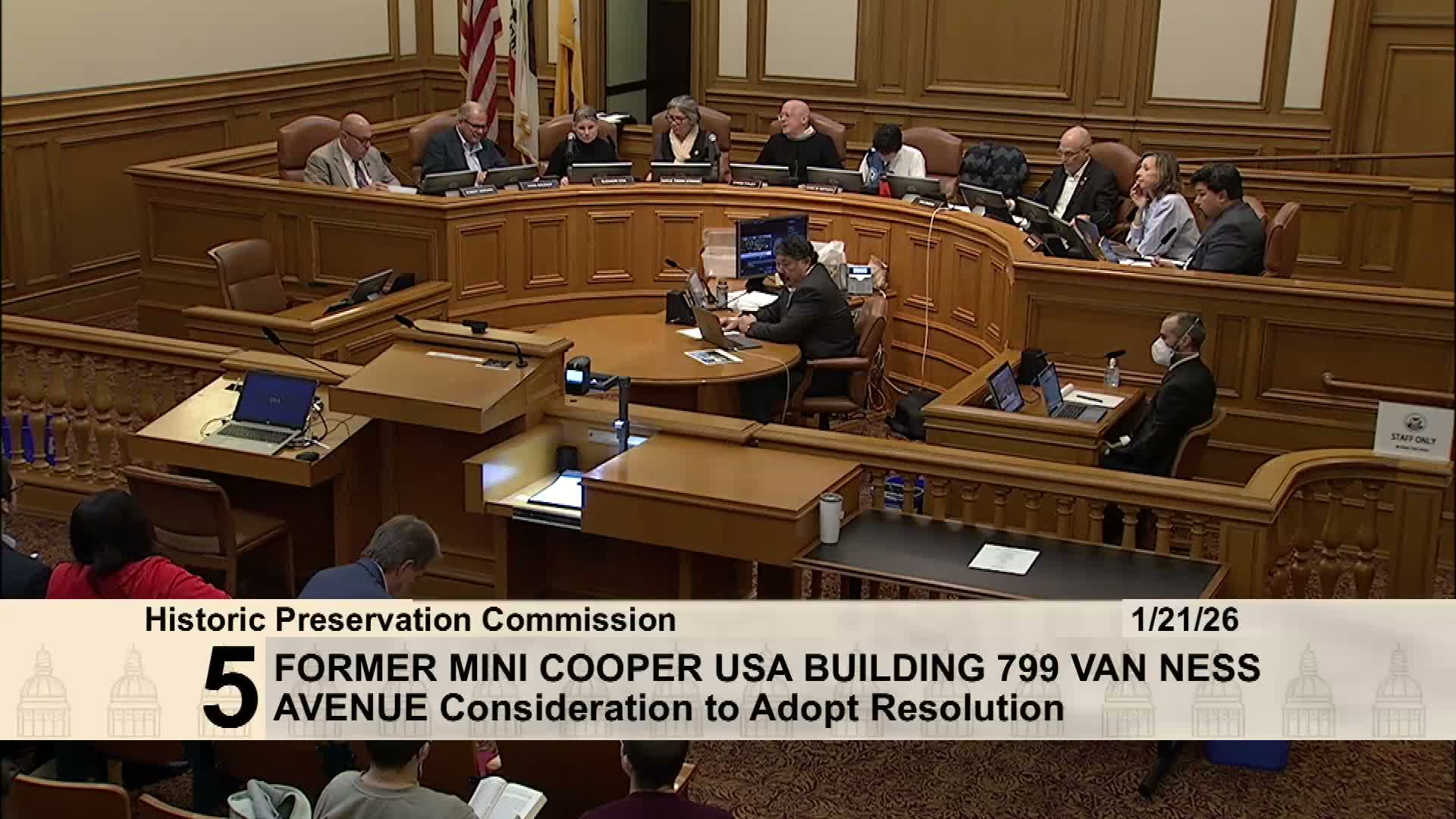
The Historic Preservation Commission on Jan. 21 voted unanimously to initiate an amendment to local landmark No. 307 to expand the Compton’s Cafeteria site to the full parcel at 101–121 Taylor Street (Turk & Taylor intersection) and to broaden the period of significance to the mid‑1960s through the mid‑1970s.
Planning staff presented a revised resolution and said the amendment would align the local landmark with the property’s Jan. 27, 2025 listing in the National Register of Historic Places. Staff noted the National Register found the site significant under social history for its association with collective resistance against police oppression and for events important to transgender and gender‑variant communities.
Compton’s Coalition representatives and numerous historians, preservationists and community members urged expansion. Andrea Horn, a longtime resident and member of the Compton’s Coalition, told the commission the amendment is needed to "update the historical record" and to reflect how events unfolded inside the cafeteria and in the surrounding building. Architectural historian Chandra Laborde and historian Susan Stryker described oral histories and archival evidence showing the riot’s origins inside the dining room, the role of the Highland Hotel upper floors as residences that sustained the community, and subsequent related protests and evictions.
Public speakers included members of the American Indian Cultural District, Indivisible San Francisco, the Tenderloin Museum, and multiple trans community leaders who said the amendment is timely amid broader threats to transgender public history. "By expanding this designation, the commission has the opportunity to affirm clearly and unequivocally that transgender history belongs at the center of San Francisco's preservation framework," architectural historian Shane Watson said during public comment.
A legal representative of the property owner submitted a letter expressing qualified support for aligning the local designation with the federal listing; staff said they received 14 additional letters of support in advance of the hearing. The commission adopted a motion to initiate the amendment and directed staff to schedule a follow‑up hearing to consider a draft ordinance identifying the property’s character‑defining exterior features.
The amended designation, if ultimately adopted by the Board of Supervisors and signed by the mayor, would expand local protections and help ensure public interpretation and stewardship for a site widely cited in scholarship and oral histories as a pivotal early transgender‑led uprising.
Planning staff presented a revised resolution and said the amendment would align the local landmark with the property’s Jan. 27, 2025 listing in the National Register of Historic Places. Staff noted the National Register found the site significant under social history for its association with collective resistance against police oppression and for events important to transgender and gender‑variant communities.
Compton’s Coalition representatives and numerous historians, preservationists and community members urged expansion. Andrea Horn, a longtime resident and member of the Compton’s Coalition, told the commission the amendment is needed to "update the historical record" and to reflect how events unfolded inside the cafeteria and in the surrounding building. Architectural historian Chandra Laborde and historian Susan Stryker described oral histories and archival evidence showing the riot’s origins inside the dining room, the role of the Highland Hotel upper floors as residences that sustained the community, and subsequent related protests and evictions.
Public speakers included members of the American Indian Cultural District, Indivisible San Francisco, the Tenderloin Museum, and multiple trans community leaders who said the amendment is timely amid broader threats to transgender public history. "By expanding this designation, the commission has the opportunity to affirm clearly and unequivocally that transgender history belongs at the center of San Francisco's preservation framework," architectural historian Shane Watson said during public comment.
A legal representative of the property owner submitted a letter expressing qualified support for aligning the local designation with the federal listing; staff said they received 14 additional letters of support in advance of the hearing. The commission adopted a motion to initiate the amendment and directed staff to schedule a follow‑up hearing to consider a draft ordinance identifying the property’s character‑defining exterior features.
The amended designation, if ultimately adopted by the Board of Supervisors and signed by the mayor, would expand local protections and help ensure public interpretation and stewardship for a site widely cited in scholarship and oral histories as a pivotal early transgender‑led uprising.
View the Full Meeting & All Its Details
This article offers just a summary. Unlock complete video, transcripts, and insights as a Founder Member.
✓
Watch full, unedited meeting videos
✓
Search every word spoken in unlimited transcripts
✓
AI summaries & real-time alerts (all government levels)
✓
Permanent access to expanding government content
30-day money-back guarantee
