Senate committee advances bill to let Oil and Gas Board repurpose old wells for geothermal use
January 22, 2026 | Transportation and Energy, Senate, Alabama Legislative Sessions, Alabama
This article was created by AI summarizing key points discussed. AI makes mistakes, so for full details and context, please refer to the video of the full meeting. Please report any errors so we can fix them. Report an error »
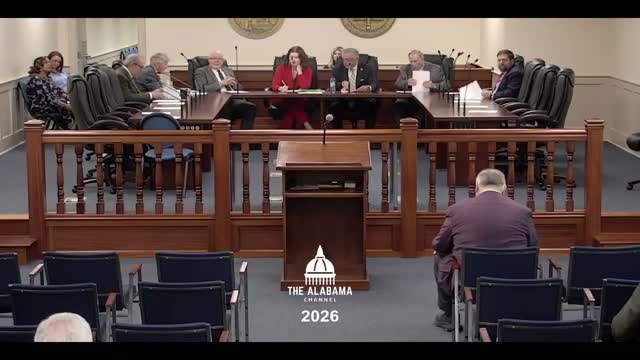
A Senate committee moved to report a bill that would let Alabama's Oil and Gas Board authorize the reuse of previously drilled oil and gas wells for geothermal energy, the bill's presenter said.
The presenter, identified in the transcript as Speaker 1, told the committee the proposal would authorize the board to reopen existing, emptied wellbores and allow geothermal companies to pump water or saline into those cavities, "let us sit there and get heated up and then extract the steam that's produced and or hot water as an energy source." The committee voted to send the measure forward in a paper report after a roll call vote.
Supporters framed the bill as a way to use existing infrastructure rather than leave wells abandoned. Speaker 1 said the change would "allow a geothermal company to come in and open that under the authority of the oil and gas board" and argued reuse would be "safer" than leaving abandoned wells uncontrolled. During the discussion, a committee member asked whether coal-methane wells are covered; Speaker 1 said the bill excludes coal methane (noted in the bill as excluded on page 3).
The presenter also drew a clear distinction between the proposal and carbon-capture programs: "This isn't carbon capture," he said. "It has nothing to do with CO2 capture ... This is dealing with mostly water, to be pumped in and so we can produce steam and heat and pull it out geothermal." That clarification was repeated after a question from another member.
After debate, Speaker 1 moved to "Move favor." The motion for a paper report was seconded, and the clerk conducted a roll call. The transcript records "Aye." responses from Senators Albritton, Barfoot, Beasley, Butler, Coleman, Hovie, Kitchens, Livingston, Sessions, Weaver and Williams; the transcript records no audible responses for Senators Stewart and Allen. The motion was carried and the committee adjourned.
Committee members asked for concrete data on how many wells in the Gulf might be affected and how many are capped. Speaker 1 said he did not have the numbers at the table but that the Oil and Gas Board maintains the data on its website and that he would provide a concise printed summary to members' desks within 24 hours.
What happens next: the committee reported the bill in a paper report to the next legislative stage, and staff committed to supplying the well counts requested by committee members. The transcript does not record bill text beyond the scope described, amendments, or an enacted statutory change.
The presenter, identified in the transcript as Speaker 1, told the committee the proposal would authorize the board to reopen existing, emptied wellbores and allow geothermal companies to pump water or saline into those cavities, "let us sit there and get heated up and then extract the steam that's produced and or hot water as an energy source." The committee voted to send the measure forward in a paper report after a roll call vote.
Supporters framed the bill as a way to use existing infrastructure rather than leave wells abandoned. Speaker 1 said the change would "allow a geothermal company to come in and open that under the authority of the oil and gas board" and argued reuse would be "safer" than leaving abandoned wells uncontrolled. During the discussion, a committee member asked whether coal-methane wells are covered; Speaker 1 said the bill excludes coal methane (noted in the bill as excluded on page 3).
The presenter also drew a clear distinction between the proposal and carbon-capture programs: "This isn't carbon capture," he said. "It has nothing to do with CO2 capture ... This is dealing with mostly water, to be pumped in and so we can produce steam and heat and pull it out geothermal." That clarification was repeated after a question from another member.
After debate, Speaker 1 moved to "Move favor." The motion for a paper report was seconded, and the clerk conducted a roll call. The transcript records "Aye." responses from Senators Albritton, Barfoot, Beasley, Butler, Coleman, Hovie, Kitchens, Livingston, Sessions, Weaver and Williams; the transcript records no audible responses for Senators Stewart and Allen. The motion was carried and the committee adjourned.
Committee members asked for concrete data on how many wells in the Gulf might be affected and how many are capped. Speaker 1 said he did not have the numbers at the table but that the Oil and Gas Board maintains the data on its website and that he would provide a concise printed summary to members' desks within 24 hours.
What happens next: the committee reported the bill in a paper report to the next legislative stage, and staff committed to supplying the well counts requested by committee members. The transcript does not record bill text beyond the scope described, amendments, or an enacted statutory change.
Don't Miss a Word: See the Full Meeting!
Go beyond summaries. Unlock every video, transcript, and key insight with a Founder Membership.
✓
Get instant access to full meeting videos
✓
Search and clip any phrase from complete transcripts
✓
Receive AI-powered summaries & custom alerts
✓
Enjoy lifetime, unrestricted access to government data
30-day money-back guarantee
