House approves a package of local constitutional amendments and bills; several measures pass by recorded vote
January 22, 2026 | House, Alabama Legislative Sessions, Alabama
This article was created by AI summarizing key points discussed. AI makes mistakes, so for full details and context, please refer to the video of the full meeting. Please report any errors so we can fix them. Report an error »
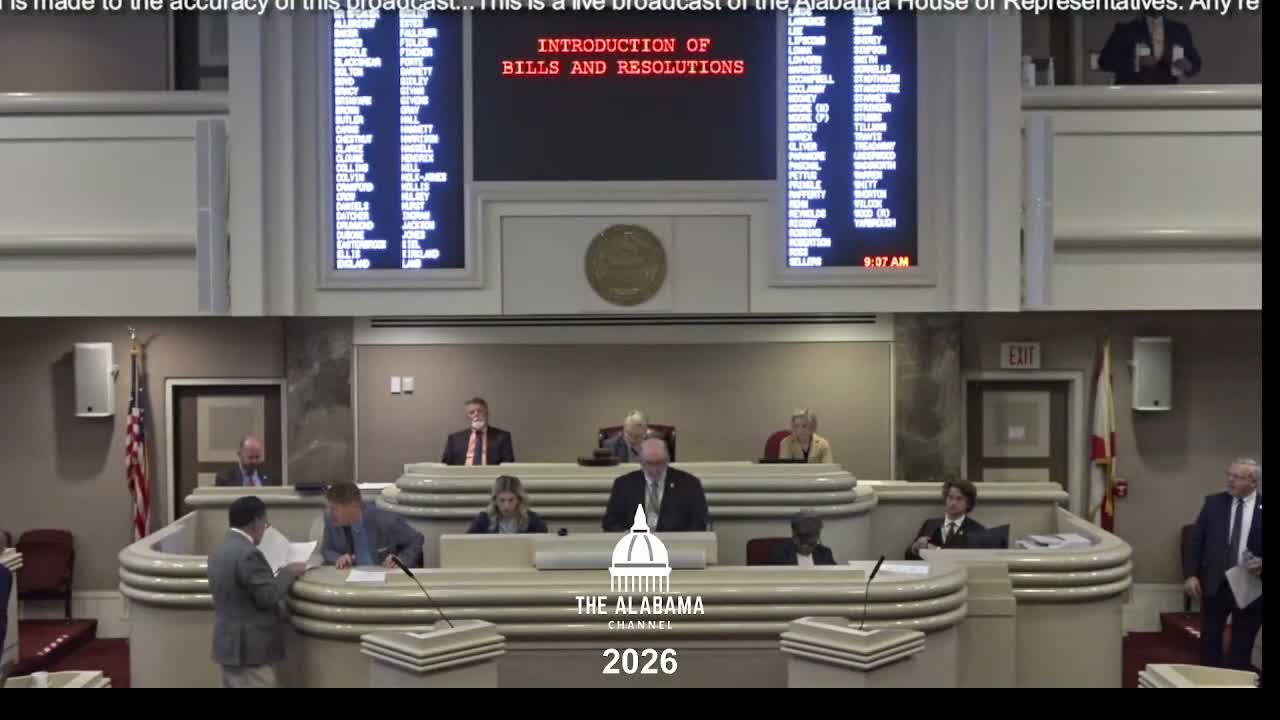
The Alabama House of Representatives met in Montgomery and recorded final passage on a series of local measures, including constitutional amendments capping homestead property tax for seniors, renewals of ad valorem levies for local hospitals, and governance adjustments for probate judges.
Clerk announcements and machine votes showed the following outcomes (votes quoted as recorded in the transcript): HB 82 (Baldwin County) — final passage announced by the Clerk; HB 202 (Baldwin County) — final passage announced by the Clerk; HB 211 (City of Locksley) — passage announced by the Clerk; HB 64 (Colbert County constitutional amendment capping homestead taxes for those 65 and older) — final passage announced with the Clerk recording '65 ayes, 0 nays'; HB 65 (Franklin County) — passage announced; HB 83 (Blount County probate-jurisdiction measure) — passage announced; HB 90 (St. Clair County retirement system participation) — passage announced; HB 109 (North Baldwin Hospital ad valorem renewal) — passage announced; HB 191 (Escambia County local court-location authority) — passage announced; HB 208 (Walker County constitutional amendment) — passage announced after recorded votes; HB 209 (local homestead tax cap) — passage announced; HB 210 (Fayette County homestead tax cap) — passage announced.
Many of the votes were recorded by machine and announced from the Clerk; where the transcript contains explicit numeric tallies those tallies are reported in the meeting timeline and in action notes. For some roll-call numbers the transcript contains artifacts (e.g., OCR-like errors) that make digits ambiguous; the Clerk’s verbal announcement of passage is recorded in the transcript for each bill.
Why it matters: the batch of measures affects property-tax protections for older homeowners in multiple counties, continues ad valorem funding for rural health care, and clarifies local judicial or retirement arrangements in select counties. The actions are local constitutional amendments or county-specific bills, so their effects are geographically targeted rather than statewide policy changes.
What’s next: the House recessed for committee meetings after completing the calendar; local application votes (where required) were taken at the end of each bill’s consideration. Any measures that require further procedural steps will follow the usual legislative process.
Clerk announcements and machine votes showed the following outcomes (votes quoted as recorded in the transcript): HB 82 (Baldwin County) — final passage announced by the Clerk; HB 202 (Baldwin County) — final passage announced by the Clerk; HB 211 (City of Locksley) — passage announced by the Clerk; HB 64 (Colbert County constitutional amendment capping homestead taxes for those 65 and older) — final passage announced with the Clerk recording '65 ayes, 0 nays'; HB 65 (Franklin County) — passage announced; HB 83 (Blount County probate-jurisdiction measure) — passage announced; HB 90 (St. Clair County retirement system participation) — passage announced; HB 109 (North Baldwin Hospital ad valorem renewal) — passage announced; HB 191 (Escambia County local court-location authority) — passage announced; HB 208 (Walker County constitutional amendment) — passage announced after recorded votes; HB 209 (local homestead tax cap) — passage announced; HB 210 (Fayette County homestead tax cap) — passage announced.
Many of the votes were recorded by machine and announced from the Clerk; where the transcript contains explicit numeric tallies those tallies are reported in the meeting timeline and in action notes. For some roll-call numbers the transcript contains artifacts (e.g., OCR-like errors) that make digits ambiguous; the Clerk’s verbal announcement of passage is recorded in the transcript for each bill.
Why it matters: the batch of measures affects property-tax protections for older homeowners in multiple counties, continues ad valorem funding for rural health care, and clarifies local judicial or retirement arrangements in select counties. The actions are local constitutional amendments or county-specific bills, so their effects are geographically targeted rather than statewide policy changes.
What’s next: the House recessed for committee meetings after completing the calendar; local application votes (where required) were taken at the end of each bill’s consideration. Any measures that require further procedural steps will follow the usual legislative process.
View the Full Meeting & All Its Details
This article offers just a summary. Unlock complete video, transcripts, and insights as a Founder Member.
✓
Watch full, unedited meeting videos
✓
Search every word spoken in unlimited transcripts
✓
AI summaries & real-time alerts (all government levels)
✓
Permanent access to expanding government content
30-day money-back guarantee
