State Board details March accountability hearings for schools with consecutive F grades under TISA (2022)
January 21, 2026 | 2026 Legislature TN, Tennessee
This article was created by AI summarizing key points discussed. AI makes mistakes, so for full details and context, please refer to the video of the full meeting. Please report any errors so we can fix them. Report an error »
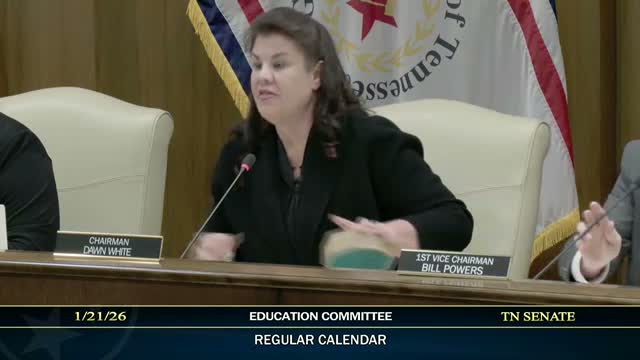
State Board of Education officials outlined a new series of public accountability hearings for school districts and charter schools that have recorded consecutive failing letter grades, saying the first hearings will be held the week of March 23 in Nashville.
Nathan James, the State Board deputy executive director, told the Senate Education Committee the hearings derive from language added to the TISA legislation in 2022 and are intended to create a public forum to review how increased K–12 funding is being spent and whether that spending is translating into improved student outcomes. "This language was added to the TISA legislation," James said, describing the board's statutory charge to convene hearings and promulgate rules.
Why it matters: the hearings give legislators, education officials and the public a structured way to question districts about school performance and resource allocation and to surface possible corrective steps. The board said the process is meant to be collaborative but not merely ceremonial: subcommittee findings may lead the full State Board to recommend either no action, a required corrective action plan to the Department of Education, or, after repeat appearances, an audit or investigation.
The board provided rules and logistics for the March sessions. Allie Reed, the State Board's chief of strategy, summarized eligibility: an LEA is called if it has at least one public school with two consecutive F letter grades, or a D followed by an F in the last two years; a district called for a hearing is exempt from another hearing for two years. Reed said the board built a two-year data requirement and included an exemption for schools that are closing to reduce one-off anomalies.
The hearings will be held in person on the 1st Floor of the Davy Crockett Tower and streamed online, with a three-hour block set aside at 9 a.m. on March 23 for in-person public comments and additional written comments accepted via the State Board website. Panelists said they will require LEA representation from the director of schools, the school board chair, and chiefs of academics and finance (or equivalents); charter hearings will require the authorizer and corresponding leaders.
James and other board members said preparation should focus on data and spending: districts should ground testimony in goals, student outcomes and how additional dollars were allocated across schools. The board recommended climate surveys and other stakeholder engagement as evidence to inform conversations about school improvement.
When asked whether the state had failed affected districts by not providing promised funding, Nathan James replied, "To my knowledge, they have been funded at the levels that has been promised," while acknowledging the hearings will surface district requests for additional support. Senators pressed on enforcement: the panel said statutory authority limits the board to investigation and recommendation, but the board's rules include subpoena power for required attendees and the Department of Education would be asked to implement any corrective-action requirements the board recommends.
The board said it had identified 18 districts and a total of 44 schools that meet the eligibility criteria; Memphis/Shelby County is the largest district called, on behalf of 14 schools. The panel said a list of districts and schools has been distributed by email and will be available on the State Board's website.
What happens next: subcommittee hearings in March will be followed by committee recommendations to the full State Board; recommendations to the Department of Education could lead to corrective action plans, monitoring, or, after repeat failures, audits or investigations.
Nathan James, the State Board deputy executive director, told the Senate Education Committee the hearings derive from language added to the TISA legislation in 2022 and are intended to create a public forum to review how increased K–12 funding is being spent and whether that spending is translating into improved student outcomes. "This language was added to the TISA legislation," James said, describing the board's statutory charge to convene hearings and promulgate rules.
Why it matters: the hearings give legislators, education officials and the public a structured way to question districts about school performance and resource allocation and to surface possible corrective steps. The board said the process is meant to be collaborative but not merely ceremonial: subcommittee findings may lead the full State Board to recommend either no action, a required corrective action plan to the Department of Education, or, after repeat appearances, an audit or investigation.
The board provided rules and logistics for the March sessions. Allie Reed, the State Board's chief of strategy, summarized eligibility: an LEA is called if it has at least one public school with two consecutive F letter grades, or a D followed by an F in the last two years; a district called for a hearing is exempt from another hearing for two years. Reed said the board built a two-year data requirement and included an exemption for schools that are closing to reduce one-off anomalies.
The hearings will be held in person on the 1st Floor of the Davy Crockett Tower and streamed online, with a three-hour block set aside at 9 a.m. on March 23 for in-person public comments and additional written comments accepted via the State Board website. Panelists said they will require LEA representation from the director of schools, the school board chair, and chiefs of academics and finance (or equivalents); charter hearings will require the authorizer and corresponding leaders.
James and other board members said preparation should focus on data and spending: districts should ground testimony in goals, student outcomes and how additional dollars were allocated across schools. The board recommended climate surveys and other stakeholder engagement as evidence to inform conversations about school improvement.
When asked whether the state had failed affected districts by not providing promised funding, Nathan James replied, "To my knowledge, they have been funded at the levels that has been promised," while acknowledging the hearings will surface district requests for additional support. Senators pressed on enforcement: the panel said statutory authority limits the board to investigation and recommendation, but the board's rules include subpoena power for required attendees and the Department of Education would be asked to implement any corrective-action requirements the board recommends.
The board said it had identified 18 districts and a total of 44 schools that meet the eligibility criteria; Memphis/Shelby County is the largest district called, on behalf of 14 schools. The panel said a list of districts and schools has been distributed by email and will be available on the State Board's website.
What happens next: subcommittee hearings in March will be followed by committee recommendations to the full State Board; recommendations to the Department of Education could lead to corrective action plans, monitoring, or, after repeat failures, audits or investigations.
View the Full Meeting & All Its Details
This article offers just a summary. Unlock complete video, transcripts, and insights as a Founder Member.
✓
Watch full, unedited meeting videos
✓
Search every word spoken in unlimited transcripts
✓
AI summaries & real-time alerts (all government levels)
✓
Permanent access to expanding government content
30-day money-back guarantee
