Virginia Passenger Rail Authority details Long Bridge construction, service changes and network expansions
January 24, 2026 | 2026 Legislature VA, Virginia
This article was created by AI summarizing key points discussed. AI makes mistakes, so for full details and context, please refer to the video of the full meeting. Please report any errors so we can fix them. Report an error »
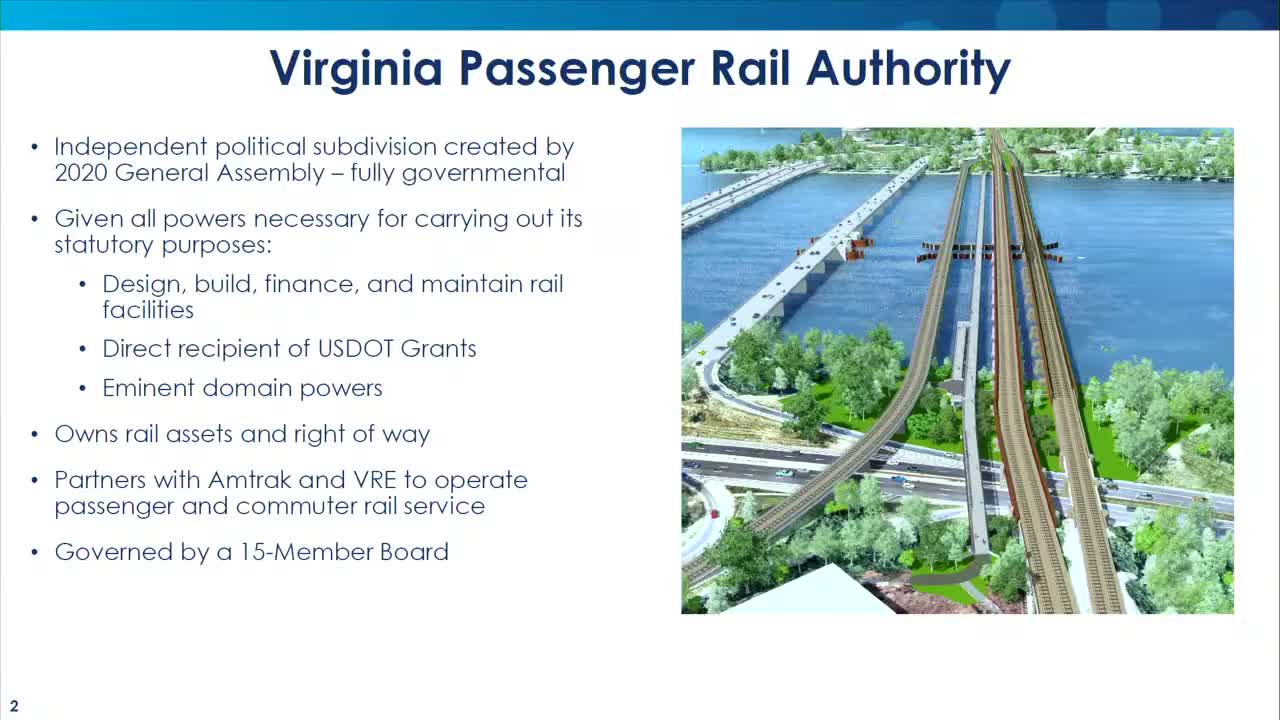
The Virginia Passenger Rail Authority told a Senate committee it is advancing a slate of projects intended to add capacity across the commonwealth, with the Long Bridge replacement across the Potomac the central constraint for growing passenger rail.
The presenter, introduced in committee as DJ Statler, said VPRA was created in 2020 to add passenger rail capacity, owns rights of way and contracts with Amtrak and VRE to operate service. He said Long Bridge—the rail crossing between Virginia and Washington, D.C.—is the critical bottleneck on the East Coast and that construction began in earnest last week. "When we got here in 2020, we said the bridge will be done in 2030. Now our estimate says the bridge will be done in 2030. So knock on wood," the presenter said.
VPRA has shifted schedules to accommodate daytime construction restrictions in the District of Columbia (work permitted 7 a.m.–7 p.m., Monday–Saturday). That window prompted a recent service change: state‑supported round trips that had been eight per day were reduced to six, with two trips replaced by buses during the work window.
The authority outlined multiple concurrent capital efforts to increase throughput between Union Station and Fredericksburg and south of Alexandria, including strategic sidings, a fourth track into the Commonwealth at Alexandria, and the Franconia‑Springfield bypass to avoid at‑grade crossovers where passenger platforms sit on opposite sides of the right‑of‑way. The presenter described the Richmond Rail Yard project to enable overnight train storage south of Main Street, currently in design with a target around 2030.
On western expansion, the presenter said the Roanoke/Lynchburg corridor will extend to the New River Valley and Christiansburg with construction likely complete in early 2027; he said service to Bristol remains a longer‑term objective that depends on completing the New River Valley segment. Committee members asked whether VPRA is building new track or negotiating with freight owners; the presenter said negotiations with Norfolk Southern allow VPRA to operate on existing main line into Christiansburg but that single‑track segments west of Christiansburg will require added infrastructure.
The meeting closed with recognition from committee members of the potential travel‑time and mobility benefits VPRA is seeking to deliver.
The presenter, introduced in committee as DJ Statler, said VPRA was created in 2020 to add passenger rail capacity, owns rights of way and contracts with Amtrak and VRE to operate service. He said Long Bridge—the rail crossing between Virginia and Washington, D.C.—is the critical bottleneck on the East Coast and that construction began in earnest last week. "When we got here in 2020, we said the bridge will be done in 2030. Now our estimate says the bridge will be done in 2030. So knock on wood," the presenter said.
VPRA has shifted schedules to accommodate daytime construction restrictions in the District of Columbia (work permitted 7 a.m.–7 p.m., Monday–Saturday). That window prompted a recent service change: state‑supported round trips that had been eight per day were reduced to six, with two trips replaced by buses during the work window.
The authority outlined multiple concurrent capital efforts to increase throughput between Union Station and Fredericksburg and south of Alexandria, including strategic sidings, a fourth track into the Commonwealth at Alexandria, and the Franconia‑Springfield bypass to avoid at‑grade crossovers where passenger platforms sit on opposite sides of the right‑of‑way. The presenter described the Richmond Rail Yard project to enable overnight train storage south of Main Street, currently in design with a target around 2030.
On western expansion, the presenter said the Roanoke/Lynchburg corridor will extend to the New River Valley and Christiansburg with construction likely complete in early 2027; he said service to Bristol remains a longer‑term objective that depends on completing the New River Valley segment. Committee members asked whether VPRA is building new track or negotiating with freight owners; the presenter said negotiations with Norfolk Southern allow VPRA to operate on existing main line into Christiansburg but that single‑track segments west of Christiansburg will require added infrastructure.
The meeting closed with recognition from committee members of the potential travel‑time and mobility benefits VPRA is seeking to deliver.
View the Full Meeting & All Its Details
This article offers just a summary. Unlock complete video, transcripts, and insights as a Founder Member.
✓
Watch full, unedited meeting videos
✓
Search every word spoken in unlimited transcripts
✓
AI summaries & real-time alerts (all government levels)
✓
Permanent access to expanding government content
30-day money-back guarantee
