Senate committee adopts substitute for bill funding April 2026 special election amid objections on notice and retroactivity
January 23, 2026 | 2026 Legislature VA, Virginia
This article was created by AI summarizing key points discussed. AI makes mistakes, so for full details and context, please refer to the video of the full meeting. Please report any errors so we can fix them. Report an error »
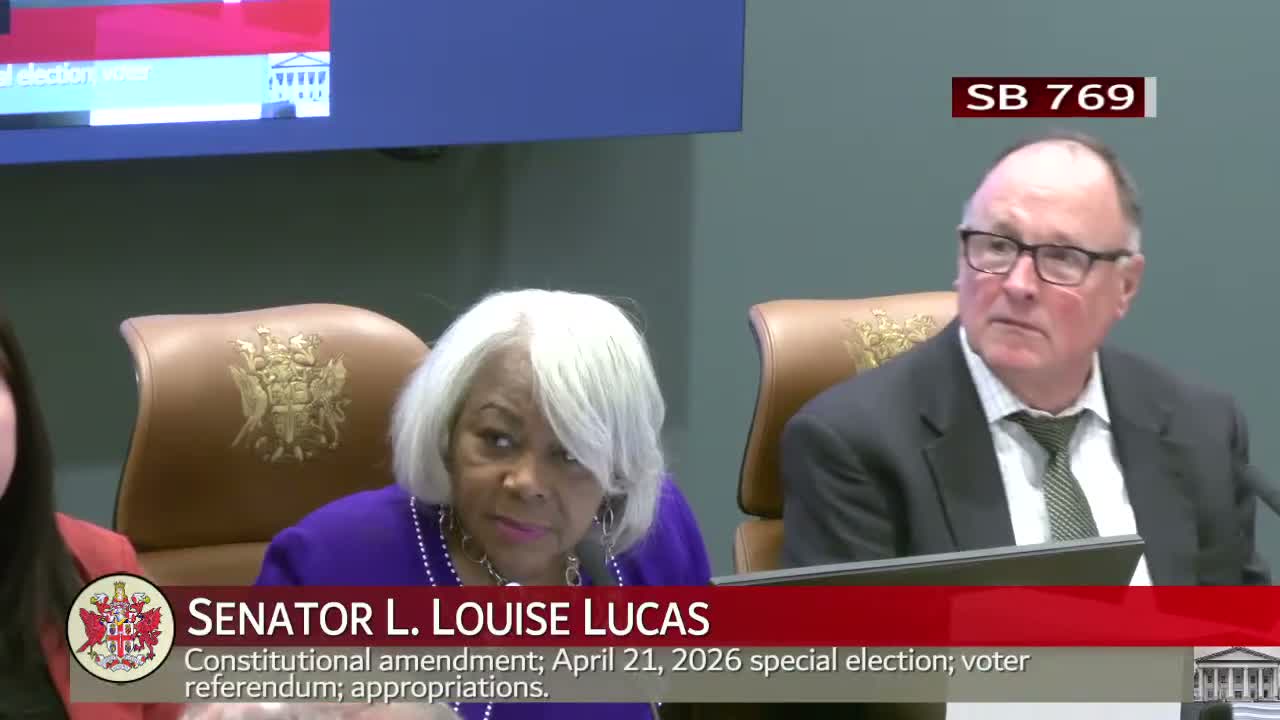
The Senate of Virginia committee on (unspecified) adopted a substitute to Senate Bill 769 on a 10-4 vote, approving funding and statutory changes tied to a special election on April 21, 2026. Legal counsel told the panel the substitute appropriates $100,000 in fiscal year 2026 to the Division of Legislative Services and $5,000,000 to the Department of Elections to cover costs such as voter education, administrative expenses, grants to localities to defray in-person absentee voting costs, and to direct localities to establish satellite offices for in-person absentee voting.
The substitute also removes an older statutory publication requirement and adds enactments that, according to counsel, would (1) enable a special election tied to a constitutional redistricting amendment on April 21, 2026, (2) repeal Code §30-13 (the clerk-of-the-House publication/posting requirement), and (3) direct venue for any suits related to those amendments or statutes to the Richmond City Circuit Court retroactive to Sept. 1, 2025. Legal counsel summarized those provisions: “It appropriates $100,000 in fiscal year 2026 to DLS … it appropriates $5,000,000 to the Department of Elections … and it provides that the venue for any suit related to constitutional amendments … shall only be proper in the Richmond City Circuit Court effective 09/01/2025.” (Legal Counsel, Unidentified Speaker 5).
Senator McDougall pressed counsel to read Code §30-13 aloud so members could hear the clerk’s historical duty to publish proposed constitutional amendments and to post copies at county and city courthouses. McDougall warned the repeal would remove local courthouse postings and said the timing—members received the substitute the same day the bill was dropped—deprived both legislators and the public of meaningful opportunity to review it. “So we are voting to say the public will not get notice from their duly elected clerks … in which they live,” he said (Senator McDougall, Speaker 6).
Other members echoed concern about process and timing. One member objected that the bill was placed before the committee on the eve of a major snowstorm with little notice, calling the speed and late drop unfair to both members and the public. Supporters of repeal and the substitute said the Code Commission recommended repealing the obsolete statutory posting requirement and that the change was intended to align statutory language with the 1971 constitution and modern notice practices. One proponent said the repeal protects past constitutional amendments from legal theories that would rely on the outdated statute.
After debate, the committee moved and seconded a motion to report SB 769 with the substitute. The motion passed on an electronic vote: Yeas 10, Nays 4. The committee then proceeded to consider member budget amendments.
What happens next: The substitute was reported out of committee and the bill is expected to be scheduled for further consideration on the Senate floor, where it will receive additional readings and debate.
The substitute also removes an older statutory publication requirement and adds enactments that, according to counsel, would (1) enable a special election tied to a constitutional redistricting amendment on April 21, 2026, (2) repeal Code §30-13 (the clerk-of-the-House publication/posting requirement), and (3) direct venue for any suits related to those amendments or statutes to the Richmond City Circuit Court retroactive to Sept. 1, 2025. Legal counsel summarized those provisions: “It appropriates $100,000 in fiscal year 2026 to DLS … it appropriates $5,000,000 to the Department of Elections … and it provides that the venue for any suit related to constitutional amendments … shall only be proper in the Richmond City Circuit Court effective 09/01/2025.” (Legal Counsel, Unidentified Speaker 5).
Senator McDougall pressed counsel to read Code §30-13 aloud so members could hear the clerk’s historical duty to publish proposed constitutional amendments and to post copies at county and city courthouses. McDougall warned the repeal would remove local courthouse postings and said the timing—members received the substitute the same day the bill was dropped—deprived both legislators and the public of meaningful opportunity to review it. “So we are voting to say the public will not get notice from their duly elected clerks … in which they live,” he said (Senator McDougall, Speaker 6).
Other members echoed concern about process and timing. One member objected that the bill was placed before the committee on the eve of a major snowstorm with little notice, calling the speed and late drop unfair to both members and the public. Supporters of repeal and the substitute said the Code Commission recommended repealing the obsolete statutory posting requirement and that the change was intended to align statutory language with the 1971 constitution and modern notice practices. One proponent said the repeal protects past constitutional amendments from legal theories that would rely on the outdated statute.
After debate, the committee moved and seconded a motion to report SB 769 with the substitute. The motion passed on an electronic vote: Yeas 10, Nays 4. The committee then proceeded to consider member budget amendments.
What happens next: The substitute was reported out of committee and the bill is expected to be scheduled for further consideration on the Senate floor, where it will receive additional readings and debate.
View the Full Meeting & All Its Details
This article offers just a summary. Unlock complete video, transcripts, and insights as a Founder Member.
✓
Watch full, unedited meeting videos
✓
Search every word spoken in unlimited transcripts
✓
AI summaries & real-time alerts (all government levels)
✓
Permanent access to expanding government content
30-day money-back guarantee
