Senate debates authorizing state-level class actions as business groups warn of costs
January 22, 2026 | 2026 Legislature VA, Virginia
This article was created by AI summarizing key points discussed. AI makes mistakes, so for full details and context, please refer to the video of the full meeting. Please report any errors so we can fix them. Report an error »
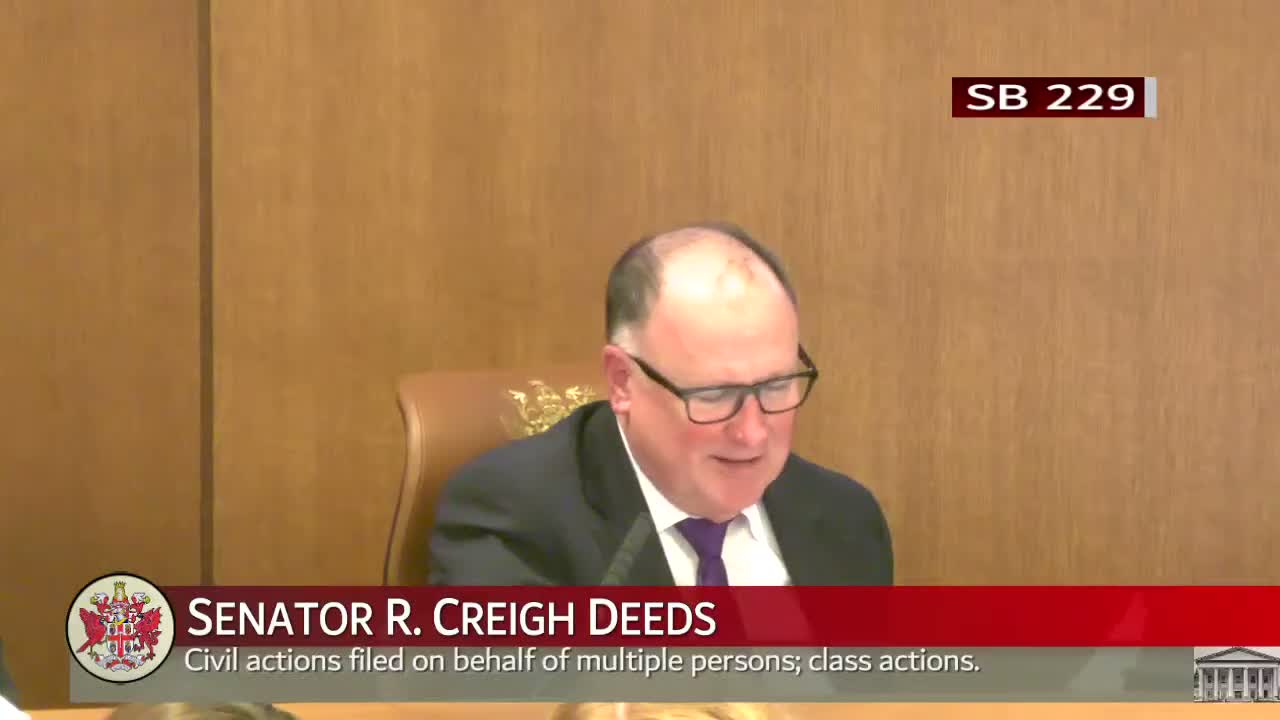
Senate Bill 229, presented by Sen. Sarvell, would authorize class actions in Virginia and clarify how statutory damages under the Virginia Consumer Protection Act (VCPA) are applied. The bill reintroduces a long-running policy debate: proponents say it remedies systemic obstacles for low‑income claimants; opponents caution it would be a major change to Virginia’s litigation landscape.
"As of today, there's only 2 states left in The United States Of America that don't have class action litigation. 1 is Mississippi and the other 1 is Us," Sen. Sarvell told the committee, framing the bill as bringing the Commonwealth in line with most states.
Supporters including the Legal Aid Justice Center, the Virginia Trial Lawyers Association and the Virginia Poverty Law Center emphasized access to justice. "We represented 19 immigrant women in a week long trial ... Instead of 1 person in probably a 1 day trial," attorney Christie Kelly said, describing resource constraints that prevent many victims from obtaining collective relief.
Opponents including the Virginia Chamber of Commerce, Volkswagen Group of America and the Virginia Hospital & Healthcare Association warned of broad disruption and urged the sponsor to align with federal Rule 23 and provide clearer limits on statutory per‑violation damages and the retroactive application period. Edward Mullen of Seven Hills Strategy Group, speaking for the Chamber, argued business stability is at stake and asked that interlocutory-appeal and summary-judgment mechanisms be carefully considered.
The committee heard extended testimony on both sides, debated per‑violation statutory damages and whether the bill's retroactivity provisions create business uncertainty, and moved to report the bill and refer it to the finance committee for further consideration.
Next steps: SB 229 was reported by the committee and will be considered further (referred to finance).
"As of today, there's only 2 states left in The United States Of America that don't have class action litigation. 1 is Mississippi and the other 1 is Us," Sen. Sarvell told the committee, framing the bill as bringing the Commonwealth in line with most states.
Supporters including the Legal Aid Justice Center, the Virginia Trial Lawyers Association and the Virginia Poverty Law Center emphasized access to justice. "We represented 19 immigrant women in a week long trial ... Instead of 1 person in probably a 1 day trial," attorney Christie Kelly said, describing resource constraints that prevent many victims from obtaining collective relief.
Opponents including the Virginia Chamber of Commerce, Volkswagen Group of America and the Virginia Hospital & Healthcare Association warned of broad disruption and urged the sponsor to align with federal Rule 23 and provide clearer limits on statutory per‑violation damages and the retroactive application period. Edward Mullen of Seven Hills Strategy Group, speaking for the Chamber, argued business stability is at stake and asked that interlocutory-appeal and summary-judgment mechanisms be carefully considered.
The committee heard extended testimony on both sides, debated per‑violation statutory damages and whether the bill's retroactivity provisions create business uncertainty, and moved to report the bill and refer it to the finance committee for further consideration.
Next steps: SB 229 was reported by the committee and will be considered further (referred to finance).
Don't Miss a Word: See the Full Meeting!
Go beyond summaries. Unlock every video, transcript, and key insight with a Founder Membership.
✓
Get instant access to full meeting videos
✓
Search and clip any phrase from complete transcripts
✓
Receive AI-powered summaries & custom alerts
✓
Enjoy lifetime, unrestricted access to government data
30-day money-back guarantee
