Oklahoma Juvenile Affairs seeks higher provider rates, Medicaid match for family therapy and staff pay raises
January 20, 2026 | 2026 Legislature OK, Oklahoma
This article was created by AI summarizing key points discussed. AI makes mistakes, so for full details and context, please refer to the video of the full meeting. Please report any errors so we can fix them. Report an error »
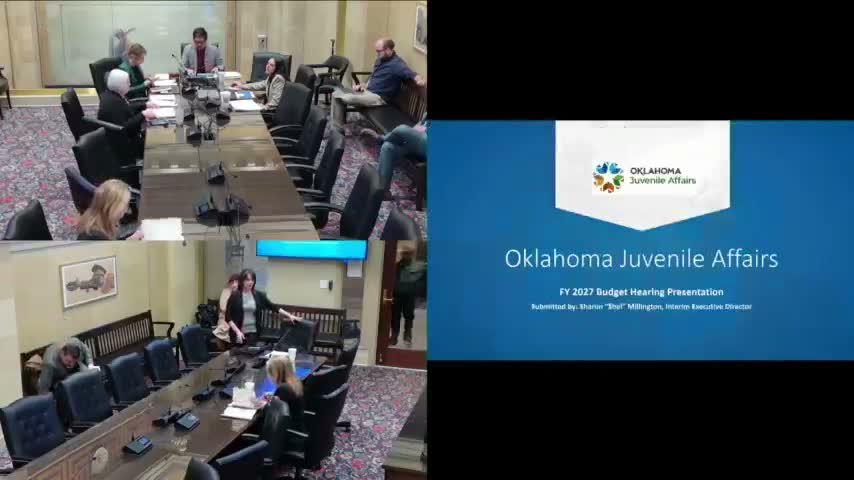
Director Kjell Millington presented the Oklahoma Juvenile Affairs (OJA) FY27 budget request, urging lawmakers to increase rates for Level E contracted group homes, provide a state match to sustain functional family therapy (FFT) once the Oklahoma Health Care Authority (OHCA) sets a Medicaid reimbursement rate, and fund a salary-adjustment plan for positions that are below market.
Millington said OJA has identified the three priorities after repeated requests over multiple years, adding that group homes are responsible for education, life skills and rehabilitative treatment for youth in OJA custody. “We are focused on ensuring that Oklahomans have the resources that they need to reach their full potential,” Millington said, framing the budget requests as investments in long-term outcomes.
Why it matters: OJA officials warned the committee that without additional rate increases some rural group-home providers may close or seek tribal contracts, reducing bed capacity and local services for high‑need youth. Millington cited a recent provider letter and the Welch Skills Center’s experience: of 16 capacity beds at Welch, eight youth work in the community and 12 participate in career‑technical training such as carpentry and welding.
On FFT, Millington described the intervention as evidence‑based, citing reductions in recidivism and improved family stability. OJA used three years of Oklahoma Medical Marijuana Authority (OMMA) funds to launch FFT; those funds end in June. OJA and OHCA have coordinated for two years to create a Medicaid reimbursement, and Millington said OJA is “anticipating the launch of that rate in September 2026,” but has encountered delays in the permanent rulemaking and federal approval steps.
The salary adjustment request follows a market analysis that identified multiple job classes below market value. Millington said OJA has internally funded raises for direct‑care staff at the Central Oklahoma Juvenile Center and some JSU workers but seeks funding to raise pay for remaining positions so the agency can recruit and retain staff across divisions.
Committee members pressed OJA on timeline and contingency plans. Representative Stark clarified that OMMA funds end in June and asked whether OJA has funds to bridge FFT until the OHCA rate takes effect; Amber Miller (OJA finance) said OJA expects to cover a short gap with internal funds. Several legislators raised concerns about COJAC staffing, security incidents and the use of temporary staffing agencies; Millington described a re‑implemented security response team and recent MANT trainer training for de‑escalation, and said temp workers receive the same two‑week classroom and on‑the‑job training as other hires.
What’s next: OJA agreed to provide additional details requested by the committee (costs of temp training, exact counts of contract staff, and the specific rate OHCA will adopt when available). The presentation closed and the subcommittee recessed for the next agency.
Millington said OJA has identified the three priorities after repeated requests over multiple years, adding that group homes are responsible for education, life skills and rehabilitative treatment for youth in OJA custody. “We are focused on ensuring that Oklahomans have the resources that they need to reach their full potential,” Millington said, framing the budget requests as investments in long-term outcomes.
Why it matters: OJA officials warned the committee that without additional rate increases some rural group-home providers may close or seek tribal contracts, reducing bed capacity and local services for high‑need youth. Millington cited a recent provider letter and the Welch Skills Center’s experience: of 16 capacity beds at Welch, eight youth work in the community and 12 participate in career‑technical training such as carpentry and welding.
On FFT, Millington described the intervention as evidence‑based, citing reductions in recidivism and improved family stability. OJA used three years of Oklahoma Medical Marijuana Authority (OMMA) funds to launch FFT; those funds end in June. OJA and OHCA have coordinated for two years to create a Medicaid reimbursement, and Millington said OJA is “anticipating the launch of that rate in September 2026,” but has encountered delays in the permanent rulemaking and federal approval steps.
The salary adjustment request follows a market analysis that identified multiple job classes below market value. Millington said OJA has internally funded raises for direct‑care staff at the Central Oklahoma Juvenile Center and some JSU workers but seeks funding to raise pay for remaining positions so the agency can recruit and retain staff across divisions.
Committee members pressed OJA on timeline and contingency plans. Representative Stark clarified that OMMA funds end in June and asked whether OJA has funds to bridge FFT until the OHCA rate takes effect; Amber Miller (OJA finance) said OJA expects to cover a short gap with internal funds. Several legislators raised concerns about COJAC staffing, security incidents and the use of temporary staffing agencies; Millington described a re‑implemented security response team and recent MANT trainer training for de‑escalation, and said temp workers receive the same two‑week classroom and on‑the‑job training as other hires.
What’s next: OJA agreed to provide additional details requested by the committee (costs of temp training, exact counts of contract staff, and the specific rate OHCA will adopt when available). The presentation closed and the subcommittee recessed for the next agency.
Don't Miss a Word: See the Full Meeting!
Go beyond summaries. Unlock every video, transcript, and key insight with a Founder Membership.
✓
Get instant access to full meeting videos
✓
Search and clip any phrase from complete transcripts
✓
Receive AI-powered summaries & custom alerts
✓
Enjoy lifetime, unrestricted access to government data
30-day money-back guarantee
