Kansas water officials urge continued funding for reservoir restoration, aquifer conservation
January 22, 2026 | Agriculture and Natural Resources Budget, Standing, HOUSE OF REPRESENTATIVES, Committees, Legislative, Kansas
This article was created by AI summarizing key points discussed. AI makes mistakes, so for full details and context, please refer to the video of the full meeting. Please report any errors so we can fix them. Report an error »
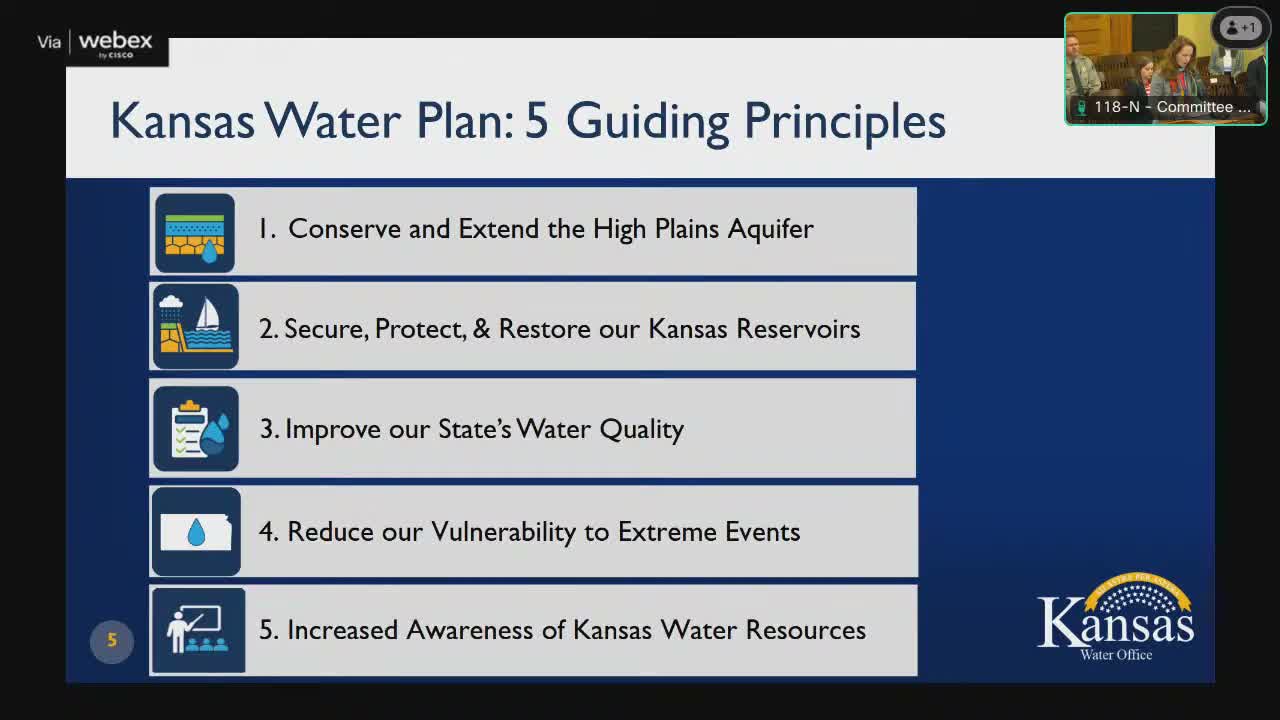
Connie Owens, presenting the Kansas Water Plan, told the House Committee on Agriculture and Natural Resources that the plan’s five guiding principles focus on conserving the High Plains (Ogallala) aquifer, securing and restoring state reservoirs, improving water quality, reducing vulnerability to extreme events, and expanding public education and outreach.
"Tuttle Creek that is now half filled with sediment, half," Owens said, illustrating the scale of reservoir loss and the urgency for restoration and new tools. She described a partnership pilot with the U.S. Army Corps of Engineers using water-injection dredging at Tuttle Creek: three 10‑day dredging sessions are planned, and initial sampling "did move sediment as designed" and did not show downstream water-quality exceedances, though more data and a public Corps webinar are forthcoming.
Owens explained funding for the State Water Plan Fund, noting statutory transfers established in 1989 and fee revenue that together can approach roughly $40 million per year when combined with the five‑year HB 2302 allocation. She said HB 2302 provided an additional $18 million annually that sunsets in two years and left an $84 million deficit from earlier missed appropriations that the state is still addressing.
Dawn Buehler, chair of the Kansas Water Authority, summarized the Authority’s annual report and its top recommendations. The authority asked the legislature to pay off the remaining storage debt for Milford and Perry reservoirs so the state would control that storage without incurring operation and maintenance costs until the water is put into service. "Paying off these debts will lock in Kansas control of the state storage in Milford and Perry Lakes," Buehler said, and she provided an estimated payoff amount of $35,423,000 (April 2026) while noting $52,000,000 had been set aside in investments from HB 2302.
Buehler and Owens also urged expansion of best-management practices on the landscape, nutrient-reduction work through KDHE, cost-share support for precision irrigation technologies, and examining incentives or programs to reduce use in the Ogallala. Owens pointed to local enhanced management areas (LIMAs) where producers voluntarily reduced pumping and, with precision agriculture, sometimes exceeded initial reduction goals.
Committee members asked technical and program questions about dredging timelines, whether hydro‑suction is ready for John Redmond (it is in planning), how to measure pilot success, and how to communicate the statewide implications of Western Kansas groundwater work to urban constituents. Owens and Buehler emphasized the need for continued monitoring, public education, and funding to scale local successes statewide.
Next steps: more detailed Corps sampling results and public webinars are expected; the water authority will continue to press the legislature on paying the reservoir debt and on enhancement funding requests included in its report.
"Tuttle Creek that is now half filled with sediment, half," Owens said, illustrating the scale of reservoir loss and the urgency for restoration and new tools. She described a partnership pilot with the U.S. Army Corps of Engineers using water-injection dredging at Tuttle Creek: three 10‑day dredging sessions are planned, and initial sampling "did move sediment as designed" and did not show downstream water-quality exceedances, though more data and a public Corps webinar are forthcoming.
Owens explained funding for the State Water Plan Fund, noting statutory transfers established in 1989 and fee revenue that together can approach roughly $40 million per year when combined with the five‑year HB 2302 allocation. She said HB 2302 provided an additional $18 million annually that sunsets in two years and left an $84 million deficit from earlier missed appropriations that the state is still addressing.
Dawn Buehler, chair of the Kansas Water Authority, summarized the Authority’s annual report and its top recommendations. The authority asked the legislature to pay off the remaining storage debt for Milford and Perry reservoirs so the state would control that storage without incurring operation and maintenance costs until the water is put into service. "Paying off these debts will lock in Kansas control of the state storage in Milford and Perry Lakes," Buehler said, and she provided an estimated payoff amount of $35,423,000 (April 2026) while noting $52,000,000 had been set aside in investments from HB 2302.
Buehler and Owens also urged expansion of best-management practices on the landscape, nutrient-reduction work through KDHE, cost-share support for precision irrigation technologies, and examining incentives or programs to reduce use in the Ogallala. Owens pointed to local enhanced management areas (LIMAs) where producers voluntarily reduced pumping and, with precision agriculture, sometimes exceeded initial reduction goals.
Committee members asked technical and program questions about dredging timelines, whether hydro‑suction is ready for John Redmond (it is in planning), how to measure pilot success, and how to communicate the statewide implications of Western Kansas groundwater work to urban constituents. Owens and Buehler emphasized the need for continued monitoring, public education, and funding to scale local successes statewide.
Next steps: more detailed Corps sampling results and public webinars are expected; the water authority will continue to press the legislature on paying the reservoir debt and on enhancement funding requests included in its report.
Don't Miss a Word: See the Full Meeting!
Go beyond summaries. Unlock every video, transcript, and key insight with a Founder Membership.
✓
Get instant access to full meeting videos
✓
Search and clip any phrase from complete transcripts
✓
Receive AI-powered summaries & custom alerts
✓
Enjoy lifetime, unrestricted access to government data
30-day money-back guarantee
