Committee hears sharply divided testimony on bill to bar public advocacy of ballot measures
January 23, 2026 | Committee on Elections, Standing, HOUSE OF REPRESENTATIVES, Committees, Legislative, Kansas
This article was created by AI summarizing key points discussed. AI makes mistakes, so for full details and context, please refer to the video of the full meeting. Please report any errors so we can fix them. Report an error »
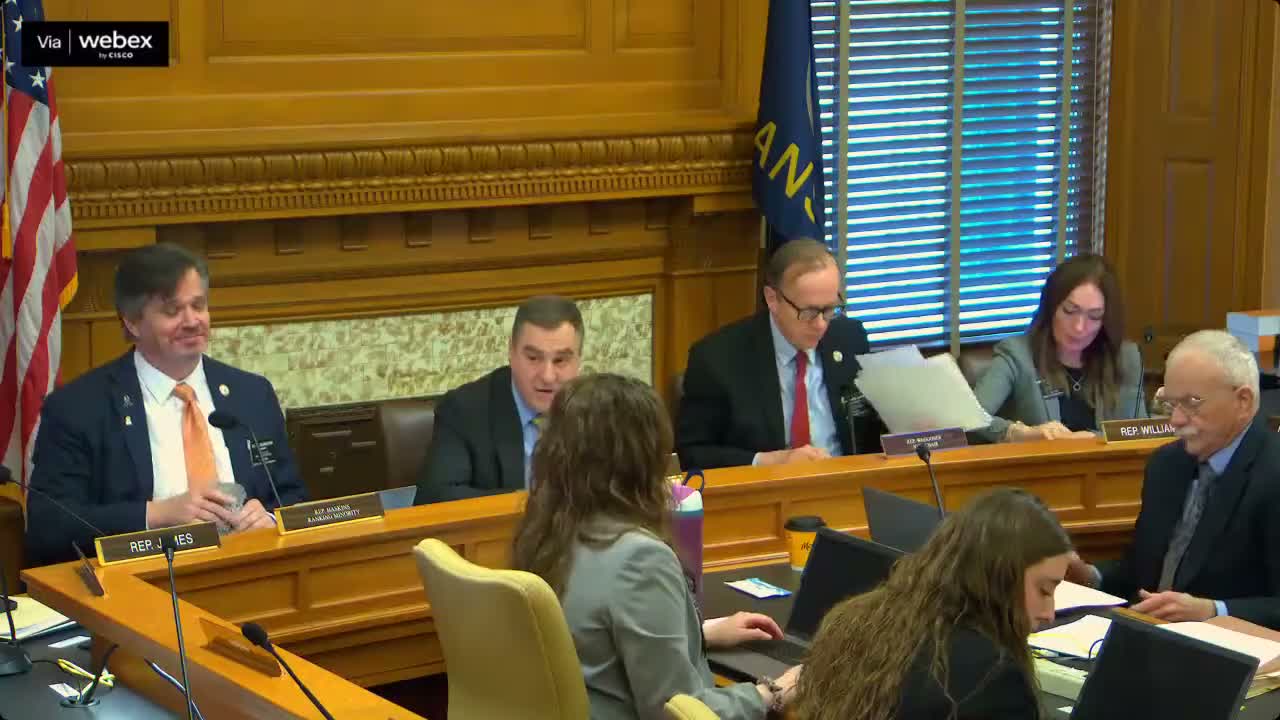
The Committee on Elections heard proponent and opponent testimony on House Bill 24-51, legislation that would prohibit state and municipal officers and employees from using public funds, materials or direct mass communications to advocate for or against constitutional amendments or ballot questions.
Revisor Mike Hine told the panel the measure would expand current law (cited in testimony as K.S.A. 25-41-69(a)) to bar explicit advocacy by public officers and employees while still allowing neutral responses and neutral informational publications; direct mass communications such as mailers, flyers, signage and social-media statements would be prohibited under the proposal and violations were described in testimony as a class C misdemeanor (30 days or up to a $500 fine).
Proponents said local examples demonstrate the need for statutory clarity. Senator Doug Shane described reported practices in Lewisburg he said involved school-district-produced yard signs, promotional materials and extra-credit assignments that pressured students to advocate. Lisonbee Reed, with a local group called Stop the Bond Hutchison, presented materials she said showed identical graphics and messaging between the district and a "Vote Yes for Hutch Kids" campaign and alleged that taxpayers funded mailers, yard signs and online ads used by outside advocates.
Opponents — including Jay Hall of the Kansas Association of Counties, Jim Carlson of the United School Administrators of Kansas and a League of Kansas Municipalities representative — said the bill as written lacks necessary definitions (particularly of "neutral"), risks criminalizing ordinary communications, and could chill routine informational activity such as city mailers that explain what a sales-tax referendum would cost households. Several witnesses pointed to existing attorney-general opinions that distinguish permissible education from impermissible advocacy and urged more narrowly tailored statutory language or administrative guidance.
Committee members pressed proponents for documentary proof and for more precise enforcement language; proponents pointed to local reporting and school-board minutes but acknowledged some online material had been removed. Repeated questions centered on how neutrality would be defined and which office (county/district attorneys or the attorney general) would investigate alleged violations. The chair closed the hearing without a committee vote.
The hearing captured tension between concerns about taxpayer-funded influence in local ballots and the practical need for clear statutory language that preserves neutral public education and avoids unintended criminalization of public employees.
Revisor Mike Hine told the panel the measure would expand current law (cited in testimony as K.S.A. 25-41-69(a)) to bar explicit advocacy by public officers and employees while still allowing neutral responses and neutral informational publications; direct mass communications such as mailers, flyers, signage and social-media statements would be prohibited under the proposal and violations were described in testimony as a class C misdemeanor (30 days or up to a $500 fine).
Proponents said local examples demonstrate the need for statutory clarity. Senator Doug Shane described reported practices in Lewisburg he said involved school-district-produced yard signs, promotional materials and extra-credit assignments that pressured students to advocate. Lisonbee Reed, with a local group called Stop the Bond Hutchison, presented materials she said showed identical graphics and messaging between the district and a "Vote Yes for Hutch Kids" campaign and alleged that taxpayers funded mailers, yard signs and online ads used by outside advocates.
Opponents — including Jay Hall of the Kansas Association of Counties, Jim Carlson of the United School Administrators of Kansas and a League of Kansas Municipalities representative — said the bill as written lacks necessary definitions (particularly of "neutral"), risks criminalizing ordinary communications, and could chill routine informational activity such as city mailers that explain what a sales-tax referendum would cost households. Several witnesses pointed to existing attorney-general opinions that distinguish permissible education from impermissible advocacy and urged more narrowly tailored statutory language or administrative guidance.
Committee members pressed proponents for documentary proof and for more precise enforcement language; proponents pointed to local reporting and school-board minutes but acknowledged some online material had been removed. Repeated questions centered on how neutrality would be defined and which office (county/district attorneys or the attorney general) would investigate alleged violations. The chair closed the hearing without a committee vote.
The hearing captured tension between concerns about taxpayer-funded influence in local ballots and the practical need for clear statutory language that preserves neutral public education and avoids unintended criminalization of public employees.
Don't Miss a Word: See the Full Meeting!
Go beyond summaries. Unlock every video, transcript, and key insight with a Founder Membership.
✓
Get instant access to full meeting videos
✓
Search and clip any phrase from complete transcripts
✓
Receive AI-powered summaries & custom alerts
✓
Enjoy lifetime, unrestricted access to government data
30-day money-back guarantee
