Executive and LFC present contrasting FY27 budget frameworks; members press on reserves and nonrecurring priorities
January 12, 2026 | Appropriations & Finance, House of Representatives, Committees, Legislative, New Mexico
This article was created by AI summarizing key points discussed. AI makes mistakes, so for full details and context, please refer to the video of the full meeting. Please report any errors so we can fix them. Report an error »
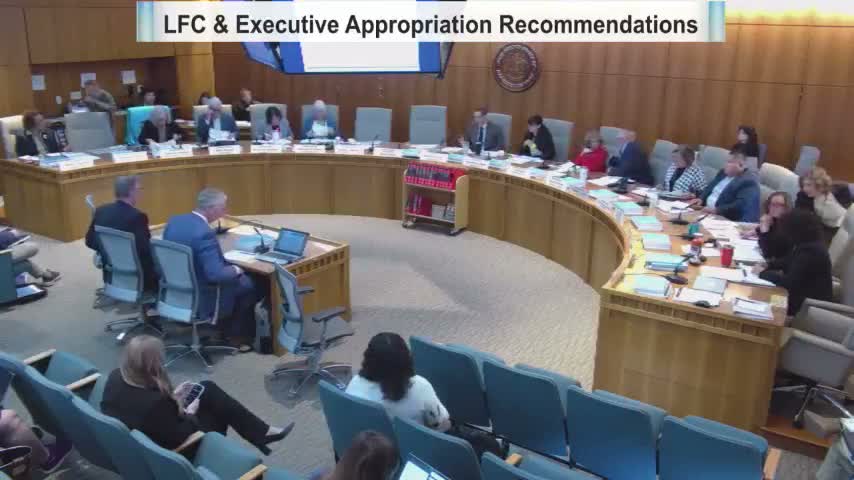
The House Appropriations and Finance Committee heard competing but largely aligned plans for FY27 budgets on Jan. 6. Wayne Probst of the Department of Finance and Administration outlined the executive recommendation, telling the committee that the administration built the FY27 proposal to cover mandatory costs and to recognize moderating revenue growth: "The total budget recommendation from the executive is 11,329,000,000.000," he said, and the proposal funds mandatory increases (health benefits, IT and GSD rate changes) while applying a roughly 2–3% growth assumption for most agencies and larger increases for specified priorities.
The executive set aside nonrecurring and recurring pools for legislative consideration: about $1.7 billion in nonrecurring general fund recommendations, a $200 million placeholder for a tax package, and a $525 million starting point for capital outlay. Probst detailed nonrecurring priorities that include a $200 million suggestion for a federal reimbursement revolving fund, $100 million for state fair site selection and $100 million for revitalization, $65 million for housing initiatives, and $60 million added to a New Mexico match fund to help local projects secure federal grants.
Charles Sully, director of the Legislative Finance Committee, presented the LFC framework that recommends more conservative recurring growth and stronger reserves: "The LFC recurring budget recommendation grows the base budget about 2 and a half percent," he said, recommending reserves north of 32% to preserve fiscal capacity and support long‑term investments. LFC urged using nonrecurring funds for strategic capital (including a higher‑education infrastructure fund to support a new UNM medical school) and to prioritize investments that raise New Mexicans' earned income and expand health and behavioral health access.
What members asked: Representatives queried whether certain nonrecurring items duplicate existing programs (for example, child care vouchers vs. universal pre‑K), asked for clarity on which body approves large one‑time expenditures (members asked whether the state fair commission’s decisions would come before the Legislature), requested historical side‑by‑side spreadsheets for agency budgets, and pressed for a breakdown showing how much of the multi‑billion nonrecurring pool has already been earmarked or set aside in trust funds.
Next steps: Committee members signaled they will dig into recurring vs. nonrecurring tradeoffs, review proposed tax‑package scenarios, and request more detailed program‑level cost and implementation information from DFA and LFC.
The executive set aside nonrecurring and recurring pools for legislative consideration: about $1.7 billion in nonrecurring general fund recommendations, a $200 million placeholder for a tax package, and a $525 million starting point for capital outlay. Probst detailed nonrecurring priorities that include a $200 million suggestion for a federal reimbursement revolving fund, $100 million for state fair site selection and $100 million for revitalization, $65 million for housing initiatives, and $60 million added to a New Mexico match fund to help local projects secure federal grants.
Charles Sully, director of the Legislative Finance Committee, presented the LFC framework that recommends more conservative recurring growth and stronger reserves: "The LFC recurring budget recommendation grows the base budget about 2 and a half percent," he said, recommending reserves north of 32% to preserve fiscal capacity and support long‑term investments. LFC urged using nonrecurring funds for strategic capital (including a higher‑education infrastructure fund to support a new UNM medical school) and to prioritize investments that raise New Mexicans' earned income and expand health and behavioral health access.
What members asked: Representatives queried whether certain nonrecurring items duplicate existing programs (for example, child care vouchers vs. universal pre‑K), asked for clarity on which body approves large one‑time expenditures (members asked whether the state fair commission’s decisions would come before the Legislature), requested historical side‑by‑side spreadsheets for agency budgets, and pressed for a breakdown showing how much of the multi‑billion nonrecurring pool has already been earmarked or set aside in trust funds.
Next steps: Committee members signaled they will dig into recurring vs. nonrecurring tradeoffs, review proposed tax‑package scenarios, and request more detailed program‑level cost and implementation information from DFA and LFC.
Don't Miss a Word: See the Full Meeting!
Go beyond summaries. Unlock every video, transcript, and key insight with a Founder Membership.
✓
Get instant access to full meeting videos
✓
Search and clip any phrase from complete transcripts
✓
Receive AI-powered summaries & custom alerts
✓
Enjoy lifetime, unrestricted access to government data
30-day money-back guarantee
