Working group backs $22.5 million scenario to implement Lower Rio Grande settlement, with $17 million for temporary fallowing
January 24, 2026 | Appropriations & Finance, House of Representatives, Committees, Legislative, New Mexico
This article was created by AI summarizing key points discussed. AI makes mistakes, so for full details and context, please refer to the video of the full meeting. Please report any errors so we can fix them. Report an error »
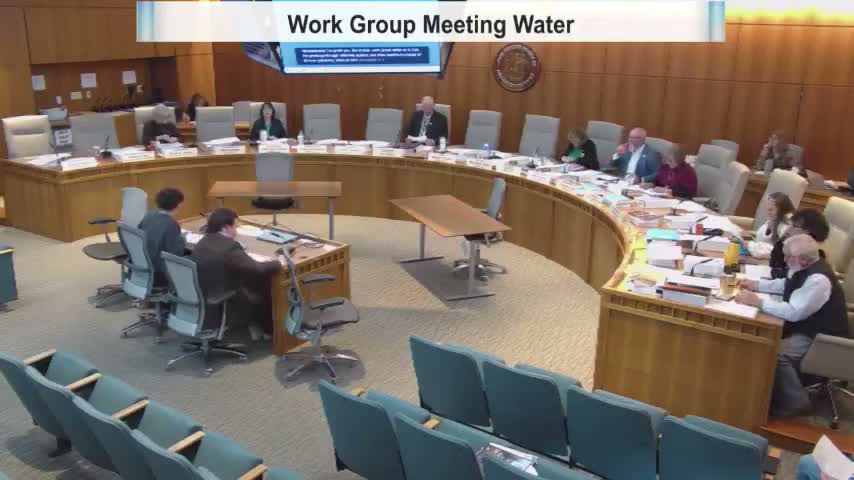
The Appropriations & Finance work group reviewed a scenario that would include the state engineer’s full $22.5 million request to implement the Lower Rio Grande settlement, stressing that most of the funds will be used for temporary fallowing programs.
"This scenario would include their full 22,500,000," committee staff said when introducing the state engineer’s request. State engineer office representatives later told the committee that "we're likely going to use the large majority of the 22.5, probably 17,000,000 or so, for temporary fallowing." The agency described options that allow farmers to enroll for up to three years.
The settlement requires retiring 18,200 acre-feet over a 10-year timeline, a detail committee members emphasized in questions. Rafael Rabirosa, who identified himself to the committee as president of an irrigation district, said his district negotiated the settlement "for the sustainability of the region" and supported retiring the required acre-feet while retaining productive use of the lands.
Agency staff described the temporary (dynamic) fallowing program as an early, higher-cost approach intended to accelerate compliance while permanent solutions are developed. "We've got folks engaged out for the next 3 years," an agency representative said, and reported the program has about 160 enrollees. That representative also said the program’s calculations indicate it is "saving about 75 to 90% of the water we're ultimately gonna have to save" to meet compact obligations.
Committee members asked for additional materials: a clearer accounting of how trust funds and prior appropriations are used, a breakdown of how much of the $22.5 million is dedicated to temporary versus permanent measures, and program evaluation reports. Staff said they would provide follow-up documents and the agency said they would supply program data and reports on outcomes.
The work group did not vote on the package; members were told they would receive refined language and additional information before any formal adoption.
"This scenario would include their full 22,500,000," committee staff said when introducing the state engineer’s request. State engineer office representatives later told the committee that "we're likely going to use the large majority of the 22.5, probably 17,000,000 or so, for temporary fallowing." The agency described options that allow farmers to enroll for up to three years.
The settlement requires retiring 18,200 acre-feet over a 10-year timeline, a detail committee members emphasized in questions. Rafael Rabirosa, who identified himself to the committee as president of an irrigation district, said his district negotiated the settlement "for the sustainability of the region" and supported retiring the required acre-feet while retaining productive use of the lands.
Agency staff described the temporary (dynamic) fallowing program as an early, higher-cost approach intended to accelerate compliance while permanent solutions are developed. "We've got folks engaged out for the next 3 years," an agency representative said, and reported the program has about 160 enrollees. That representative also said the program’s calculations indicate it is "saving about 75 to 90% of the water we're ultimately gonna have to save" to meet compact obligations.
Committee members asked for additional materials: a clearer accounting of how trust funds and prior appropriations are used, a breakdown of how much of the $22.5 million is dedicated to temporary versus permanent measures, and program evaluation reports. Staff said they would provide follow-up documents and the agency said they would supply program data and reports on outcomes.
The work group did not vote on the package; members were told they would receive refined language and additional information before any formal adoption.
Don't Miss a Word: See the Full Meeting!
Go beyond summaries. Unlock every video, transcript, and key insight with a Founder Membership.
✓
Get instant access to full meeting videos
✓
Search and clip any phrase from complete transcripts
✓
Receive AI-powered summaries & custom alerts
✓
Enjoy lifetime, unrestricted access to government data
30-day money-back guarantee
