Fort Thomas board questions scale, openings and materials for Jolley house addition
January 23, 2026 | Fort Thomas, Campbell County, Kentucky
This article was created by AI summarizing key points discussed. AI makes mistakes, so for full details and context, please refer to the video of the full meeting. Please report any errors so we can fix them. Report an error »
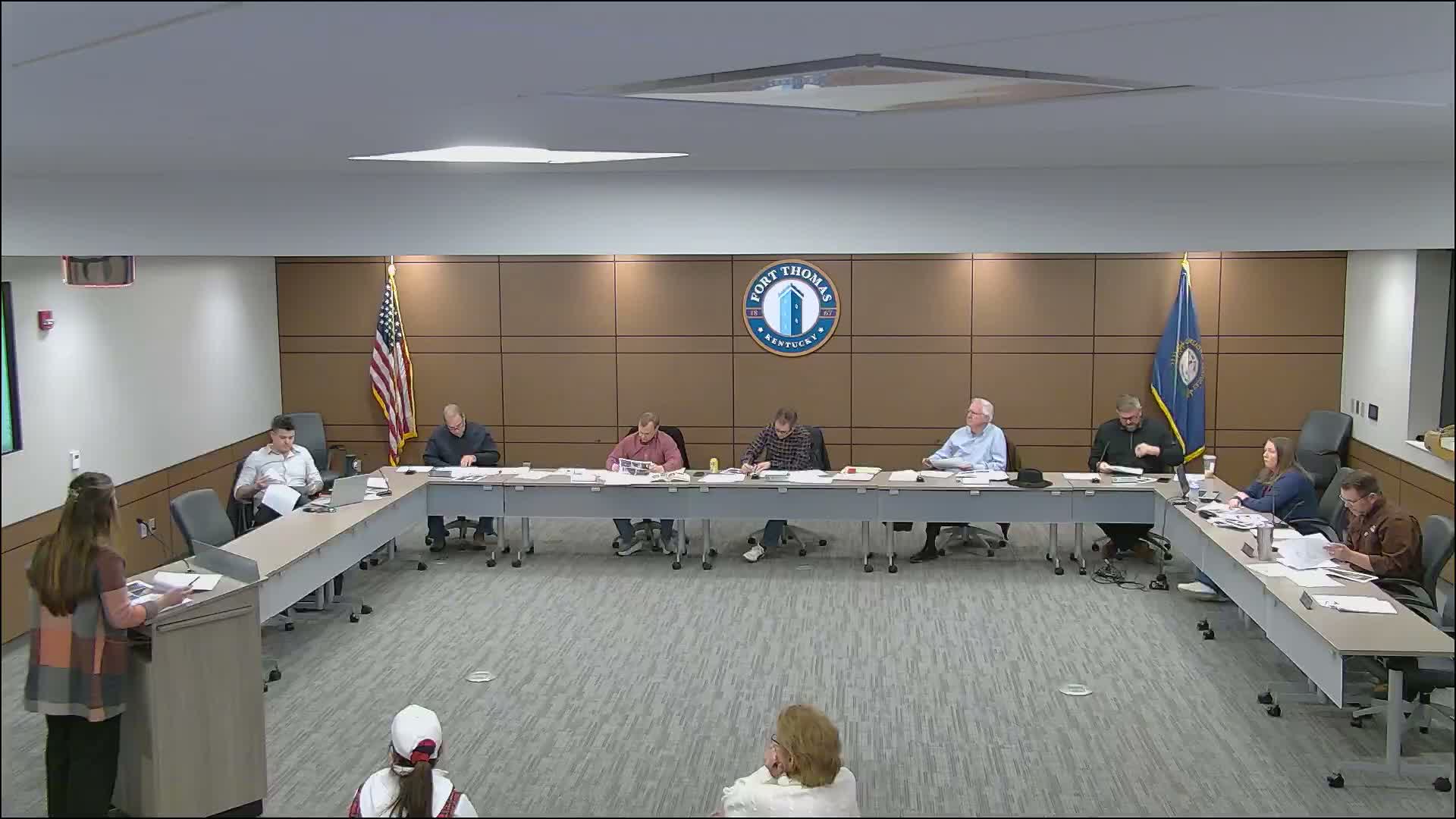
The Fort Thomas preservation review convened to consider a proposed rear addition and a modified garage at the Jolley property, with the design team presenting elevations, roof plans and three‑dimensional views to demonstrate how the new work would relate to the existing historic shell.
Presenter (S1), the project architect, said the design aims to keep the addition subordinate by matching the house’s principal roof pitches and adding a shallow, 1/12‑pitch ‘reprieve’ adjacent to the existing elevation. “That reprieve, that’s almost 20 feet deep,” S1 said, and the team intends the 10/12 gables on the addition to “complement the geometrical massing” of the main structure while keeping new ridgelines below the existing eave height.
Board members pressed several technical points. Multiple members questioned changes to the rear facade that would enlarge openings and remove historic wall fabric; one member (S6) said the proposal would remove “about 20 some feet worth of wall length” and called that a significant hurdle. The board repeatedly raised the difficulty of matching original brick and suggested the project consider tighter masonry detailing or selective reuse of brick to improve compatibility.
The design team offered several clarifications. S1 said the new garage apron will be sunk approximately two feet to allow modern garage doors and to address existing water intrusion problems at the first floor; the presenter added that the project will not raise the first‑floor elevation: “we are not going above the 1st Floor Level.” S1 also highlighted that second‑floor openings and much of the existing brick shell would remain untouched.
Preservation policy and the site’s legal constraints framed much of the discussion. A preservation specialist on the panel (S4) reminded members that the property’s sale from the Veterans Administration included an MOA and mitigation tied to Section 106 of the National Historic Preservation Act, and that the Secretary of the Interior’s standards (the “standards” versus “guidelines”) provide the legal baseline for what alterations are permitted. “They stipulated that in order for that sale to go through, they had to put an MOA,” S4 said, noting the MOA functions as mitigation and limits some alterations to nationally significant properties.
Homeowners (S7) said the design team had tried to incorporate prior feedback and expressed frustration at repeated rounds of changes. “What can we do to get a yes?” S7 asked, urging the board to identify a clear set of required changes or, alternatively, to reject the proposal outright so the owners can stop investing in revisions.
No formal motion or vote appears in the transcript. Board members said more material and analysis were needed to reconcile the project with guidance on subordination, massing and historic fenestration; several indicated they were open to continuing review if the team returned with revised masonry detailing, reduced openings or other rightsizing measures to make the addition read as subordinate to the original footprint.
Next steps: the transcript ends with procedural discussion and no recorded vote. The homeowners requested specific, actionable feedback; the board signaled it would need further documentation and revisions before taking a formal decision.
Presenter (S1), the project architect, said the design aims to keep the addition subordinate by matching the house’s principal roof pitches and adding a shallow, 1/12‑pitch ‘reprieve’ adjacent to the existing elevation. “That reprieve, that’s almost 20 feet deep,” S1 said, and the team intends the 10/12 gables on the addition to “complement the geometrical massing” of the main structure while keeping new ridgelines below the existing eave height.
Board members pressed several technical points. Multiple members questioned changes to the rear facade that would enlarge openings and remove historic wall fabric; one member (S6) said the proposal would remove “about 20 some feet worth of wall length” and called that a significant hurdle. The board repeatedly raised the difficulty of matching original brick and suggested the project consider tighter masonry detailing or selective reuse of brick to improve compatibility.
The design team offered several clarifications. S1 said the new garage apron will be sunk approximately two feet to allow modern garage doors and to address existing water intrusion problems at the first floor; the presenter added that the project will not raise the first‑floor elevation: “we are not going above the 1st Floor Level.” S1 also highlighted that second‑floor openings and much of the existing brick shell would remain untouched.
Preservation policy and the site’s legal constraints framed much of the discussion. A preservation specialist on the panel (S4) reminded members that the property’s sale from the Veterans Administration included an MOA and mitigation tied to Section 106 of the National Historic Preservation Act, and that the Secretary of the Interior’s standards (the “standards” versus “guidelines”) provide the legal baseline for what alterations are permitted. “They stipulated that in order for that sale to go through, they had to put an MOA,” S4 said, noting the MOA functions as mitigation and limits some alterations to nationally significant properties.
Homeowners (S7) said the design team had tried to incorporate prior feedback and expressed frustration at repeated rounds of changes. “What can we do to get a yes?” S7 asked, urging the board to identify a clear set of required changes or, alternatively, to reject the proposal outright so the owners can stop investing in revisions.
No formal motion or vote appears in the transcript. Board members said more material and analysis were needed to reconcile the project with guidance on subordination, massing and historic fenestration; several indicated they were open to continuing review if the team returned with revised masonry detailing, reduced openings or other rightsizing measures to make the addition read as subordinate to the original footprint.
Next steps: the transcript ends with procedural discussion and no recorded vote. The homeowners requested specific, actionable feedback; the board signaled it would need further documentation and revisions before taking a formal decision.
View the Full Meeting & All Its Details
This article offers just a summary. Unlock complete video, transcripts, and insights as a Founder Member.
✓
Watch full, unedited meeting videos
✓
Search every word spoken in unlimited transcripts
✓
AI summaries & real-time alerts (all government levels)
✓
Permanent access to expanding government content
30-day money-back guarantee
