Arizona House launches Artificial Intelligence and Innovation Committee, adopts rules
January 22, 2026 | 2026 Legislature Arizona, Arizona
This article was created by AI summarizing key points discussed. AI makes mistakes, so for full details and context, please refer to the video of the full meeting. Please report any errors so we can fix them. Report an error »
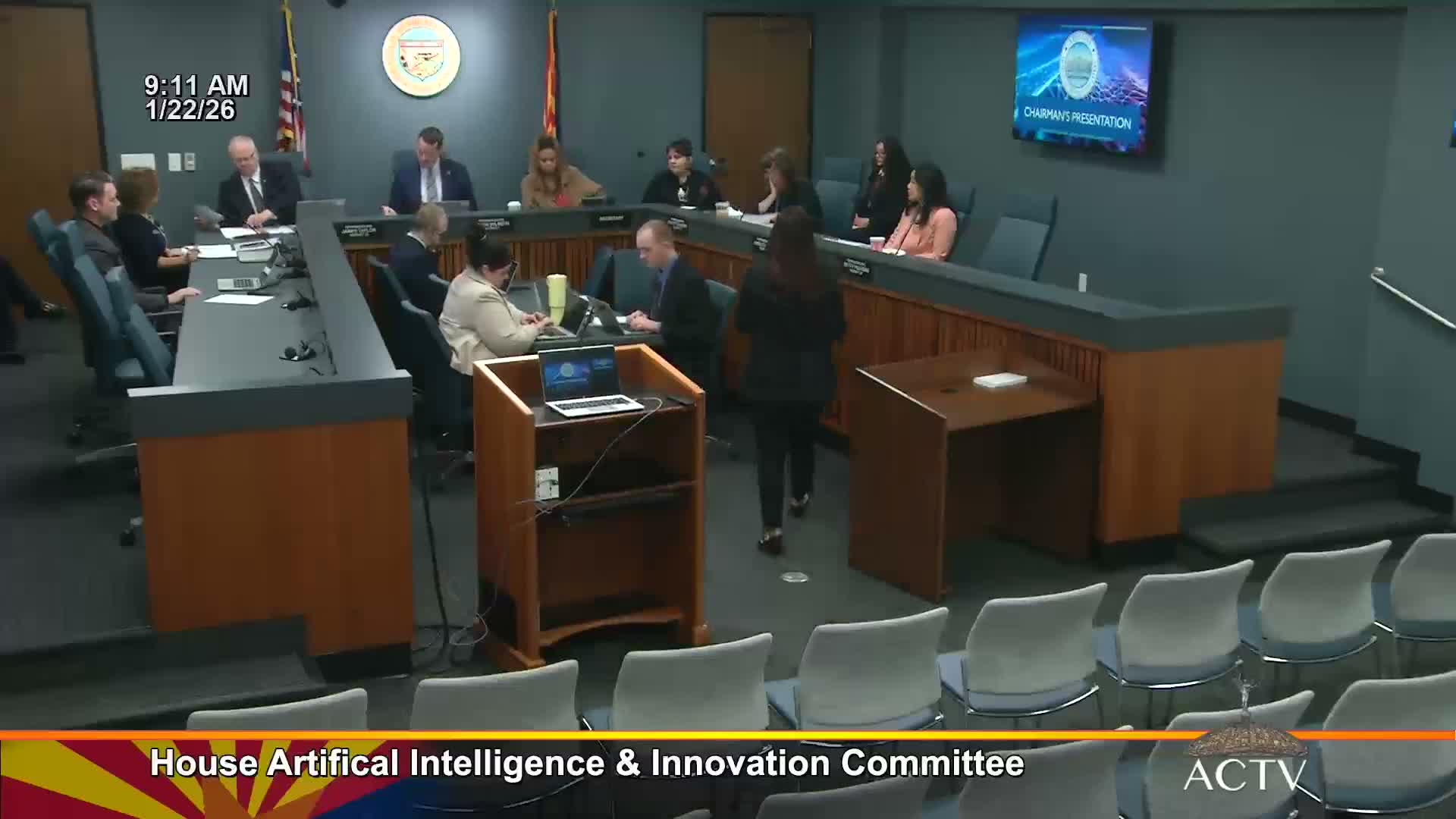
The Arizona House on Thursday convened its inaugural Artificial Intelligence and Innovation Committee, adopted standing committee rules by voice vote and heard Chair Justin Wilmoth outline a program of weekly expert presentations, member questions and bipartisan discussion.
Wilmoth, the committee chair, opened the session by saying the panel is intended "to listen and learn" about AI and to take an innovation-friendly approach. "This is a very important topic, and it's something that is changing constantly," he said, adding the committee will rely on short presentations followed by discussion so members can bring ideas back to their districts.
Research analyst Tasha McMaster briefed members on the proposed standing committee rules and deadlines. She told the committee that the rules mirror House rules and that "all amendments except for strike everything amendments are required to be distributed by noon on Wednesday; strike everything amendments must be distributed by 5 p.m. Tuesday," and that verbal amendments are allowed at the chairman's discretion. Vice Chair James Taylor moved "that the committee rules as printed and distributed be adopted." The chair called a voice vote; members answered "aye," and the rules were ordered filed with the chief clerk under House Rule 9(c).
Wilmoth delivered a wide-ranging presentation that described current AI systems as tools, not conscious actors, and used practical examples such as transcription and recommendation algorithms to show how the technology is already embedded in everyday services. "It's like a very fast intern," he said, demonstrating examples from image tools and meeting-transcription apps that he uses. He also played a short video highlighting surveillance and biometric uses of AI abroad to underscore potential government overreach and civil-rights concerns.
Members discussed uses and risks across policy areas. Representative Nick Kappper described personal uses for tools such as ChatGPT and Grok, saying, "I use grok more than I use any other AI for that particular purpose," and urged the committee to foster innovation while preventing harms. Representative Willoughby focused on health care, citing radiology and diagnostic examples and stressing the need for human oversight when high-stakes decisions are involved; she referenced earlier legislation that required human review in some medical-billing and denial decisions. Representative Stacy Travers highlighted educational uses for students with disabilities, saying AI can help access information and learn in nontraditional ways.
Members flagged resource and infrastructure issues that the committee will examine, including energy and water needs for data centers and workforce development tied to local semiconductor manufacturing. Wilmoth named Intel and TSMC as anchors of the state's technology ecosystem and said universities and apprenticeship programs are working to supply qualified workers.
Throughout the session members described a mix of optimism and caution. Several said they were "cautiously optimistic" about AI's potential but emphasized guardrails for privacy, cybersecurity and human review in consequential decisions. The chair said the committee will meet weekly at 9 a.m. for presentations and Q&A and expects to receive bills as the session progresses; no bills were considered Thursday.
The committee adjourned after roughly 30 minutes of business and an extended discussion of the chair's presentation and members' priorities. The panel is scheduled to meet again for presentations and member-driven follow-up.
Wilmoth, the committee chair, opened the session by saying the panel is intended "to listen and learn" about AI and to take an innovation-friendly approach. "This is a very important topic, and it's something that is changing constantly," he said, adding the committee will rely on short presentations followed by discussion so members can bring ideas back to their districts.
Research analyst Tasha McMaster briefed members on the proposed standing committee rules and deadlines. She told the committee that the rules mirror House rules and that "all amendments except for strike everything amendments are required to be distributed by noon on Wednesday; strike everything amendments must be distributed by 5 p.m. Tuesday," and that verbal amendments are allowed at the chairman's discretion. Vice Chair James Taylor moved "that the committee rules as printed and distributed be adopted." The chair called a voice vote; members answered "aye," and the rules were ordered filed with the chief clerk under House Rule 9(c).
Wilmoth delivered a wide-ranging presentation that described current AI systems as tools, not conscious actors, and used practical examples such as transcription and recommendation algorithms to show how the technology is already embedded in everyday services. "It's like a very fast intern," he said, demonstrating examples from image tools and meeting-transcription apps that he uses. He also played a short video highlighting surveillance and biometric uses of AI abroad to underscore potential government overreach and civil-rights concerns.
Members discussed uses and risks across policy areas. Representative Nick Kappper described personal uses for tools such as ChatGPT and Grok, saying, "I use grok more than I use any other AI for that particular purpose," and urged the committee to foster innovation while preventing harms. Representative Willoughby focused on health care, citing radiology and diagnostic examples and stressing the need for human oversight when high-stakes decisions are involved; she referenced earlier legislation that required human review in some medical-billing and denial decisions. Representative Stacy Travers highlighted educational uses for students with disabilities, saying AI can help access information and learn in nontraditional ways.
Members flagged resource and infrastructure issues that the committee will examine, including energy and water needs for data centers and workforce development tied to local semiconductor manufacturing. Wilmoth named Intel and TSMC as anchors of the state's technology ecosystem and said universities and apprenticeship programs are working to supply qualified workers.
Throughout the session members described a mix of optimism and caution. Several said they were "cautiously optimistic" about AI's potential but emphasized guardrails for privacy, cybersecurity and human review in consequential decisions. The chair said the committee will meet weekly at 9 a.m. for presentations and Q&A and expects to receive bills as the session progresses; no bills were considered Thursday.
The committee adjourned after roughly 30 minutes of business and an extended discussion of the chair's presentation and members' priorities. The panel is scheduled to meet again for presentations and member-driven follow-up.
Don't Miss a Word: See the Full Meeting!
Go beyond summaries. Unlock every video, transcript, and key insight with a Founder Membership.
✓
Get instant access to full meeting videos
✓
Search and clip any phrase from complete transcripts
✓
Receive AI-powered summaries & custom alerts
✓
Enjoy lifetime, unrestricted access to government data
30-day money-back guarantee
