Committee makes permanent emergency election-calendar fixes, including primary date and cure rules
January 21, 2026 | 2026 Legislature Arizona, Arizona
This article was created by AI summarizing key points discussed. AI makes mistakes, so for full details and context, please refer to the video of the full meeting. Please report any errors so we can fix them. Report an error »
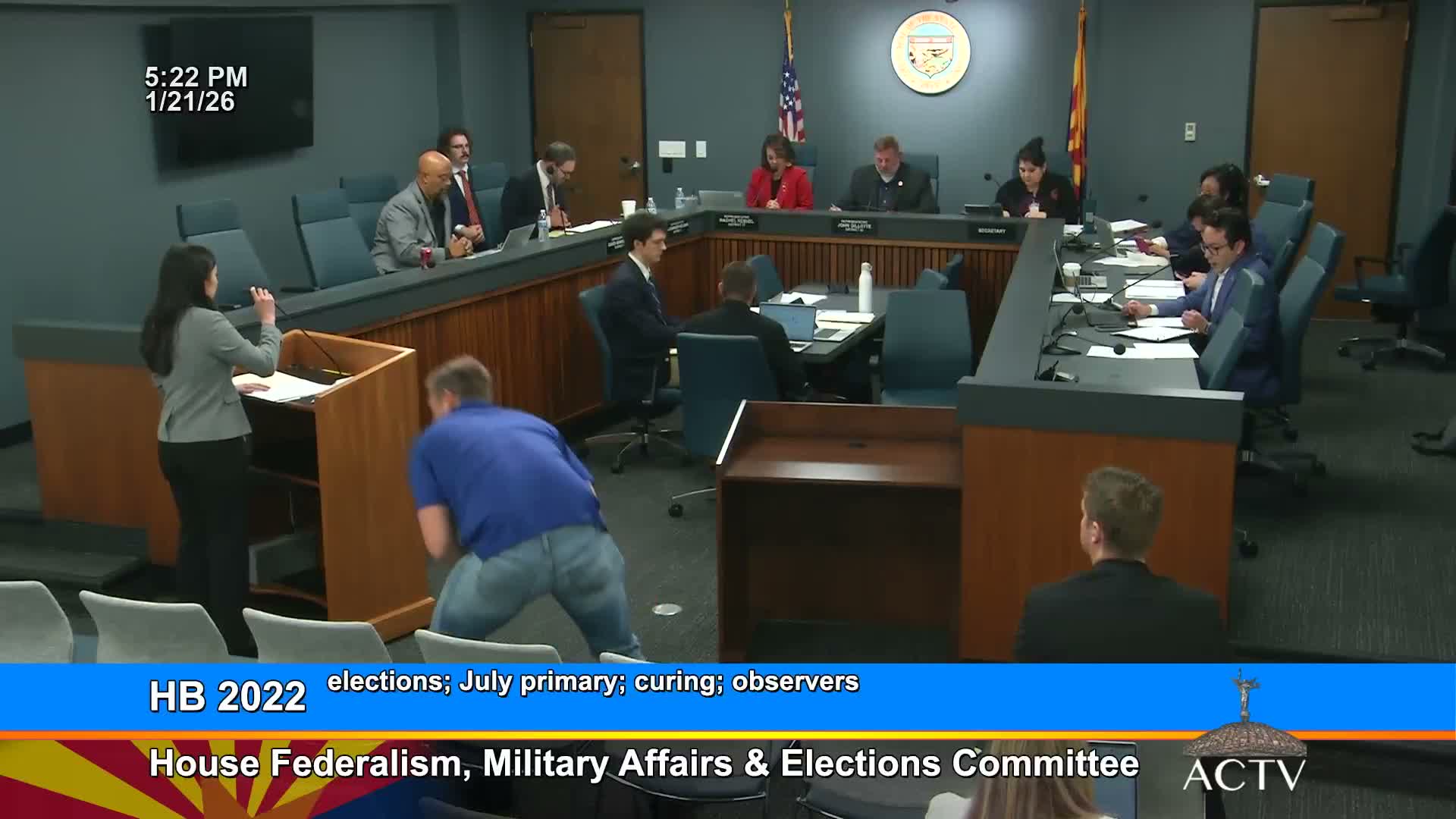
The House committee voted to return House Bill 2022 with a due-pass recommendation after testimony that temporary calendar changes adopted in 2024 are necessary to protect overseas voters and to meet federal electoral deadlines.
Sponsor Representative Alexander Collin said HB 2022 preserves the July primary adopted by emergency action in 2024 and keeps ballot-signature cure timelines that were part of the temporary package enacted to avoid conflict with the Revised Electoral Count Act’s deadlines. “If this body did not pull their irons out of the fire, none of Arizona’s overseas members of the military would have been able to vote,” Collin told the committee.
Supporters, including the County Supervisors Association and several recorders, said the bill fixes timing that would otherwise expire and jeopardize the ability to produce and mail correct general-election ballots to UOCAVA voters and to accommodate automatic recounts. Jacob Edmit, speaking for the supervisors association, described the measure as time-sensitive and necessary to avoid calendar conflicts that could arise if the 2024 temporary fixes expired.
Opponents principally challenged the bill’s decision to shorten certain ballot-signature cure windows (changing business days to calendar days and reducing cure windows for provisional ballots), arguing this would disproportionately affect rural and tribal voters who rely on slower communication channels and have more difficulty curing ballots within a shorter timeframe. Tom Przelski of Rural Arizona Action said shortening the cure window would likely lead to more disenfranchised voters, particularly on tribal lands.
Committee members debated trade-offs between protecting overseas voters and preserving local access. Representative Marquez said he supported changing the primary date but could not back the cure-period changes without more study. Ultimately the committee reported HB 2022 out with a due-pass recommendation (5 ayes, 2 nays).
What happens next: The bill will proceed to the House calendar. Sponsors said the measure includes an emergency clause and will require floor votes with sufficient support to secure immediate effect if enacted.
Sponsor Representative Alexander Collin said HB 2022 preserves the July primary adopted by emergency action in 2024 and keeps ballot-signature cure timelines that were part of the temporary package enacted to avoid conflict with the Revised Electoral Count Act’s deadlines. “If this body did not pull their irons out of the fire, none of Arizona’s overseas members of the military would have been able to vote,” Collin told the committee.
Supporters, including the County Supervisors Association and several recorders, said the bill fixes timing that would otherwise expire and jeopardize the ability to produce and mail correct general-election ballots to UOCAVA voters and to accommodate automatic recounts. Jacob Edmit, speaking for the supervisors association, described the measure as time-sensitive and necessary to avoid calendar conflicts that could arise if the 2024 temporary fixes expired.
Opponents principally challenged the bill’s decision to shorten certain ballot-signature cure windows (changing business days to calendar days and reducing cure windows for provisional ballots), arguing this would disproportionately affect rural and tribal voters who rely on slower communication channels and have more difficulty curing ballots within a shorter timeframe. Tom Przelski of Rural Arizona Action said shortening the cure window would likely lead to more disenfranchised voters, particularly on tribal lands.
Committee members debated trade-offs between protecting overseas voters and preserving local access. Representative Marquez said he supported changing the primary date but could not back the cure-period changes without more study. Ultimately the committee reported HB 2022 out with a due-pass recommendation (5 ayes, 2 nays).
What happens next: The bill will proceed to the House calendar. Sponsors said the measure includes an emergency clause and will require floor votes with sufficient support to secure immediate effect if enacted.
Don't Miss a Word: See the Full Meeting!
Go beyond summaries. Unlock every video, transcript, and key insight with a Founder Membership.
✓
Get instant access to full meeting videos
✓
Search and clip any phrase from complete transcripts
✓
Receive AI-powered summaries & custom alerts
✓
Enjoy lifetime, unrestricted access to government data
30-day money-back guarantee
