House committee advances bill to drop late-filing penalties when no tax is owed
January 21, 2026 | 2026 Legislature Arizona, Arizona
This article was created by AI summarizing key points discussed. AI makes mistakes, so for full details and context, please refer to the video of the full meeting. Please report any errors so we can fix them. Report an error »
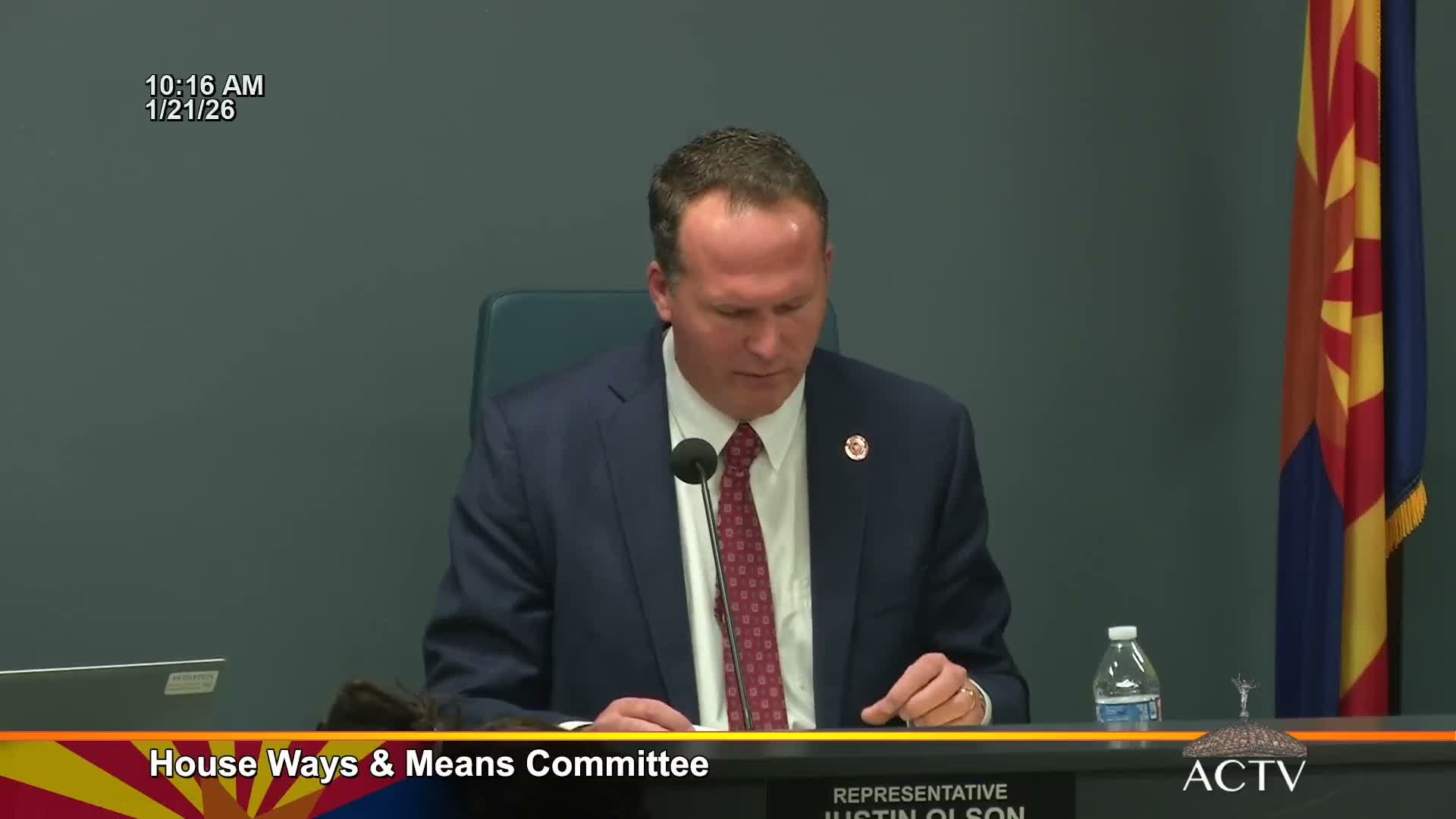
The House Ways and Means Committee voted to return House Bill 2016 with a due-pass recommendation after a brief staff presentation and discussion. The bill would eliminate automatic late-filing penalties imposed by the Department of Revenue when a taxpayer’s return shows $0 due.
Connor Sakata, a House majority research intern, told the committee the bill "removes the penalty due to the Department of Revenue for late filing tax returns if the tax return shows $0 due." Sponsor Representative Wei said the change is about "fairness and common sense," arguing that "if you owe the state nothing you should not be fined for filing late period." Representative Wei told members the measure would remove the automatic penalty streamlining relief for taxpayers who have no tax liability.
Members asked whether taxpayers would still be required to file returns that show $0; Representative Wei confirmed that filing would still be required but the bill would remove the automatic penalty rather than require taxpayers to apply for individual waivers. Research analyst Vince Perez said there "potentially is a fiscal impact" but expected it to be minimal, and other members described the revenue effect as small.
After discussion, the vice chair moved the bill and the secretary called the roll. The committee returned HB2016 with a due-pass recommendation by recorded votes of eight ayes and one nay. Representative Maya Sandoval explained her no vote, saying the current law allows the Department of Revenue to waive penalties case by case and that an automatic exemption could create retroactive compliance and enforcement issues.
The bill will move forward with the committee’s due-pass recommendation and next steps will depend on scheduling by the House leadership.
Connor Sakata, a House majority research intern, told the committee the bill "removes the penalty due to the Department of Revenue for late filing tax returns if the tax return shows $0 due." Sponsor Representative Wei said the change is about "fairness and common sense," arguing that "if you owe the state nothing you should not be fined for filing late period." Representative Wei told members the measure would remove the automatic penalty streamlining relief for taxpayers who have no tax liability.
Members asked whether taxpayers would still be required to file returns that show $0; Representative Wei confirmed that filing would still be required but the bill would remove the automatic penalty rather than require taxpayers to apply for individual waivers. Research analyst Vince Perez said there "potentially is a fiscal impact" but expected it to be minimal, and other members described the revenue effect as small.
After discussion, the vice chair moved the bill and the secretary called the roll. The committee returned HB2016 with a due-pass recommendation by recorded votes of eight ayes and one nay. Representative Maya Sandoval explained her no vote, saying the current law allows the Department of Revenue to waive penalties case by case and that an automatic exemption could create retroactive compliance and enforcement issues.
The bill will move forward with the committee’s due-pass recommendation and next steps will depend on scheduling by the House leadership.
View the Full Meeting & All Its Details
This article offers just a summary. Unlock complete video, transcripts, and insights as a Founder Member.
✓
Watch full, unedited meeting videos
✓
Search every word spoken in unlimited transcripts
✓
AI summaries & real-time alerts (all government levels)
✓
Permanent access to expanding government content
30-day money-back guarantee
