Committee advances bill to bar reassessment of agricultural land for four years after SBOE win
January 21, 2026 | 2026 Legislature Arizona, Arizona
This article was created by AI summarizing key points discussed. AI makes mistakes, so for full details and context, please refer to the video of the full meeting. Please report any errors so we can fix them. Report an error »
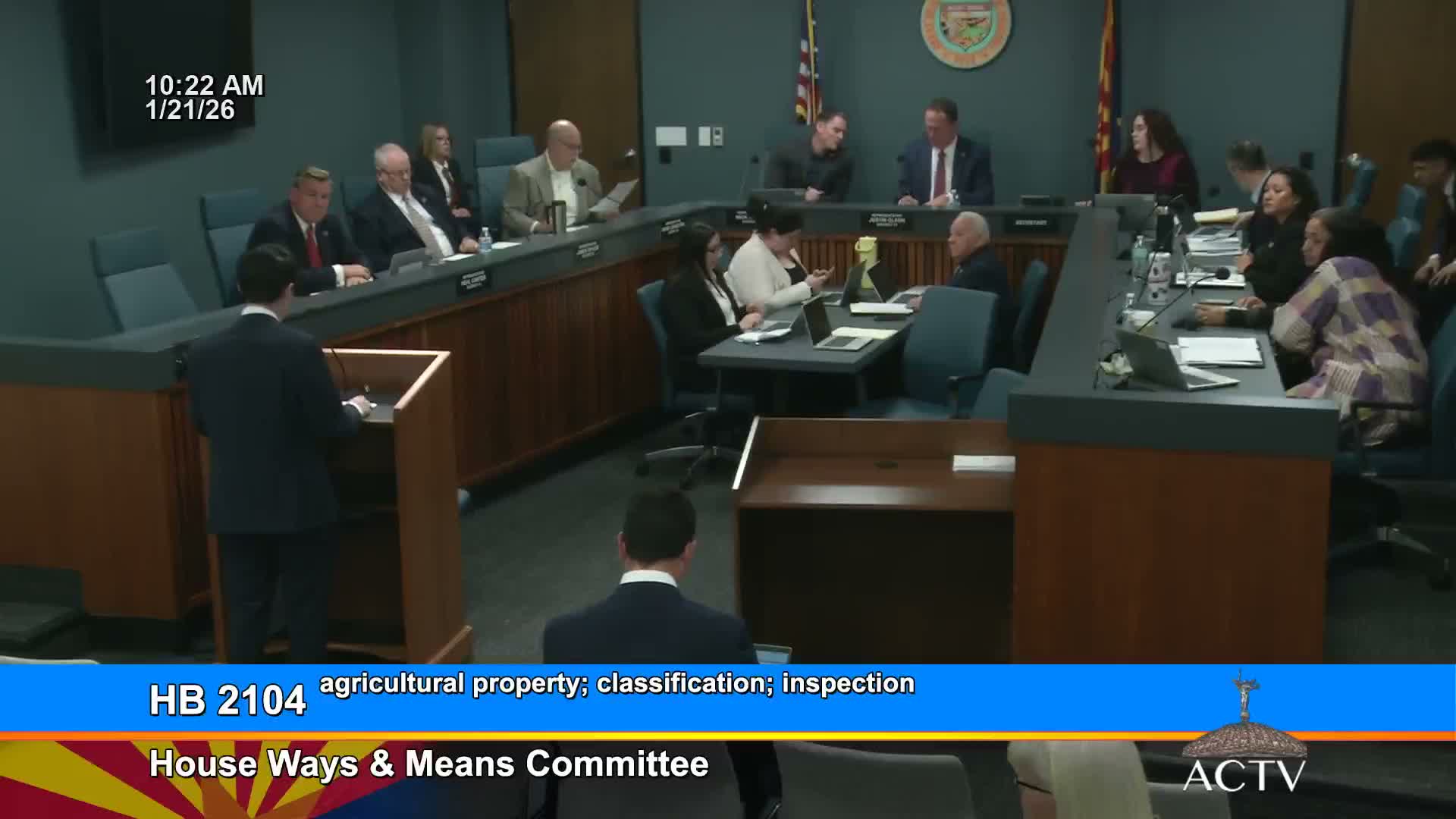
The committee returned House Bill 2104 with a due-pass recommendation after extended testimony and debate over property-tax fairness, administrative burden and legal risk.
Staff explained HB2104 would prohibit a county assessor from reclassifying agricultural property for four years if the owner prevails on appeal, unless the owner files a change-in-use notice, the property is split, or ownership changes. Sponsor Representative Carter told the panel the measure targets a recurring problem: taxpayers who win appeals at the state board often face reinspection and repeated appeals the next year, which he described as a burden on both property owners and assessor offices.
Britney Bingold of Pivotal Policy Consulting testified on behalf of the Arizona Cattle Growers Association that ranchers have faced repeated appeals and shifting rationales at the State Board of Equalization, generating duplicative costs. "We think House Bill 2104 addresses this problem narrowly," she told the committee, adding the bill would apply only when an owner prevails on appeal and would allow reassessment when substantive changes occur on the property.
Maricopa County Assessor Eddie Cook, representing all 15 county assessors, opposed the bill. Cook said his office follows statutes and that some SBOE decisions have overturned assessor determinations even when his staff believed the property did not qualify as agricultural. "We have many, many good actors in the ag community but unfortunately we have some bad ones," he said, and argued the bill would rely on an honor system if owners fail to file change-of-use notices. Cook also warned the measure could raise legal issues related to Arizona's uniformity clause.
Members debated the trade-offs. Supporters said the bill would give property owners stability and reduce needless relitigation; opponents warned it could reduce oversight, create inequities across taxpayers and invite legal challenges. After questions and additional testimony from the Arizona Farm and Ranch Group and irrigation-district representatives emphasizing seasonal practices, the vice chair moved the bill. The committee returned HB2104 with a due-pass recommendation by recorded voice (committee reported as 5 ayes, 4 nays).
Staff explained HB2104 would prohibit a county assessor from reclassifying agricultural property for four years if the owner prevails on appeal, unless the owner files a change-in-use notice, the property is split, or ownership changes. Sponsor Representative Carter told the panel the measure targets a recurring problem: taxpayers who win appeals at the state board often face reinspection and repeated appeals the next year, which he described as a burden on both property owners and assessor offices.
Britney Bingold of Pivotal Policy Consulting testified on behalf of the Arizona Cattle Growers Association that ranchers have faced repeated appeals and shifting rationales at the State Board of Equalization, generating duplicative costs. "We think House Bill 2104 addresses this problem narrowly," she told the committee, adding the bill would apply only when an owner prevails on appeal and would allow reassessment when substantive changes occur on the property.
Maricopa County Assessor Eddie Cook, representing all 15 county assessors, opposed the bill. Cook said his office follows statutes and that some SBOE decisions have overturned assessor determinations even when his staff believed the property did not qualify as agricultural. "We have many, many good actors in the ag community but unfortunately we have some bad ones," he said, and argued the bill would rely on an honor system if owners fail to file change-of-use notices. Cook also warned the measure could raise legal issues related to Arizona's uniformity clause.
Members debated the trade-offs. Supporters said the bill would give property owners stability and reduce needless relitigation; opponents warned it could reduce oversight, create inequities across taxpayers and invite legal challenges. After questions and additional testimony from the Arizona Farm and Ranch Group and irrigation-district representatives emphasizing seasonal practices, the vice chair moved the bill. The committee returned HB2104 with a due-pass recommendation by recorded voice (committee reported as 5 ayes, 4 nays).
View the Full Meeting & All Its Details
This article offers just a summary. Unlock complete video, transcripts, and insights as a Founder Member.
✓
Watch full, unedited meeting videos
✓
Search every word spoken in unlimited transcripts
✓
AI summaries & real-time alerts (all government levels)
✓
Permanent access to expanding government content
30-day money-back guarantee
