Arizona House Judiciary Committee advances package of bills on online consent, fetal protections, child support and public safety
January 21, 2026 | 2026 Legislature Arizona, Arizona
This article was created by AI summarizing key points discussed. AI makes mistakes, so for full details and context, please refer to the video of the full meeting. Please report any errors so we can fix them. Report an error »
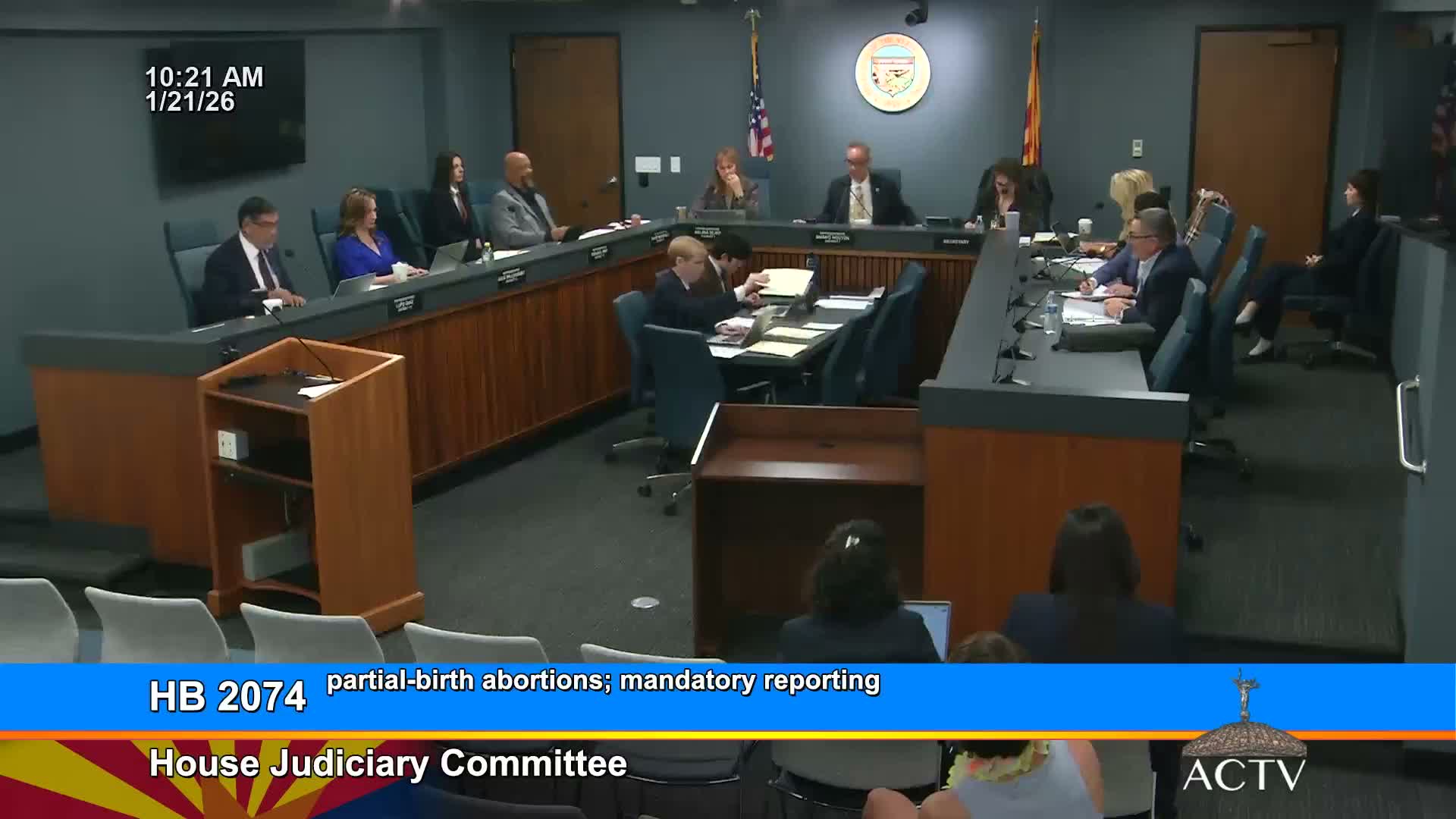
The Arizona House Judiciary Committee on Jan. 14 advanced a package of bills that would change criminal, family and court procedures across the state, approving due-pass recommendations on every item on its agenda.
The measures drew sharply divided testimony on reproductive-policy and criminal-justice questions and prompted technical and constitutional concerns from several members. Chairman Winn presided over a full day of presentations, testimony and roll-call votes that ended with all bills receiving committee recommendations to move forward and one amendment adopted to HB 20-74.
House Bill 21-33 would require commercial platforms that publish sexually explicit material to obtain consent verification and to verify that each depicted person was at least 18 at the time of creation; it explicitly covers AI-generated and altered images and would create civil penalties for violations. Sherry Lopez, president of the Arizona Human Trafficking Survivors Coalition, told the committee the bill "closes dangerous loopholes that allow abuse to continue without accountability," and argued that "requiring age and consent verification before publication is a reasonable safeguard." Opponents including Pamela Hicks of the Arizona Attorneys for Criminal Justice urged stakeholder meetings and cautioned about adding criminal definitions without fuller review. The committee gave HB 21-33 a due-pass recommendation (7 yes, 1 no).
On criminal statute changes, HB 20-43 would amend the felony-murder provision (Arizona Revised Statutes 13-1105) so that the death of an unborn child during the commission of a listed felony could be charged as first-degree felony murder. Christy Kelly, speaking for the Pinal County Attorney's Office, said the amendment "addresses a profound gap" prosecutors encountered after a six-month-pregnant victim died in a case they could not charge as felony murder under current language. Opponents — including Jody Liggett of Reproductive Freedom for All Arizona — warned the change could extend "personhood" doctrines with broad effects on reproductive health. The committee moved HB 20-43 with a due-pass recommendation (reported as 6 yes, 2 no, 1 absent).
HB 21-44 would allow certain child-support calculations and retroactive orders to begin during pregnancy but would limit those orders to pregnancy-related medical expenses and exclude elective-abortion costs. Supporters said the bill aligns Arizona with other states in ensuring financial support for pregnant people; opponents again warned of fetal-personhood implications and potential conflicts with Arizona's constitutional protections for abortion. The committee advanced the bill with a due-pass recommendation (6 yes, 2 no, 1 absent).
Public-safety measures included HB 20-45, which expands the definition of discharging a firearm from a motor vehicle to include discharges from the "immediate area" of the vehicle so prosecutors can charge drivers who step partially out of a vehicle to shoot. Supporters — including retired prosecutors and the Pinal County Attorney's Office — said the change closes an enforcement gap; critics raised vagueness questions about how to define "immediate area." The committee gave HB 20-45 a due-pass recommendation.
The committee also approved bills to: require notice to victims of probation-related prehearings for certain young offenders (HB 20-46); remove private process servers' authority to serve exclusive-possession orders of protection in domestic-violence cases, a change proponents say protects victims while process-server groups warn it could slow service in jurisdictions with backlogs (HB 20-48); add mandatory reporting for partial-birth abortion incidents and adopt an amendment in Chairman Wynne's name to that measure (HB 20-74 as amended); and create a traffic offense category for harm to vulnerable pedestrians using mobility aids (HB 20-64). Each bill received a due-pass recommendation at committee.
Members used their opportunity to explain their votes on several bills, with Representative Garcia repeatedly warning that some measures raised "personhood" concerns and could have unintended effects on reproductive freedoms. Representative Hernandez and others said they supported victims' rights but urged attention to narrow drafting and resource questions. Representative Kuppur, sponsor of HB 21-33, argued the measure updates protections to digital realities.
Votes at a glance: HB 21-33 (online consent/age verification) — due-pass recommendation, reported 7 yes, 1 no; HB 20-43 (unborn child as felony murder victim) — due-pass recommendation, reported 6 yes, 2 no, 1 absent; HB 21-44 (prenatal child support) — due-pass recommendation, reported 6 yes, 2 no, 1 absent; HB 21-26 (change of venue for judicial-branch employees) — due-pass recommendation (motion adopted); HB 20-45 (expand drive-by/discharge definition) — due-pass recommendation, reported 7 yes, 1 no, 1 absent; HB 20-46 (victim notice for probation prehearings) — due-pass recommendation, unanimous in recorded roll calls; HB 20-48 (process servers and exclusive possession orders) — due-pass recommendation, reported 8 yes, 1 present; HB 20-74 (mandatory reporting amendment adopted) — due-pass recommendation as amended, 5 ayes, 3 nays, 1 absent; HB 20-64 (harm to vulnerable pedestrians) — due-pass recommendation, reported 8 yes, 1 no.
What happens next: Bills with a due-pass recommendation are eligible to be scheduled for floor action. Several members asked for follow-up technical amendments and pledged to continue off-floor discussions with stakeholders on drafting and enforcement details.
The committee adjourned after completing the agenda.
The measures drew sharply divided testimony on reproductive-policy and criminal-justice questions and prompted technical and constitutional concerns from several members. Chairman Winn presided over a full day of presentations, testimony and roll-call votes that ended with all bills receiving committee recommendations to move forward and one amendment adopted to HB 20-74.
House Bill 21-33 would require commercial platforms that publish sexually explicit material to obtain consent verification and to verify that each depicted person was at least 18 at the time of creation; it explicitly covers AI-generated and altered images and would create civil penalties for violations. Sherry Lopez, president of the Arizona Human Trafficking Survivors Coalition, told the committee the bill "closes dangerous loopholes that allow abuse to continue without accountability," and argued that "requiring age and consent verification before publication is a reasonable safeguard." Opponents including Pamela Hicks of the Arizona Attorneys for Criminal Justice urged stakeholder meetings and cautioned about adding criminal definitions without fuller review. The committee gave HB 21-33 a due-pass recommendation (7 yes, 1 no).
On criminal statute changes, HB 20-43 would amend the felony-murder provision (Arizona Revised Statutes 13-1105) so that the death of an unborn child during the commission of a listed felony could be charged as first-degree felony murder. Christy Kelly, speaking for the Pinal County Attorney's Office, said the amendment "addresses a profound gap" prosecutors encountered after a six-month-pregnant victim died in a case they could not charge as felony murder under current language. Opponents — including Jody Liggett of Reproductive Freedom for All Arizona — warned the change could extend "personhood" doctrines with broad effects on reproductive health. The committee moved HB 20-43 with a due-pass recommendation (reported as 6 yes, 2 no, 1 absent).
HB 21-44 would allow certain child-support calculations and retroactive orders to begin during pregnancy but would limit those orders to pregnancy-related medical expenses and exclude elective-abortion costs. Supporters said the bill aligns Arizona with other states in ensuring financial support for pregnant people; opponents again warned of fetal-personhood implications and potential conflicts with Arizona's constitutional protections for abortion. The committee advanced the bill with a due-pass recommendation (6 yes, 2 no, 1 absent).
Public-safety measures included HB 20-45, which expands the definition of discharging a firearm from a motor vehicle to include discharges from the "immediate area" of the vehicle so prosecutors can charge drivers who step partially out of a vehicle to shoot. Supporters — including retired prosecutors and the Pinal County Attorney's Office — said the change closes an enforcement gap; critics raised vagueness questions about how to define "immediate area." The committee gave HB 20-45 a due-pass recommendation.
The committee also approved bills to: require notice to victims of probation-related prehearings for certain young offenders (HB 20-46); remove private process servers' authority to serve exclusive-possession orders of protection in domestic-violence cases, a change proponents say protects victims while process-server groups warn it could slow service in jurisdictions with backlogs (HB 20-48); add mandatory reporting for partial-birth abortion incidents and adopt an amendment in Chairman Wynne's name to that measure (HB 20-74 as amended); and create a traffic offense category for harm to vulnerable pedestrians using mobility aids (HB 20-64). Each bill received a due-pass recommendation at committee.
Members used their opportunity to explain their votes on several bills, with Representative Garcia repeatedly warning that some measures raised "personhood" concerns and could have unintended effects on reproductive freedoms. Representative Hernandez and others said they supported victims' rights but urged attention to narrow drafting and resource questions. Representative Kuppur, sponsor of HB 21-33, argued the measure updates protections to digital realities.
Votes at a glance: HB 21-33 (online consent/age verification) — due-pass recommendation, reported 7 yes, 1 no; HB 20-43 (unborn child as felony murder victim) — due-pass recommendation, reported 6 yes, 2 no, 1 absent; HB 21-44 (prenatal child support) — due-pass recommendation, reported 6 yes, 2 no, 1 absent; HB 21-26 (change of venue for judicial-branch employees) — due-pass recommendation (motion adopted); HB 20-45 (expand drive-by/discharge definition) — due-pass recommendation, reported 7 yes, 1 no, 1 absent; HB 20-46 (victim notice for probation prehearings) — due-pass recommendation, unanimous in recorded roll calls; HB 20-48 (process servers and exclusive possession orders) — due-pass recommendation, reported 8 yes, 1 present; HB 20-74 (mandatory reporting amendment adopted) — due-pass recommendation as amended, 5 ayes, 3 nays, 1 absent; HB 20-64 (harm to vulnerable pedestrians) — due-pass recommendation, reported 8 yes, 1 no.
What happens next: Bills with a due-pass recommendation are eligible to be scheduled for floor action. Several members asked for follow-up technical amendments and pledged to continue off-floor discussions with stakeholders on drafting and enforcement details.
The committee adjourned after completing the agenda.
View the Full Meeting & All Its Details
This article offers just a summary. Unlock complete video, transcripts, and insights as a Founder Member.
✓
Watch full, unedited meeting videos
✓
Search every word spoken in unlimited transcripts
✓
AI summaries & real-time alerts (all government levels)
✓
Permanent access to expanding government content
30-day money-back guarantee
