Panel approves narrowing grant uses, removing education and research from fund purposes
January 20, 2026 | 2026 Legislature Arizona, Arizona
This article was created by AI summarizing key points discussed. AI makes mistakes, so for full details and context, please refer to the video of the full meeting. Please report any errors so we can fix them. Report an error »
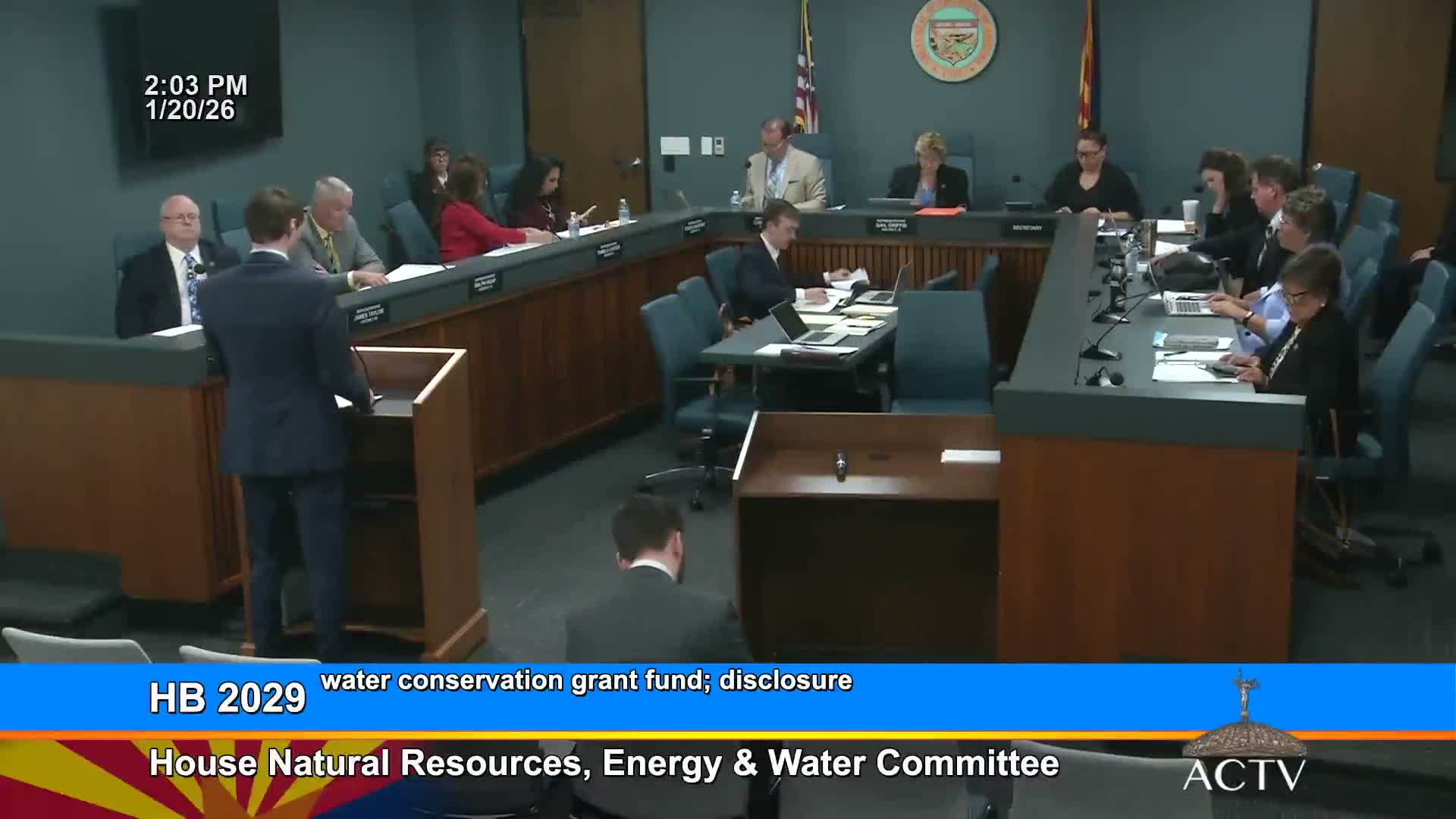
The House Committee on Natural Resources, Energy and Water on Thursday recommended passage of House Bill 20 30, a bill that would remove education and research programs from the list of authorized uses for monies in the Water Conservation Grant Fund.
A committee presenter said removing the category would narrow the fund’s eligible uses to on-the-ground conservation projects. During questioning, a member asked how much had been spent on education and research; the presenter said that as of June 19, 2025, about $7,000,000 of previous awards went to education/research out of roughly $210,000,000 awarded overall—about 4% of the total.
Judah Waxbaum, chief of government affairs for the Water Infrastructure Finance Authority, told the committee he was neutral on HB 20 30 and that of WIFA’s 211 funded projects, 15 included an education or research component totaling about $10,500,000 in grants and an estimated 180,000 acre-feet in projected savings. He emphasized those savings are projections and said WIFA requests low-end and high-end estimates and performs auditing via annual reports.
Several members spoke against removing education and research from the fund. Representative Contreras argued that research-enabled projects contributed measurable savings and said the statewide scope of education programs matters; Contreras said, "We're saving ... 180,000 acre feet. I think that's pretty significant," and announced a no vote. Other members who said they would vote no cited the statewide role of education and research in identifying conservation projects.
The committee returned HB 20 30 with a due-pass recommendation by a vote of 6 ayes and 4 nays. The committee record includes several members explaining their votes; opponents said the research and education components help identify and support water-saving projects across the state.
The bill will move on with the committee’s recommendation.
A committee presenter said removing the category would narrow the fund’s eligible uses to on-the-ground conservation projects. During questioning, a member asked how much had been spent on education and research; the presenter said that as of June 19, 2025, about $7,000,000 of previous awards went to education/research out of roughly $210,000,000 awarded overall—about 4% of the total.
Judah Waxbaum, chief of government affairs for the Water Infrastructure Finance Authority, told the committee he was neutral on HB 20 30 and that of WIFA’s 211 funded projects, 15 included an education or research component totaling about $10,500,000 in grants and an estimated 180,000 acre-feet in projected savings. He emphasized those savings are projections and said WIFA requests low-end and high-end estimates and performs auditing via annual reports.
Several members spoke against removing education and research from the fund. Representative Contreras argued that research-enabled projects contributed measurable savings and said the statewide scope of education programs matters; Contreras said, "We're saving ... 180,000 acre feet. I think that's pretty significant," and announced a no vote. Other members who said they would vote no cited the statewide role of education and research in identifying conservation projects.
The committee returned HB 20 30 with a due-pass recommendation by a vote of 6 ayes and 4 nays. The committee record includes several members explaining their votes; opponents said the research and education components help identify and support water-saving projects across the state.
The bill will move on with the committee’s recommendation.
Don't Miss a Word: See the Full Meeting!
Go beyond summaries. Unlock every video, transcript, and key insight with a Founder Membership.
✓
Get instant access to full meeting videos
✓
Search and clip any phrase from complete transcripts
✓
Receive AI-powered summaries & custom alerts
✓
Enjoy lifetime, unrestricted access to government data
30-day money-back guarantee
