Committee backs bill to let counties use revolving funds to remediate illegal cesspools
January 20, 2026 | 2026 Legislature Arizona, Arizona
This article was created by AI summarizing key points discussed. AI makes mistakes, so for full details and context, please refer to the video of the full meeting. Please report any errors so we can fix them. Report an error »
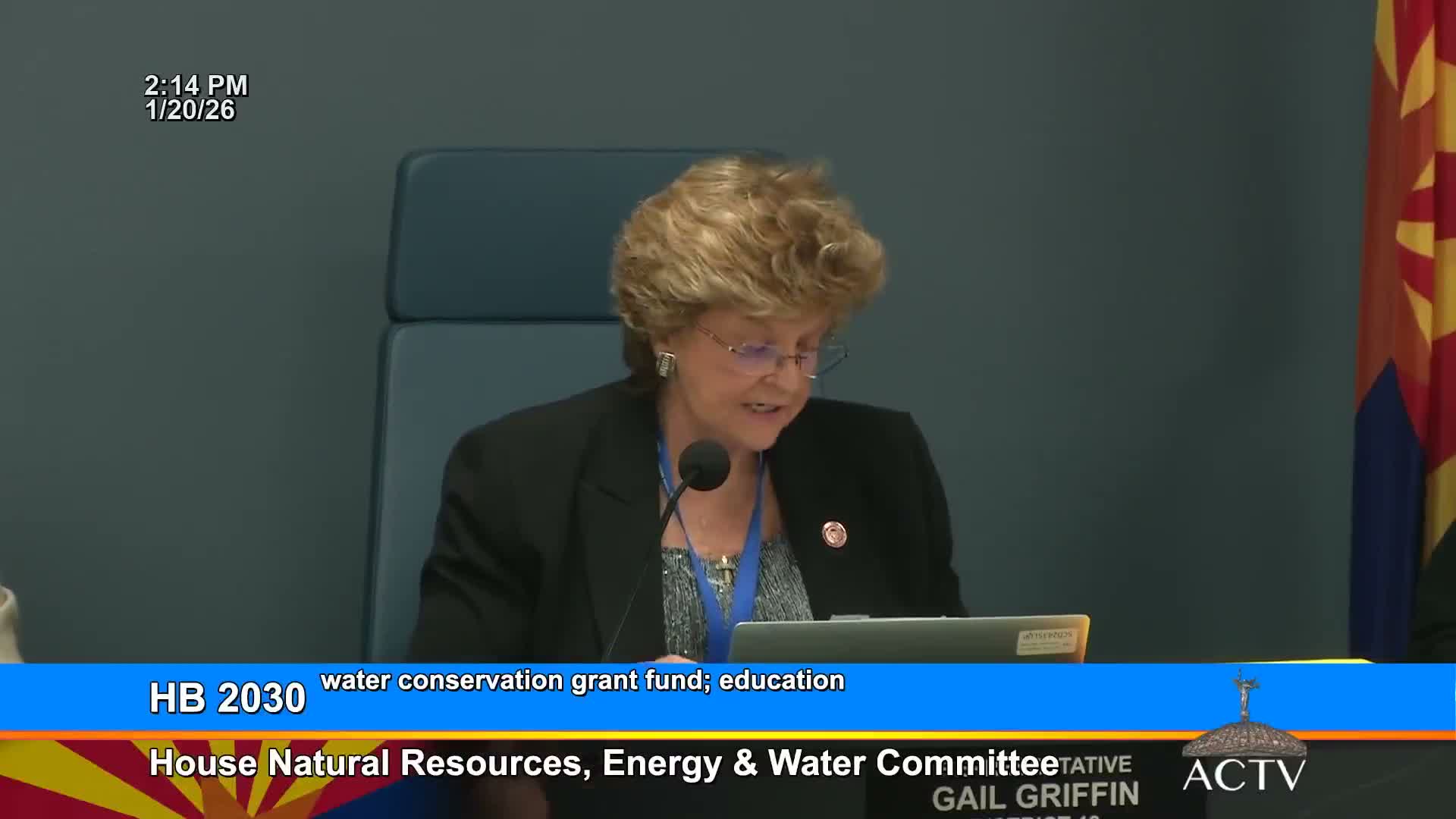
The House Committee on Natural Resources, Energy and Water unanimously approved House Bill 20 96, a measure that would expand projects eligible for assistance from the Water Infrastructure Finance Authority to include remediation, closure or replacement of cesspools that threaten groundwater, surface water or public health.
Corbin introduced the bill, which directs WIFA to award financial assistance for such projects from the Clean Water State Revolving Fund and the Drinking Water Revolving Fund. The bill would also set reporting requirements and allow counties to establish income-based eligibility for assistance.
Michael Driscoll, deputy county manager of Gila County, told the committee his county has "approximately 5,000 cesspools," which he said were outlawed in 1976 and pose a high risk of groundwater contamination in areas near local waterways. He urged the committee to open WIFA funding to other counties so they can offer forgivable loans or low-cost financing to help homeowners replace or remediate illegal cesspools.
On cost questions, Driscoll said replacement costs depend on parcel size and the technology needed; he estimated "anywhere from $20,000 to $30,000" for some alternative systems and explained that conventional septic systems can be less expensive when sufficient land is available. He said counties typically identify cesspools through complaints and required permitting when homeowners remodel or when a system fails; counties lack comprehensive historic records.
Judah Waxbaum of WIFA said the bill clarifies statutory ambiguity about whether counties may enter into loans with WIFA for this work. He said the Clean Water State Revolving Fund is federally capitalized and can include forgivable principal in some cases—"up to a 100% of the loan forgiven" depending on EPA formulas and census data.
Jacob Emdin, for the County Supervisors Association, spoke in strong support and warned of groundwater contamination risks, including bacteria and nitrates. Krista Osterberg, chief legislative liaison for the Arizona Department of Environmental Quality, said ADEQ is neutral and that identifying and mitigating cesspools is a strategic agency priority.
Vice Chair moved the bill with a due-pass recommendation; the committee approved HB 20 96 by a 10–0 vote. The committee adjourned after the vote.
Corbin introduced the bill, which directs WIFA to award financial assistance for such projects from the Clean Water State Revolving Fund and the Drinking Water Revolving Fund. The bill would also set reporting requirements and allow counties to establish income-based eligibility for assistance.
Michael Driscoll, deputy county manager of Gila County, told the committee his county has "approximately 5,000 cesspools," which he said were outlawed in 1976 and pose a high risk of groundwater contamination in areas near local waterways. He urged the committee to open WIFA funding to other counties so they can offer forgivable loans or low-cost financing to help homeowners replace or remediate illegal cesspools.
On cost questions, Driscoll said replacement costs depend on parcel size and the technology needed; he estimated "anywhere from $20,000 to $30,000" for some alternative systems and explained that conventional septic systems can be less expensive when sufficient land is available. He said counties typically identify cesspools through complaints and required permitting when homeowners remodel or when a system fails; counties lack comprehensive historic records.
Judah Waxbaum of WIFA said the bill clarifies statutory ambiguity about whether counties may enter into loans with WIFA for this work. He said the Clean Water State Revolving Fund is federally capitalized and can include forgivable principal in some cases—"up to a 100% of the loan forgiven" depending on EPA formulas and census data.
Jacob Emdin, for the County Supervisors Association, spoke in strong support and warned of groundwater contamination risks, including bacteria and nitrates. Krista Osterberg, chief legislative liaison for the Arizona Department of Environmental Quality, said ADEQ is neutral and that identifying and mitigating cesspools is a strategic agency priority.
Vice Chair moved the bill with a due-pass recommendation; the committee approved HB 20 96 by a 10–0 vote. The committee adjourned after the vote.
View the Full Meeting & All Its Details
This article offers just a summary. Unlock complete video, transcripts, and insights as a Founder Member.
✓
Watch full, unedited meeting videos
✓
Search every word spoken in unlimited transcripts
✓
AI summaries & real-time alerts (all government levels)
✓
Permanent access to expanding government content
30-day money-back guarantee
