Committee advances bill to raise insurer asset-assessment caps to fund regulators
January 20, 2026 | 2026 Legislature Arizona, Arizona
This article was created by AI summarizing key points discussed. AI makes mistakes, so for full details and context, please refer to the video of the full meeting. Please report any errors so we can fix them. Report an error »
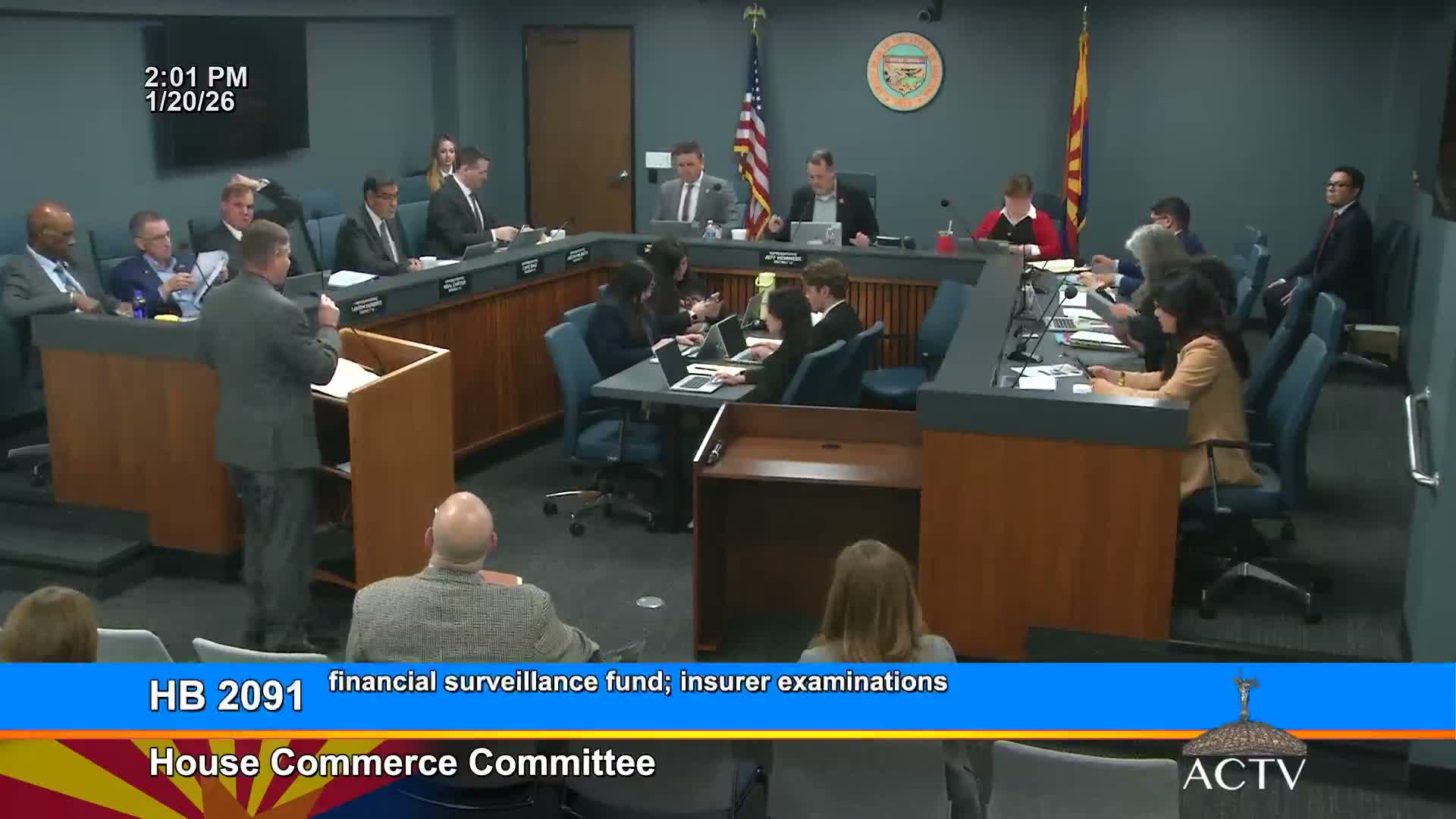
House Commerce Committee members voted to return House Bill 2091 with a due-pass recommendation after hearing that the measure would raise the maximum asset-assessment amounts insurers pay to fund the Department of Insurance & Financial Institutions's (DIFI) financial-analyst staff.
Paul Penney, research analyst for the Commerce Committee, told members that "House bill 2091 increases the maximum allowable assets assessment amount for each range of total admitted assets and provides for the calculation of the maximum asset amount beginning 07/01/2027." The bill passed the committee by roll call, 11-0.
Why it matters: Supporters said the fees have not been updated in 25 years and current assessments no longer fund the department's workload as insurers and assets domiciled in Arizona have grown. Sponsor Representative David Livingston (District 28) said the change will let the department hire regulators to process audits, review new products and protect consumers more promptly.
Industry witnesses urged passage. Mark Osborne, testifying for Prudential and other carriers, said Arizona has become a regulatory home for many insurers and that resources have not kept pace: "In 2001 there were 93 domesticated [companies] with about $95,000,000,000 under assets. Now we're at ... 138 companies with $380,000,000,000 under assets." Osborne told the committee he did not expect the change to raise premiums: "No." He said a stable baseline of fees would let the department hire staff and reduce costly contracted work and delays.
Committee members pressed for details about indexing and caps in the bill. Supporters said the proposal combines an inflation index with adjustments for asset growth and includes a cap to avoid excessive automatic increases.
What happened next: A member moved to return HB2091 with a due-pass recommendation; the roll-call vote was 11 ayes, 0 nays. The bill will proceed with the committee's due-pass recommendation to the next legislative stage.
Sources: Committee analyst and sponsor remarks; Mark Osborne, industry testimony; roll-call vote recorded in committee proceedings.
Paul Penney, research analyst for the Commerce Committee, told members that "House bill 2091 increases the maximum allowable assets assessment amount for each range of total admitted assets and provides for the calculation of the maximum asset amount beginning 07/01/2027." The bill passed the committee by roll call, 11-0.
Why it matters: Supporters said the fees have not been updated in 25 years and current assessments no longer fund the department's workload as insurers and assets domiciled in Arizona have grown. Sponsor Representative David Livingston (District 28) said the change will let the department hire regulators to process audits, review new products and protect consumers more promptly.
Industry witnesses urged passage. Mark Osborne, testifying for Prudential and other carriers, said Arizona has become a regulatory home for many insurers and that resources have not kept pace: "In 2001 there were 93 domesticated [companies] with about $95,000,000,000 under assets. Now we're at ... 138 companies with $380,000,000,000 under assets." Osborne told the committee he did not expect the change to raise premiums: "No." He said a stable baseline of fees would let the department hire staff and reduce costly contracted work and delays.
Committee members pressed for details about indexing and caps in the bill. Supporters said the proposal combines an inflation index with adjustments for asset growth and includes a cap to avoid excessive automatic increases.
What happened next: A member moved to return HB2091 with a due-pass recommendation; the roll-call vote was 11 ayes, 0 nays. The bill will proceed with the committee's due-pass recommendation to the next legislative stage.
Sources: Committee analyst and sponsor remarks; Mark Osborne, industry testimony; roll-call vote recorded in committee proceedings.
Don't Miss a Word: See the Full Meeting!
Go beyond summaries. Unlock every video, transcript, and key insight with a Founder Membership.
✓
Get instant access to full meeting videos
✓
Search and clip any phrase from complete transcripts
✓
Receive AI-powered summaries & custom alerts
✓
Enjoy lifetime, unrestricted access to government data
30-day money-back guarantee
