University of Pittsburgh launches 'assistive-technology' moonshot, highlights research and inclusion goals
December 06, 2024 | University of Pittsburgh, Other State Agencies, Organizations, Executive, Pennsylvania
This article was created by AI summarizing key points discussed. AI makes mistakes, so for full details and context, please refer to the video of the full meeting. Please report any errors so we can fix them. Report an error »
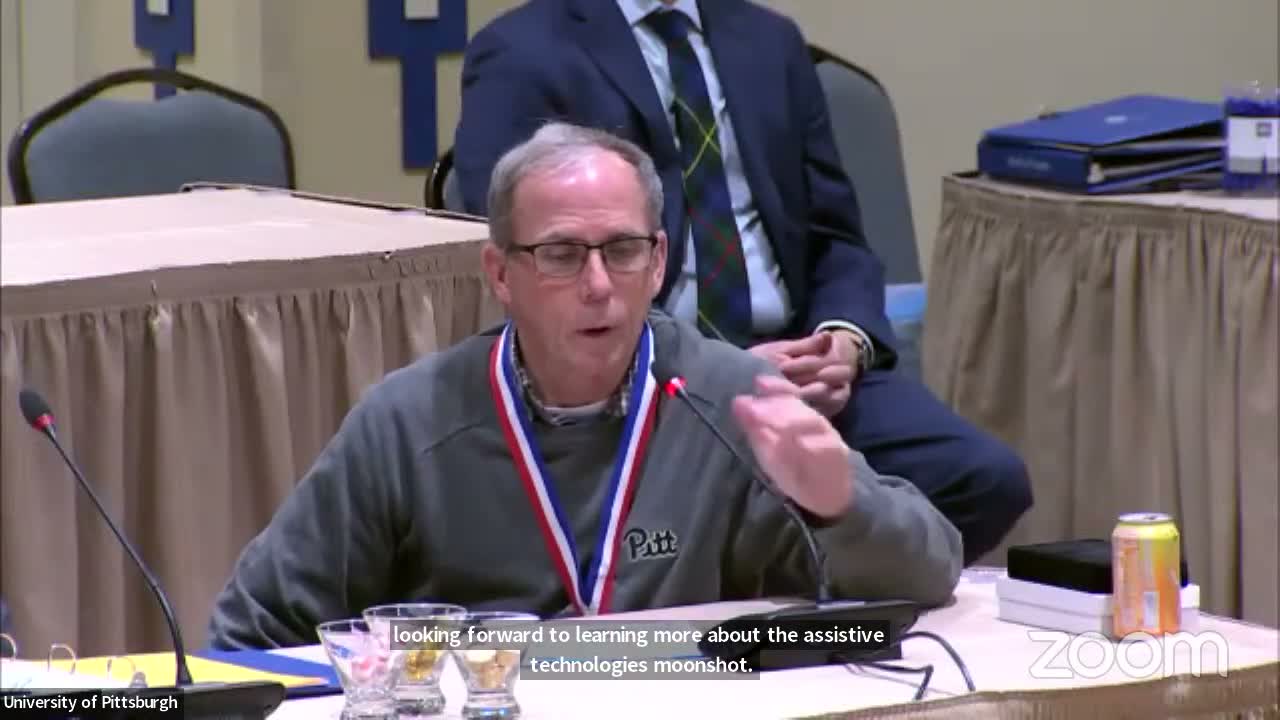
Dr. Rory Cooper, founding director of the Human Engineering Research Laboratories, presented the University of Pittsburgh's new 'assistive-technology' moonshot to the Board of Trustees on Nov. 12, saying the multi-year effort will center people with disabilities in research, education and workforce development. "We need to engage people with disabilities throughout this process," Cooper said, arguing the university should include people with disabilities as students, colleagues, researchers and entrepreneurs.
Cooper described Pitt's existing strengths in the field: three of the 15 centers funded by the National Institute on Disability, Independent Living, and Rehabilitation Research (NIDILRR) are run by Pitt faculty and several more have Pitt affiliations. He listed major federal and philanthropic funders that already support related work at Pitt, including NIH, DARPA, the Department of Defense and foundations with links to the university's research units.
The presentation cited a figure Cooper attributed to public data that about 61,000,000 Americans report some form of disability. Cooper used that statistic to argue the initiative has both societal and market relevance: "People with disabilities themselves have resources," he said, and families, employers and other payers expand the potential impact of assistive products and services.
Cooper outlined technology and research domains the moonshot will target, including wheelchair and prosthetic design, neuroengineering, communication technologies, accessibility for aging populations and transportation solutions. He described educational and outreach efforts such as the Healthy Home and Communities Lab, undergraduate research experiences, and partnerships with Gallaudet University to advance sign-language resources for science.
The presentation included a brief video showing a graduate student and a mobility device designed at the Human Engineering Research Laboratories being used at a water park; Cooper said such real-world demonstrations help normalize participation and reduce societal bias. He also described international and interagency collaboration, including a Department of State-funded project with Timor-Leste facilitated through a campus connection.
Trustees responded with praise and questions about how the initiative will connect disparate research groups across campus. Cooper acknowledged the university already has many related efforts but said the moonshot's value is in creating cohesion and accelerating translation from grants and patents to outcomes such as standards, trained students and startups.
The board took no formal action related to the moonshot during the meeting; Cooper invited follow-up questions and offered to provide additional details about timelines and funding as the initiative develops.
Cooper described Pitt's existing strengths in the field: three of the 15 centers funded by the National Institute on Disability, Independent Living, and Rehabilitation Research (NIDILRR) are run by Pitt faculty and several more have Pitt affiliations. He listed major federal and philanthropic funders that already support related work at Pitt, including NIH, DARPA, the Department of Defense and foundations with links to the university's research units.
The presentation cited a figure Cooper attributed to public data that about 61,000,000 Americans report some form of disability. Cooper used that statistic to argue the initiative has both societal and market relevance: "People with disabilities themselves have resources," he said, and families, employers and other payers expand the potential impact of assistive products and services.
Cooper outlined technology and research domains the moonshot will target, including wheelchair and prosthetic design, neuroengineering, communication technologies, accessibility for aging populations and transportation solutions. He described educational and outreach efforts such as the Healthy Home and Communities Lab, undergraduate research experiences, and partnerships with Gallaudet University to advance sign-language resources for science.
The presentation included a brief video showing a graduate student and a mobility device designed at the Human Engineering Research Laboratories being used at a water park; Cooper said such real-world demonstrations help normalize participation and reduce societal bias. He also described international and interagency collaboration, including a Department of State-funded project with Timor-Leste facilitated through a campus connection.
Trustees responded with praise and questions about how the initiative will connect disparate research groups across campus. Cooper acknowledged the university already has many related efforts but said the moonshot's value is in creating cohesion and accelerating translation from grants and patents to outcomes such as standards, trained students and startups.
The board took no formal action related to the moonshot during the meeting; Cooper invited follow-up questions and offered to provide additional details about timelines and funding as the initiative develops.
Don't Miss a Word: See the Full Meeting!
Go beyond summaries. Unlock every video, transcript, and key insight with a Founder Membership.
✓
Get instant access to full meeting videos
✓
Search and clip any phrase from complete transcripts
✓
Receive AI-powered summaries & custom alerts
✓
Enjoy lifetime, unrestricted access to government data
30-day money-back guarantee
