Arizona Senate opens session, extends filing deadlines and lists bills for referral
January 20, 2026 | 2026 Legislature Arizona, Arizona
This article was created by AI summarizing key points discussed. AI makes mistakes, so for full details and context, please refer to the video of the full meeting. Please report any errors so we can fix them. Report an error »
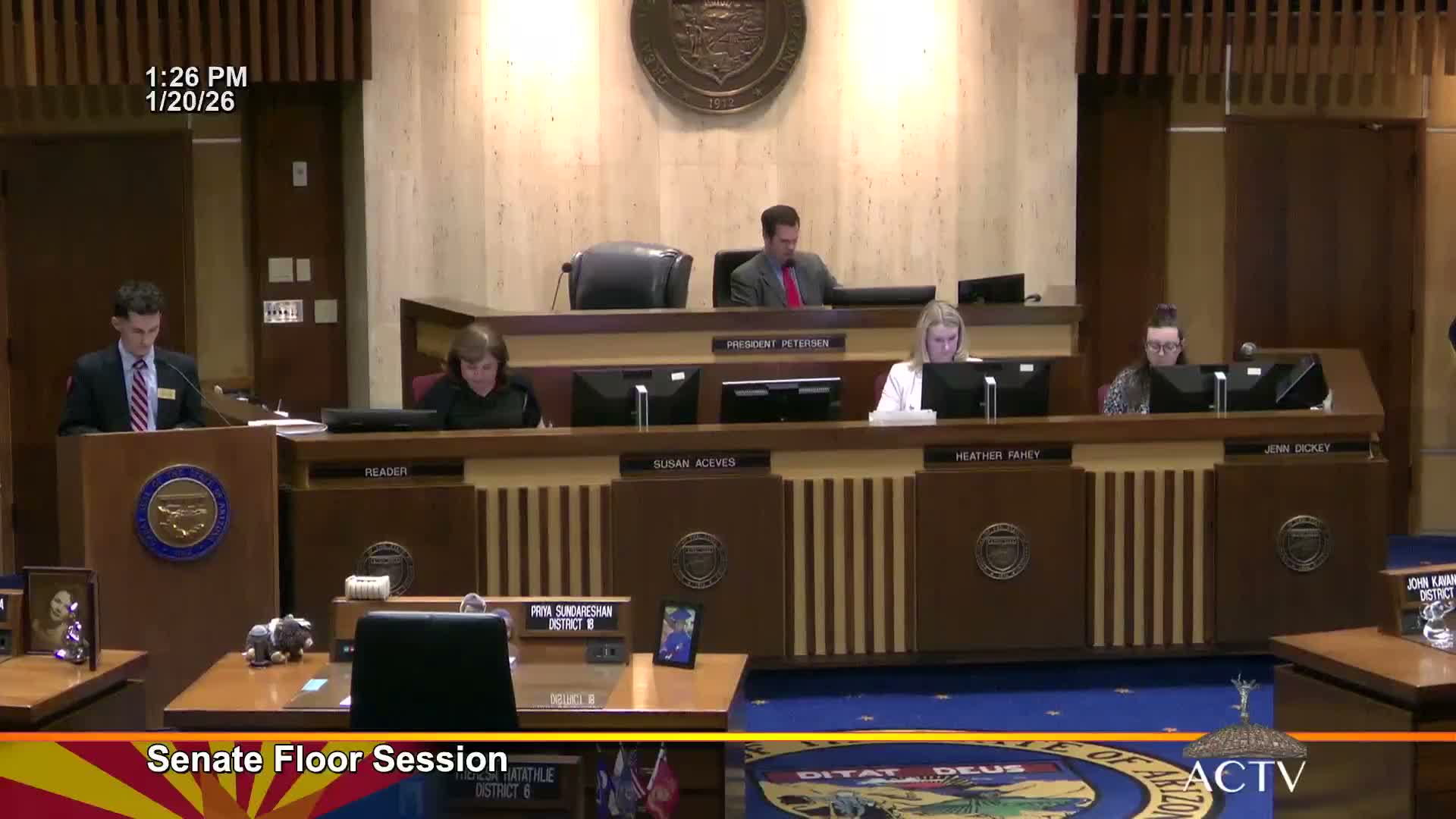
The Arizona State Senate convened on Jan. 20, 2026, opening with a prayer by Reverend Anne Leiter of Saint Matthews United Methodist Church and the Pledge of Allegiance led by Senator Bravo. The chamber recorded 27 senators present with three excused.
Presiding officers told members they had extended administrative deadlines under Legislative Council rules: the deadline to open Senate folders was extended to Tuesday, Jan. 20 at 5 p.m., and the deadline for preparing Senate bill introduction (intro set) was extended to Monday, Feb. 2. The presiding officer reminded members that Feb. 2 is the deadline to introduce Senate bills so Legislative Council has time to convert drafts into printed intro sets.
Majority Leader introduced Dr. Tammy Penhollow as doctor of the day, describing her as a board-certified anesthesiologist and pain medicine physician, a U.S. Navy veteran and the founder of a physician-owned regenerative medicine practice in Scottsdale. “If she can't cure your pain, she can put you to sleep,” the Majority Leader said, introducing Penhollow to the gallery.
Senator Bullock introduced Sean McMahon, a constituent who has been shadowing the senator and described as a grassroots engagement director for a local nonprofit. Senator Warner introduced representatives from Republic Services, listing Ginger Richardson, Alberto Guardado, Taryn Sims, Charlotte Thomas and Sadiq Young and noting the company’s local employment and statewide operations.
Chamber clerks and presiding officers read an extensive list of assigned bills and their committee referrals. The clerk identified measures across policy areas including education (S.B. 1166 on high school equivalency), health and human services (multiple measures on medical education, behavioral health and facility oversight), natural resources (S.B. 1200 and related groundwater and water-supply items), public safety and judiciary topics, and a variety of appropriations and regulatory measures. Many measures were placed for second reading or assigned to specific standing committees.
Several senators announced committee meeting schedules for the following day, including Health and Human Services at 9:00 a.m. in SHR2, Regulatory Affairs and Government Efficiency at 10:00 a.m. in Hearing Room 1, Education at 1:30 p.m. in Room 130 and Judiciary and Elections at 1:30 p.m. or on adjournment of the floor in Hearing Room 2. Meeting times were attributed to the respective committee chairs or members making the announcements.
Before adjourning, the Majority Leader moved that the Senate stand adjourned until Wednesday, Jan. 21, 2026, at 1:15 p.m.; the motion was carried by voice vote and the Senate adjourned.
The session’s actions were largely procedural: scheduling, administrative deadlines, guest introductions and the formal reading of bill assignments. No committee votes or floor votes on bills were recorded in the transcript for this session.
Presiding officers told members they had extended administrative deadlines under Legislative Council rules: the deadline to open Senate folders was extended to Tuesday, Jan. 20 at 5 p.m., and the deadline for preparing Senate bill introduction (intro set) was extended to Monday, Feb. 2. The presiding officer reminded members that Feb. 2 is the deadline to introduce Senate bills so Legislative Council has time to convert drafts into printed intro sets.
Majority Leader introduced Dr. Tammy Penhollow as doctor of the day, describing her as a board-certified anesthesiologist and pain medicine physician, a U.S. Navy veteran and the founder of a physician-owned regenerative medicine practice in Scottsdale. “If she can't cure your pain, she can put you to sleep,” the Majority Leader said, introducing Penhollow to the gallery.
Senator Bullock introduced Sean McMahon, a constituent who has been shadowing the senator and described as a grassroots engagement director for a local nonprofit. Senator Warner introduced representatives from Republic Services, listing Ginger Richardson, Alberto Guardado, Taryn Sims, Charlotte Thomas and Sadiq Young and noting the company’s local employment and statewide operations.
Chamber clerks and presiding officers read an extensive list of assigned bills and their committee referrals. The clerk identified measures across policy areas including education (S.B. 1166 on high school equivalency), health and human services (multiple measures on medical education, behavioral health and facility oversight), natural resources (S.B. 1200 and related groundwater and water-supply items), public safety and judiciary topics, and a variety of appropriations and regulatory measures. Many measures were placed for second reading or assigned to specific standing committees.
Several senators announced committee meeting schedules for the following day, including Health and Human Services at 9:00 a.m. in SHR2, Regulatory Affairs and Government Efficiency at 10:00 a.m. in Hearing Room 1, Education at 1:30 p.m. in Room 130 and Judiciary and Elections at 1:30 p.m. or on adjournment of the floor in Hearing Room 2. Meeting times were attributed to the respective committee chairs or members making the announcements.
Before adjourning, the Majority Leader moved that the Senate stand adjourned until Wednesday, Jan. 21, 2026, at 1:15 p.m.; the motion was carried by voice vote and the Senate adjourned.
The session’s actions were largely procedural: scheduling, administrative deadlines, guest introductions and the formal reading of bill assignments. No committee votes or floor votes on bills were recorded in the transcript for this session.
Don't Miss a Word: See the Full Meeting!
Go beyond summaries. Unlock every video, transcript, and key insight with a Founder Membership.
✓
Get instant access to full meeting videos
✓
Search and clip any phrase from complete transcripts
✓
Receive AI-powered summaries & custom alerts
✓
Enjoy lifetime, unrestricted access to government data
30-day money-back guarantee
