Richland police brief council on planned Public Safety Aerial Response (SAR) drone program
January 20, 2026 | Richland , Benton County, Washington
This article was created by AI summarizing key points discussed. AI makes mistakes, so for full details and context, please refer to the video of the full meeting. Please report any errors so we can fix them. Report an error »
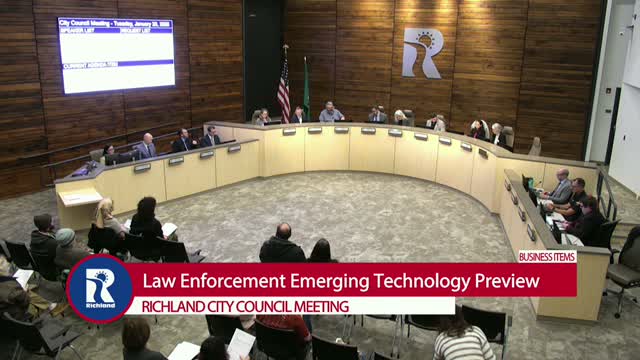
The Richland Police Department presented an informational briefing on Jan. 20 about a planned Public Safety Aerial Response (SAR) program that will provide real-time aerial situational awareness to support police, fire and emergency medical responders.
Chief Marty Pilcher introduced the briefing and said the capability is intended to benefit "public safety as a whole, not merely law enforcement." Operations Commander Chris Mason described SAR as an operational-support capability that streams live video to officers and supervisors, is not autonomous or armed, and is governed by written policy intended to comply with Washington state law and FAA regulations. "SAR is a tool that helps us to see first, decide smarter, and act safer," Mason said.
Mason identified the equipment chosen for SAR as the Skydio X-ten and said the program uses fixed docking stations that perform automated system checks to ensure cybersecurity and reliability. He said the SAR program as presented will be civilian operated and command guided, and co-located within a real-time information center. The department said the SAR program is modeled on successful programs elsewhere and includes a public-facing policy, a complaint and review process, and regular reporting to promote transparency.
Council members asked about program scale, capabilities, data retention, and access controls. Mason said the department currently has two Skydio X-ten aircraft allocated for SAR and an existing drone team of six aircraft (five DJI models and one Freefly Astro) that officers operate. He described data retention and access controls: video and associated records will be housed by the city through an Axon account, retained approximately 30 days unless evidence requires longer retention, and access will be limited to department-issued devices and audited logs. Civilian SAR operators will undergo background checks and vetting, and initial dissemination of live feed will likely be command- and supervisor-level with further adjustments determined after implementation. Mason said loiter times vary by wind and conditions (approximately 10–25 minutes) and that a mobile, officer-operated drone can be redeployed if needed.
Council members requested a year-end report showing usage, response-time impacts and cost comparisons to help evaluate the program. Mason said the department plans deliberate implementation with oversight and expects to measure response times, documented de‑escalation outcomes and community feedback. The department indicated a target implementation timeframe through 2027 for deliberate rollout and oversight.
Chief Marty Pilcher introduced the briefing and said the capability is intended to benefit "public safety as a whole, not merely law enforcement." Operations Commander Chris Mason described SAR as an operational-support capability that streams live video to officers and supervisors, is not autonomous or armed, and is governed by written policy intended to comply with Washington state law and FAA regulations. "SAR is a tool that helps us to see first, decide smarter, and act safer," Mason said.
Mason identified the equipment chosen for SAR as the Skydio X-ten and said the program uses fixed docking stations that perform automated system checks to ensure cybersecurity and reliability. He said the SAR program as presented will be civilian operated and command guided, and co-located within a real-time information center. The department said the SAR program is modeled on successful programs elsewhere and includes a public-facing policy, a complaint and review process, and regular reporting to promote transparency.
Council members asked about program scale, capabilities, data retention, and access controls. Mason said the department currently has two Skydio X-ten aircraft allocated for SAR and an existing drone team of six aircraft (five DJI models and one Freefly Astro) that officers operate. He described data retention and access controls: video and associated records will be housed by the city through an Axon account, retained approximately 30 days unless evidence requires longer retention, and access will be limited to department-issued devices and audited logs. Civilian SAR operators will undergo background checks and vetting, and initial dissemination of live feed will likely be command- and supervisor-level with further adjustments determined after implementation. Mason said loiter times vary by wind and conditions (approximately 10–25 minutes) and that a mobile, officer-operated drone can be redeployed if needed.
Council members requested a year-end report showing usage, response-time impacts and cost comparisons to help evaluate the program. Mason said the department plans deliberate implementation with oversight and expects to measure response times, documented de‑escalation outcomes and community feedback. The department indicated a target implementation timeframe through 2027 for deliberate rollout and oversight.
View the Full Meeting & All Its Details
This article offers just a summary. Unlock complete video, transcripts, and insights as a Founder Member.
✓
Watch full, unedited meeting videos
✓
Search every word spoken in unlimited transcripts
✓
AI summaries & real-time alerts (all government levels)
✓
Permanent access to expanding government content
30-day money-back guarantee
