Oklahoma Broadband Office says state is on track for 95% high‑speed coverage; BEAD funding still pending approval
January 21, 2026 | 2026 Legislature OK, Oklahoma
This article was created by AI summarizing key points discussed. AI makes mistakes, so for full details and context, please refer to the video of the full meeting. Please report any errors so we can fix them. Report an error »
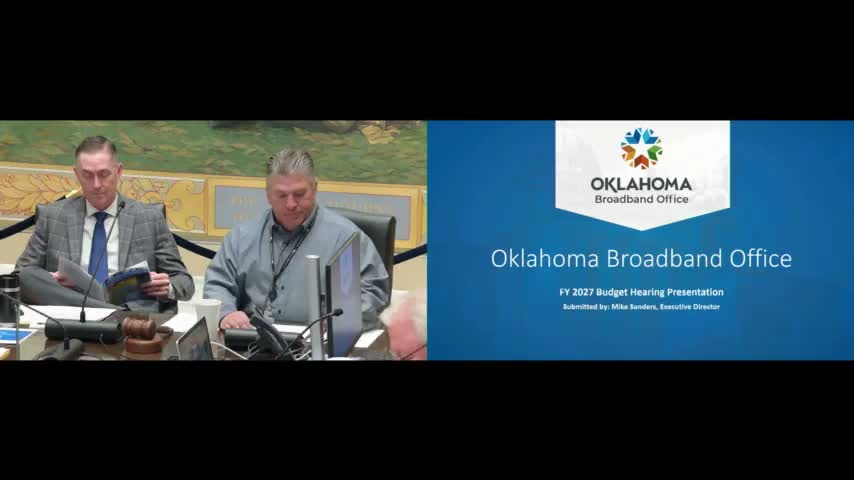
Mike Sanders, executive director of the Oklahoma Broadband Office, told a House committee Tuesday that the office is administering federal grant programs and on track to meet the legislature’s goal of at least 95% high‑speed coverage.
Sanders said the office does not plan to request a state appropriation and is overseeing more than $700,000,000 in project investments (including private matches) from one‑time federal programs. “We’re not asking for an appropriation,” he said.
The office reported a mix of technologies under the programs: about 82% of funded deployments are fiber and about 18% are fixed wireless. Sanders said the projects will connect roughly 67,000 homes and businesses by 2026 and that, of 159 awarded projects, two had completed construction and 119 were under construction.
On service levels, Sanders told members the programs he administers target speeds of 100 Mbps down / 20 Mbps up for eligibility, and that most projects are symmetrical at 100/100 Mbps. He said that the office uses the FCC map and other federal program rules to determine where it may fund projects and that it cannot “overbuild” locations that federal maps show as served.
Members asked whether recent headlines alleging the state had sent hundreds of millions back to the federal government were accurate. Sanders called that narrative false and said Oklahoma had not received BEAD funds for distribution because NTIA had not completed approvals; he said the state expects to retain a significant portion of its BEAD allocation if it satisfies NTIA requirements. “The narrative that was released was false,” he said, and explained that program rules changed and that much of the BEAD process remains subject to NTIA approval.
The director also described program management changes: the office finalized closeout and default processes for grantees, assigns grant analysts who meet weekly with providers, and is prioritizing completing ARPA projects before key grant deadlines. Brian Walters, the office’s finance consultant, said the state’s SLFRF account had a projected remaining balance for FY26 that would largely be expended this fiscal year, leaving approximately $31,000,000 to be paid out in FY2027.
Sanders discussed satellite service (for example Starlink‑style deployments), saying satellite projects follow different federal rules, may have a 10‑year compliance window, and typically require customers to install provided equipment. He said satellite can be an important option for remote, very costly locations but stressed that fiber remains the “gold standard” where practicable.
Committee members asked follow‑up questions about speed definitions, the possibility of base‑growth changing the calculus for the 95% target, and how the office is coordinating with federal agencies. Sanders offered to continue offline briefings on satellite and other technical points. The committee took no votes and adjourned after questions.
Sanders said the office does not plan to request a state appropriation and is overseeing more than $700,000,000 in project investments (including private matches) from one‑time federal programs. “We’re not asking for an appropriation,” he said.
The office reported a mix of technologies under the programs: about 82% of funded deployments are fiber and about 18% are fixed wireless. Sanders said the projects will connect roughly 67,000 homes and businesses by 2026 and that, of 159 awarded projects, two had completed construction and 119 were under construction.
On service levels, Sanders told members the programs he administers target speeds of 100 Mbps down / 20 Mbps up for eligibility, and that most projects are symmetrical at 100/100 Mbps. He said that the office uses the FCC map and other federal program rules to determine where it may fund projects and that it cannot “overbuild” locations that federal maps show as served.
Members asked whether recent headlines alleging the state had sent hundreds of millions back to the federal government were accurate. Sanders called that narrative false and said Oklahoma had not received BEAD funds for distribution because NTIA had not completed approvals; he said the state expects to retain a significant portion of its BEAD allocation if it satisfies NTIA requirements. “The narrative that was released was false,” he said, and explained that program rules changed and that much of the BEAD process remains subject to NTIA approval.
The director also described program management changes: the office finalized closeout and default processes for grantees, assigns grant analysts who meet weekly with providers, and is prioritizing completing ARPA projects before key grant deadlines. Brian Walters, the office’s finance consultant, said the state’s SLFRF account had a projected remaining balance for FY26 that would largely be expended this fiscal year, leaving approximately $31,000,000 to be paid out in FY2027.
Sanders discussed satellite service (for example Starlink‑style deployments), saying satellite projects follow different federal rules, may have a 10‑year compliance window, and typically require customers to install provided equipment. He said satellite can be an important option for remote, very costly locations but stressed that fiber remains the “gold standard” where practicable.
Committee members asked follow‑up questions about speed definitions, the possibility of base‑growth changing the calculus for the 95% target, and how the office is coordinating with federal agencies. Sanders offered to continue offline briefings on satellite and other technical points. The committee took no votes and adjourned after questions.
View the Full Meeting & All Its Details
This article offers just a summary. Unlock complete video, transcripts, and insights as a Founder Member.
✓
Watch full, unedited meeting videos
✓
Search every word spoken in unlimited transcripts
✓
AI summaries & real-time alerts (all government levels)
✓
Permanent access to expanding government content
30-day money-back guarantee
