Oklahoma Broadband Office says ARPA-funded network will be operational statewide by end of 2026
January 21, 2026 | 2026 Legislature OK, Oklahoma
This article was created by AI summarizing key points discussed. AI makes mistakes, so for full details and context, please refer to the video of the full meeting. Please report any errors so we can fix them. Report an error »
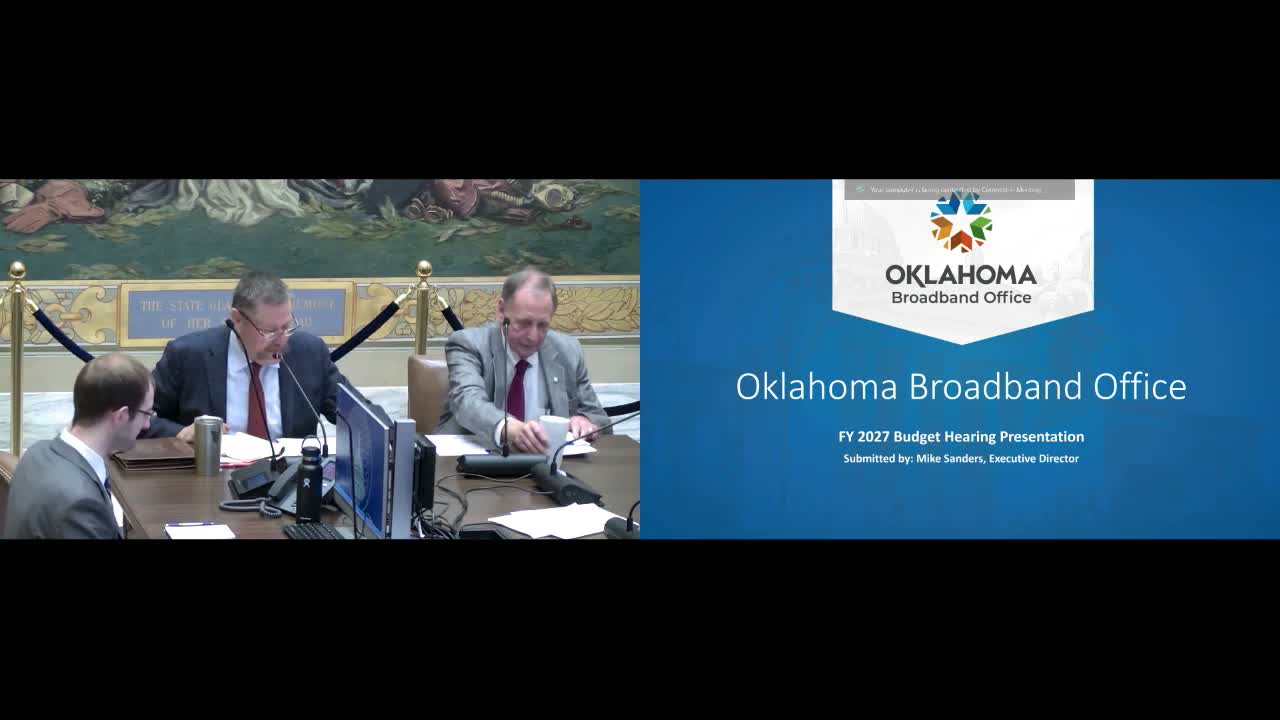
Mike Sanders, executive director of the Oklahoma Broadband Office, told the legislature’s ARPA oversight subcommittee that his office is administering roughly $1,000,000,000 in federal funds to extend service to unserved and underserved Oklahomans.
"I'm Mike Sanders, executive director of the Oklahoma Broadband Office," Sanders said, opening his presentation. He told senators the office does not plan to ask for state appropriations: "I'm not asking for an appropriation," he said.
Sanders said the program has mobilized more than $700,000,000 in combined award and private-match investment and that deployed technology is about 82% fiber and 18% fixed wireless. He estimated roughly 67,000 homes and businesses will gain access to high-speed internet services through the office’s programs by 2026.
On program management, Sanders described two formal processes the office has finalized: a closeout process to reimburse awardees who meet obligations and a default process to identify and address providers that fail to meet milestones. He said awardees are monitored closely, noting his staff meet with providers weekly or biweekly to anticipate problems.
Sanders gave counts of program status: 159 projects were awarded, two projects have been completed, and roughly 119 are under construction or working to close out with the office. He emphasized that all ARPA-funded work must be built and operational by the end of calendar year 2026: "They have to be operational and ... they will be lit. They will be hot," Sanders said when asked to clarify the deadline.
Committee members asked about the final 5 percent of unserved locations. Sanders said the remaining unserved addresses are scattered across the state, with more concentration in southeast and eastern Oklahoma due to terrain, and that the office used the FCC map to identify unserved and underserved areas. He explained the program minimum service is 100/20 megabits per second and that most projects will deliver 100/100.
On staffing and finance, Brian Walters, the office’s CFO consultant, told the committee the state was awarded $385,000,000 in SLFRF funding in FY22 and that between FY22 and FY25 about $75,000,000 was spent; he estimated about $279,000,000 of the FY25 ending balance would be expended by the end of FY26. Sanders said his office is staffed with 15 FTEs and does not anticipate seeking additional appropriations for operations.
Sanders also briefed the committee on the BED program, a separate federal grant the office administers. He said BED’s timeline runs to about 2030 and that the BED program is expected to address many of the hardest-to-serve locations beyond the ARPA timeline.
The office offered the committee a public dashboard and contact information for constituent requests, and Sanders said staff would provide follow-up as needed on project specifics and timelines.
"I'm Mike Sanders, executive director of the Oklahoma Broadband Office," Sanders said, opening his presentation. He told senators the office does not plan to ask for state appropriations: "I'm not asking for an appropriation," he said.
Sanders said the program has mobilized more than $700,000,000 in combined award and private-match investment and that deployed technology is about 82% fiber and 18% fixed wireless. He estimated roughly 67,000 homes and businesses will gain access to high-speed internet services through the office’s programs by 2026.
On program management, Sanders described two formal processes the office has finalized: a closeout process to reimburse awardees who meet obligations and a default process to identify and address providers that fail to meet milestones. He said awardees are monitored closely, noting his staff meet with providers weekly or biweekly to anticipate problems.
Sanders gave counts of program status: 159 projects were awarded, two projects have been completed, and roughly 119 are under construction or working to close out with the office. He emphasized that all ARPA-funded work must be built and operational by the end of calendar year 2026: "They have to be operational and ... they will be lit. They will be hot," Sanders said when asked to clarify the deadline.
Committee members asked about the final 5 percent of unserved locations. Sanders said the remaining unserved addresses are scattered across the state, with more concentration in southeast and eastern Oklahoma due to terrain, and that the office used the FCC map to identify unserved and underserved areas. He explained the program minimum service is 100/20 megabits per second and that most projects will deliver 100/100.
On staffing and finance, Brian Walters, the office’s CFO consultant, told the committee the state was awarded $385,000,000 in SLFRF funding in FY22 and that between FY22 and FY25 about $75,000,000 was spent; he estimated about $279,000,000 of the FY25 ending balance would be expended by the end of FY26. Sanders said his office is staffed with 15 FTEs and does not anticipate seeking additional appropriations for operations.
Sanders also briefed the committee on the BED program, a separate federal grant the office administers. He said BED’s timeline runs to about 2030 and that the BED program is expected to address many of the hardest-to-serve locations beyond the ARPA timeline.
The office offered the committee a public dashboard and contact information for constituent requests, and Sanders said staff would provide follow-up as needed on project specifics and timelines.
Don't Miss a Word: See the Full Meeting!
Go beyond summaries. Unlock every video, transcript, and key insight with a Founder Membership.
✓
Get instant access to full meeting videos
✓
Search and clip any phrase from complete transcripts
✓
Receive AI-powered summaries & custom alerts
✓
Enjoy lifetime, unrestricted access to government data
30-day money-back guarantee
