Subcommittee advances HB16 to credit incarcerated work toward court debt
January 24, 2026 | 2026 Legislature VA, Virginia
This article was created by AI summarizing key points discussed. AI makes mistakes, so for full details and context, please refer to the video of the full meeting. Please report any errors so we can fix them. Report an error »
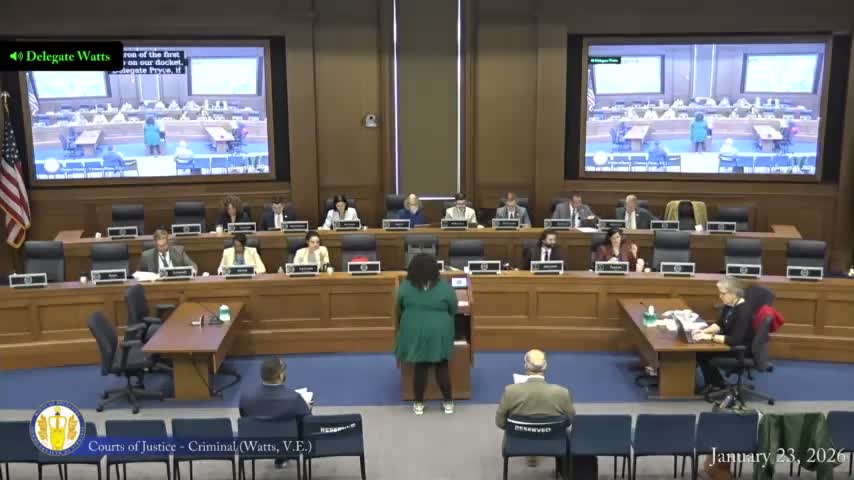
A House courts subcommittee on Monday voted unanimously to report House Bill 16, which would require tracking hours worked during incarceration so courts can apply those hours as credit toward fines and costs.
Delegate Emily Price, the bill patron, told the panel the measure does not change institutional work assignments but would create an accounting mechanism so "courts would know what of the fines or cost to discharge." Supporters said the change would improve reentry outcomes and reduce uncollectible debt.
"This bill would allow him to be steady footed when he returns to the community," said Maisie Osteen, a senior supervising attorney at the Legal Aid Justice Center, describing a client who worked hundreds of hours inside state facilities yet had paid only 6 percent of his court debt on release. Taj Mahanhaft of the Humanization Project and Cammie Blatt of the Commonwealth Institute also urged passage, noting that wages inside jails and prisons are extremely low and often do little to chip away at court debt.
A returning citizen who testified, Maurice Neenan, said current practice leaves credit to "the discretion" of the court and urged a streamlined approach so people returning to work and school are not immediately saddled with garnishments.
Patron Delegate Price proposed and the committee adopted a line amendment changing the retroactive tracking window from work "on or after 07/01/2020" to work "on or after 07/01/2023" after staff informed the committee that institutions stopped comprehensive tracking earlier than originally drafted. The amendment was moved and seconded and adopted without recorded opposition. The committee then voted to report the bill and refer it to appropriations.
The measure, as amended, now moves to the Appropriations Committee for further consideration. Supporters said the bill aims to reduce long-term debt burdens and improve the odds of stable reentry; opponents did not offer arguments during the hearing recorded here.
Delegate Emily Price, the bill patron, told the panel the measure does not change institutional work assignments but would create an accounting mechanism so "courts would know what of the fines or cost to discharge." Supporters said the change would improve reentry outcomes and reduce uncollectible debt.
"This bill would allow him to be steady footed when he returns to the community," said Maisie Osteen, a senior supervising attorney at the Legal Aid Justice Center, describing a client who worked hundreds of hours inside state facilities yet had paid only 6 percent of his court debt on release. Taj Mahanhaft of the Humanization Project and Cammie Blatt of the Commonwealth Institute also urged passage, noting that wages inside jails and prisons are extremely low and often do little to chip away at court debt.
A returning citizen who testified, Maurice Neenan, said current practice leaves credit to "the discretion" of the court and urged a streamlined approach so people returning to work and school are not immediately saddled with garnishments.
Patron Delegate Price proposed and the committee adopted a line amendment changing the retroactive tracking window from work "on or after 07/01/2020" to work "on or after 07/01/2023" after staff informed the committee that institutions stopped comprehensive tracking earlier than originally drafted. The amendment was moved and seconded and adopted without recorded opposition. The committee then voted to report the bill and refer it to appropriations.
The measure, as amended, now moves to the Appropriations Committee for further consideration. Supporters said the bill aims to reduce long-term debt burdens and improve the odds of stable reentry; opponents did not offer arguments during the hearing recorded here.
Don't Miss a Word: See the Full Meeting!
Go beyond summaries. Unlock every video, transcript, and key insight with a Founder Membership.
✓
Get instant access to full meeting videos
✓
Search and clip any phrase from complete transcripts
✓
Receive AI-powered summaries & custom alerts
✓
Enjoy lifetime, unrestricted access to government data
30-day money-back guarantee
