Virginia subcommittee advances HB 642 to create regulated adult‑use cannabis market with microlicenses, taxes and equity provisions
January 24, 2026 | 2026 Legislature VA, Virginia
This article was created by AI summarizing key points discussed. AI makes mistakes, so for full details and context, please refer to the video of the full meeting. Please report any errors so we can fix them. Report an error »
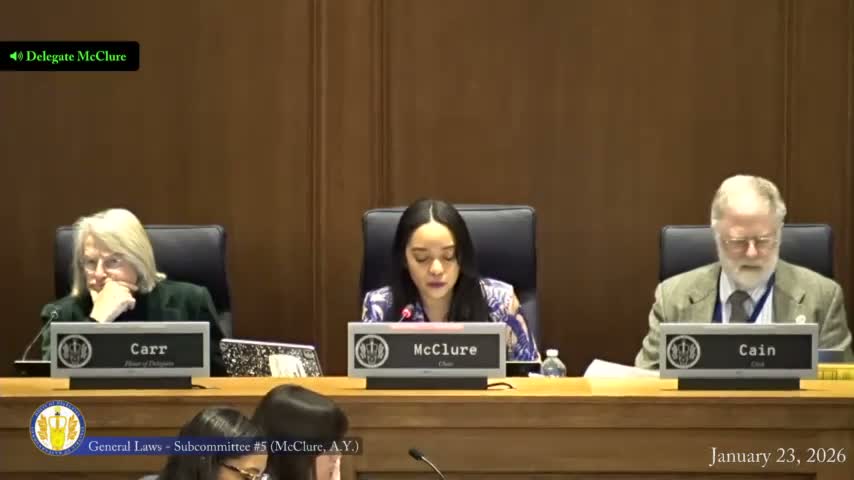
A Virginia House General Laws subcommittee on Wednesday voted to report HB 642 and refer the substitute to the Appropriations Committee, advancing legislation that would establish a regulated adult‑use cannabis market in the Commonwealth.
The substitute, which the bill patron described as the product of roughly three years of work with a joint commission and public input, would authorize a Cannabis Control Authority‑regulated market with 100 initial microbusiness licenses, tiered cultivator canopy limits and protections intended for small and legacy operators.
"This is our chance. This is our opportunity to take marijuana off the street corner and place it behind the age‑verified counter," the bill patron said while outlining the substitute and its aims to improve consumer safety and reduce illicit market activity.
Why it matters: The substitute combines immediate market access for small operations with provisions designed to address racial and economic harms from historic cannabis enforcement. It sets eligibility criteria for impact licensees, creates a revenue allocation plan for equity and treatment, and imposes criminal penalties for illegal dealing.
Key provisions
- Microbusinesses: A microbusiness license allows combined cultivation and retail within a 5,000 square‑foot canopy; the substitute sets aside 100 initial micro licenses to help start the regulated market.
- Timing and scope: Sponsors said the retail market is targeted to begin Nov. 1; the substitute also requires regulations for outdoor cultivation to be in place by Jan. 1, 2027.
- Conversion for medical operators: Existing medical cannabis processors may seek dual‑use privileges and would pay a one‑time conversion fee (the substitute sets $10,000,000 in the text discussed by counsel). Those medical operators would be allowed additional retail establishments and larger canopy allowances than new entrants, a feature supporters said preserves patient access while recognizing existing capacity.
- Taxes and purchases: The substitute outlines a combined tax of 12.625% on retail cannabis products (including an 8% marijuana‑specific tax and a state retail/use component), and limits purchases to up to 2.5 ounces per transaction; localities may opt to levy an additional 1%–3.5% local tax.
- Equity and impact licensing: The impact license program would award licenses to entities at least two‑thirds owned and controlled by eligible applicants. Eligible criteria include prior cannabis convictions (not limited to Virginia), military service, residency for multiple years in disproportionately policed jurisdictions, educational criteria tied to Pell‑grant‑eligible schools, or USDA distressed‑farmer status. Applicants must meet two criteria, one of which must be the residency/prior‑policing test in the substitute.
- Public health, product and banking rules: The substitute adds product registration requirements similar to the medical program, directs the Cannabis Public Health Advisory Council to review board regulations with a 30‑day clock, and includes provisions clarifying permissible financial services for licensed establishments.
- Penalties and workplace rules: The bill establishes graduated penalties for illegal sale: first offense Class 2 misdemeanor, second offense Class 1 misdemeanor, and third or subsequent offenses Class 6 felony. It also prohibits licensees and employees from consuming marijuana on licensed premises or while on duty.
Supporters and concerns
Industry representatives, equity advocates and legacy operators generally supported the substitute while urging amendments. Mike Aduda, a Southside Virginia farmer and impact applicant, urged a 25‑mile‑radius retail model to aid rural access. Chelsea Hickswise of Marijuana Justice and other equity advocates urged higher conversion fees to avoid granting an unfair advantage to large, vertically integrated medical operators.
Corey Conners of the Virginia Association of Community Banks told the committee the bill’s banking provisions will help clarify permissible services and protect both institutions and licensed businesses.
Opponents warned of youth and community harms. "Mass‑marketed high‑potency THC, unfortunately, does not help our kids' mental health," a representative of the Virginia Catholic Conference said, citing studies from other states. Dr. Todd Gacki of the Family Foundation argued that retail proliferation can harm neighborhoods and urged stronger local control.
The subcommittee’s action
A motion to report and refer HB 642’s substitute to the Appropriations Committee carried on a recorded vote of 7‑0.
What’s next
HB 642 will proceed to the Appropriations Committee for further consideration. Supporters said the substitute still faces additional stops, including possible conference with the Senate over timing and several technical differences.
Reporting note: Quotations and assertions in this article are drawn from testimony and committee discussion recorded in the subcommittee hearing.
The substitute, which the bill patron described as the product of roughly three years of work with a joint commission and public input, would authorize a Cannabis Control Authority‑regulated market with 100 initial microbusiness licenses, tiered cultivator canopy limits and protections intended for small and legacy operators.
"This is our chance. This is our opportunity to take marijuana off the street corner and place it behind the age‑verified counter," the bill patron said while outlining the substitute and its aims to improve consumer safety and reduce illicit market activity.
Why it matters: The substitute combines immediate market access for small operations with provisions designed to address racial and economic harms from historic cannabis enforcement. It sets eligibility criteria for impact licensees, creates a revenue allocation plan for equity and treatment, and imposes criminal penalties for illegal dealing.
Key provisions
- Microbusinesses: A microbusiness license allows combined cultivation and retail within a 5,000 square‑foot canopy; the substitute sets aside 100 initial micro licenses to help start the regulated market.
- Timing and scope: Sponsors said the retail market is targeted to begin Nov. 1; the substitute also requires regulations for outdoor cultivation to be in place by Jan. 1, 2027.
- Conversion for medical operators: Existing medical cannabis processors may seek dual‑use privileges and would pay a one‑time conversion fee (the substitute sets $10,000,000 in the text discussed by counsel). Those medical operators would be allowed additional retail establishments and larger canopy allowances than new entrants, a feature supporters said preserves patient access while recognizing existing capacity.
- Taxes and purchases: The substitute outlines a combined tax of 12.625% on retail cannabis products (including an 8% marijuana‑specific tax and a state retail/use component), and limits purchases to up to 2.5 ounces per transaction; localities may opt to levy an additional 1%–3.5% local tax.
- Equity and impact licensing: The impact license program would award licenses to entities at least two‑thirds owned and controlled by eligible applicants. Eligible criteria include prior cannabis convictions (not limited to Virginia), military service, residency for multiple years in disproportionately policed jurisdictions, educational criteria tied to Pell‑grant‑eligible schools, or USDA distressed‑farmer status. Applicants must meet two criteria, one of which must be the residency/prior‑policing test in the substitute.
- Public health, product and banking rules: The substitute adds product registration requirements similar to the medical program, directs the Cannabis Public Health Advisory Council to review board regulations with a 30‑day clock, and includes provisions clarifying permissible financial services for licensed establishments.
- Penalties and workplace rules: The bill establishes graduated penalties for illegal sale: first offense Class 2 misdemeanor, second offense Class 1 misdemeanor, and third or subsequent offenses Class 6 felony. It also prohibits licensees and employees from consuming marijuana on licensed premises or while on duty.
Supporters and concerns
Industry representatives, equity advocates and legacy operators generally supported the substitute while urging amendments. Mike Aduda, a Southside Virginia farmer and impact applicant, urged a 25‑mile‑radius retail model to aid rural access. Chelsea Hickswise of Marijuana Justice and other equity advocates urged higher conversion fees to avoid granting an unfair advantage to large, vertically integrated medical operators.
Corey Conners of the Virginia Association of Community Banks told the committee the bill’s banking provisions will help clarify permissible services and protect both institutions and licensed businesses.
Opponents warned of youth and community harms. "Mass‑marketed high‑potency THC, unfortunately, does not help our kids' mental health," a representative of the Virginia Catholic Conference said, citing studies from other states. Dr. Todd Gacki of the Family Foundation argued that retail proliferation can harm neighborhoods and urged stronger local control.
The subcommittee’s action
A motion to report and refer HB 642’s substitute to the Appropriations Committee carried on a recorded vote of 7‑0.
What’s next
HB 642 will proceed to the Appropriations Committee for further consideration. Supporters said the substitute still faces additional stops, including possible conference with the Senate over timing and several technical differences.
Reporting note: Quotations and assertions in this article are drawn from testimony and committee discussion recorded in the subcommittee hearing.
View the Full Meeting & All Its Details
This article offers just a summary. Unlock complete video, transcripts, and insights as a Founder Member.
✓
Watch full, unedited meeting videos
✓
Search every word spoken in unlimited transcripts
✓
AI summaries & real-time alerts (all government levels)
✓
Permanent access to expanding government content
30-day money-back guarantee
