OMES seeks supplemental funds for Workday, call center consolidation and procurement modernization; senators press on staffing and federal-risk
January 21, 2026 | 2026 Legislature OK, Oklahoma
This article was created by AI summarizing key points discussed. AI makes mistakes, so for full details and context, please refer to the video of the full meeting. Please report any errors so we can fix them. Report an error »
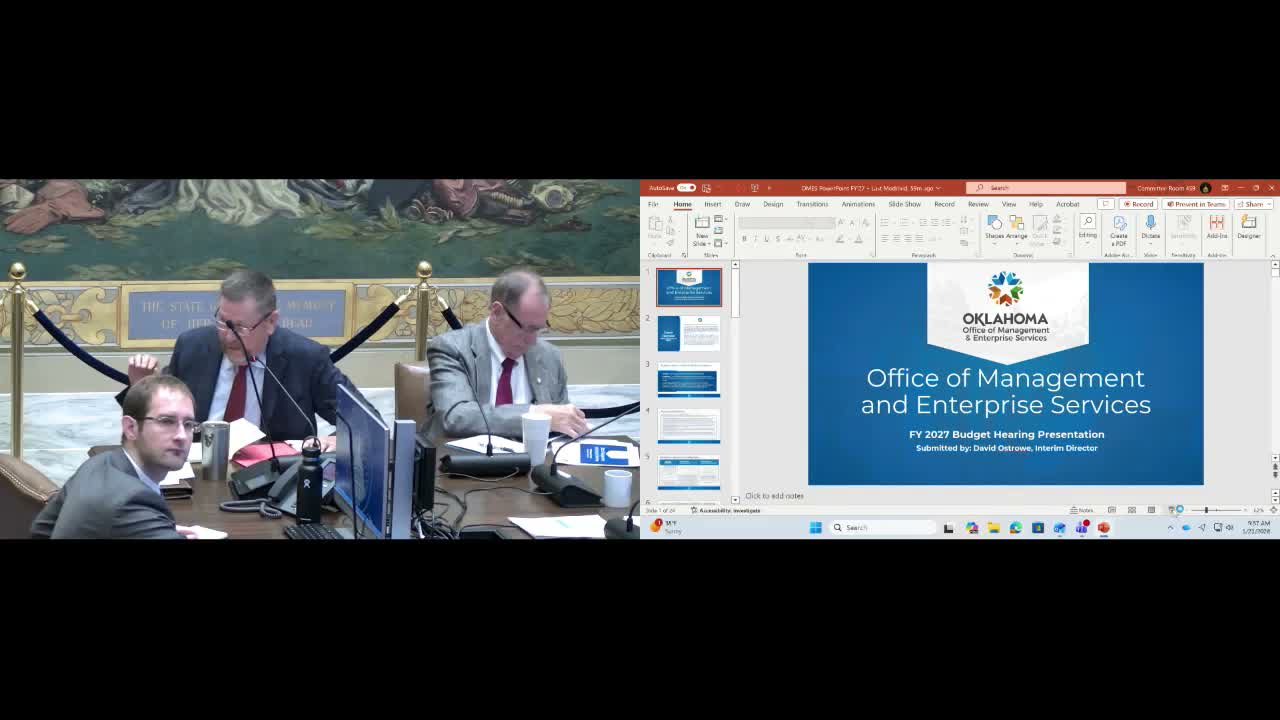
Mark Wood, director of the Office of Management and Enterprise Services, told the Senate subcommittee OMES is requesting a package of incremental and supplemental FY27 funds to address underfunded mandated responsibilities and capital needs.
Wood said OMES seeks $10,000,000 to cover underfunded mandated responsibilities (including $7,400,000 to fully pay for Workday implementation costs), $1,000,000 to create an emergency reserve, $8,000,000 (including $1,000,000 to extend grants management capacity through the end of calendar year 2026 and $7,000,000 for parking/road resurfacing), and a $19,000,000 request that includes $550,000 to automate the state budget process and $12,000,000 one-time to consolidate statewide call centers.
Data and savings claims drew detailed questioning. Dan Cronin, OMES information services director, described the call-center consolidation and estimated it could reduce operating costs by about $2,000,000 per year in steady state, with an initial one-time setup cost of $12,000,000 and recurring costs of about $8,000,000 thereafter. "We believe that human capital can come down even further and even produce better savings for the state," Cronin said, describing cross-training and "pods" that would route calls by domain (for example, health or transportation).
Senators repeatedly pressed whether those savings would be achieved by eliminating positions. Wood and Cronin said the goal is to empower and cross-train staff rather than to use technology primarily to reduce headcount, but acknowledged some attrition and role change may occur. Cronin described earlier success consolidating a tax call center and cited improved customer metrics.
Amanda Otis, state purchasing director, requested $7,000,000 to implement an e‑procurement system and $1,550,000 in annual licensing. She said the system would embed rules from the Central Purchasing Act and estimated at least a 30% reduction in procurement costs for state agencies.
Committee members pressed OMES for transparency on staffing and the possibility that reducing budgeted FTEs creates hidden costs in outsourcing or contractor replacements. Wood said many positions were assumed by agencies and OMES does not intend to refill all budgeted FTE lines; David Austro, chief operating officer, traced a decline in OMES headcount since 2019 from about 1,300 to current levels and recommended a cautious approach before changing pass-through funding.
On an accountability question, the committee asked whether shifting to direct appropriations (rather than passing funds through agencies) could jeopardize federal reimbursements. OMES staff said that exact exposure would require agency-by-agency reconciliation; Austro offered a working estimate that $20,000,000–$40,000,000 could be at risk without careful analysis. Wood and staff committed to providing comparative data (for example, leasing costs vs. enterprise and outsourcing totals) and follow-up material to the committee.
The hearing closed with the chair asking OMES to provide requested follow-up data; OMES officials said they would deliver those figures and continue coordination with the legislature.
Wood said OMES seeks $10,000,000 to cover underfunded mandated responsibilities (including $7,400,000 to fully pay for Workday implementation costs), $1,000,000 to create an emergency reserve, $8,000,000 (including $1,000,000 to extend grants management capacity through the end of calendar year 2026 and $7,000,000 for parking/road resurfacing), and a $19,000,000 request that includes $550,000 to automate the state budget process and $12,000,000 one-time to consolidate statewide call centers.
Data and savings claims drew detailed questioning. Dan Cronin, OMES information services director, described the call-center consolidation and estimated it could reduce operating costs by about $2,000,000 per year in steady state, with an initial one-time setup cost of $12,000,000 and recurring costs of about $8,000,000 thereafter. "We believe that human capital can come down even further and even produce better savings for the state," Cronin said, describing cross-training and "pods" that would route calls by domain (for example, health or transportation).
Senators repeatedly pressed whether those savings would be achieved by eliminating positions. Wood and Cronin said the goal is to empower and cross-train staff rather than to use technology primarily to reduce headcount, but acknowledged some attrition and role change may occur. Cronin described earlier success consolidating a tax call center and cited improved customer metrics.
Amanda Otis, state purchasing director, requested $7,000,000 to implement an e‑procurement system and $1,550,000 in annual licensing. She said the system would embed rules from the Central Purchasing Act and estimated at least a 30% reduction in procurement costs for state agencies.
Committee members pressed OMES for transparency on staffing and the possibility that reducing budgeted FTEs creates hidden costs in outsourcing or contractor replacements. Wood said many positions were assumed by agencies and OMES does not intend to refill all budgeted FTE lines; David Austro, chief operating officer, traced a decline in OMES headcount since 2019 from about 1,300 to current levels and recommended a cautious approach before changing pass-through funding.
On an accountability question, the committee asked whether shifting to direct appropriations (rather than passing funds through agencies) could jeopardize federal reimbursements. OMES staff said that exact exposure would require agency-by-agency reconciliation; Austro offered a working estimate that $20,000,000–$40,000,000 could be at risk without careful analysis. Wood and staff committed to providing comparative data (for example, leasing costs vs. enterprise and outsourcing totals) and follow-up material to the committee.
The hearing closed with the chair asking OMES to provide requested follow-up data; OMES officials said they would deliver those figures and continue coordination with the legislature.
View the Full Meeting & All Its Details
This article offers just a summary. Unlock complete video, transcripts, and insights as a Founder Member.
✓
Watch full, unedited meeting videos
✓
Search every word spoken in unlimited transcripts
✓
AI summaries & real-time alerts (all government levels)
✓
Permanent access to expanding government content
30-day money-back guarantee
