Subcommittee backs substitute for HB118 to broaden access to copies of discovery, adds dash-cam/body-worn camera language
January 24, 2026 | 2026 Legislature VA, Virginia
This article was created by AI summarizing key points discussed. AI makes mistakes, so for full details and context, please refer to the video of the full meeting. Please report any errors so we can fix them. Report an error »
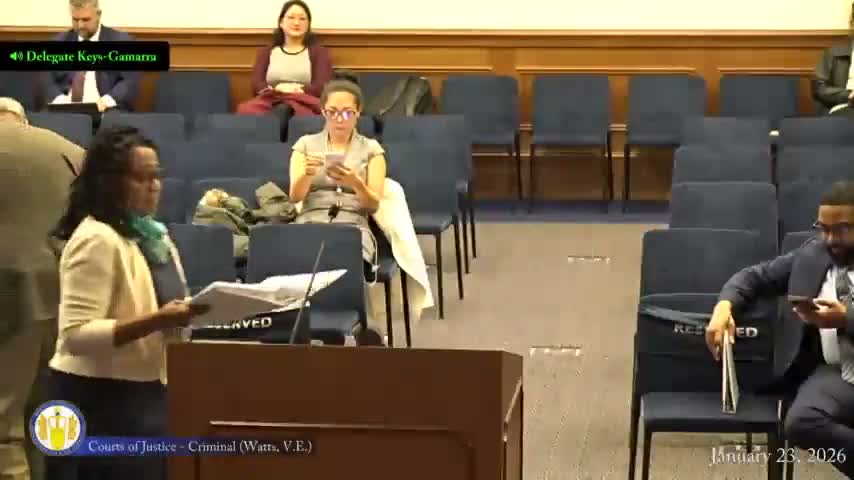
The subcommittee voted to report a substituted and amended version of HB118, which would allow people accused in criminal cases to request copies of discovery materials — including photographs and, by amendment, dash-cam and body-worn camera footage — to aid defense preparation.
Sponsor Delegate Keese Gamora and supporters framed the bill as an access-to-justice measure for defendants who often cannot obtain copies of evidence without significant delay. Allison Powers of the Indigent Defense Commission and public defenders argued that giving counsel copies reduces barriers to representation and lowers the administrative burden of in-person copying. "Electronic discovery was what I signed up to speak in favor of," said Dwayne Baron, a public defender, who said the substitute still improves efficiency by providing copies.
Commonwealth's Attorney Nathan Green and other prosecutors warned that secure electronic transmission can impose costs on local prosecution offices and that sensitive victim materials require safeguards; counsel for the patron and OES agreed to carve out privacy protections in the substitute. Committee counsel also noted a constitutional concern: the substitute provides copies to counsel but may leave pro se defendants without a guaranteed copy, an issue acknowledged but not resolved at the subcommittee.
The committee adopted an amendment explicitly including dash-cam and body-worn footage in the list of discoverable materials and reported the substitute as amended by a recorded vote of 9 to 1.
Sponsor Delegate Keese Gamora and supporters framed the bill as an access-to-justice measure for defendants who often cannot obtain copies of evidence without significant delay. Allison Powers of the Indigent Defense Commission and public defenders argued that giving counsel copies reduces barriers to representation and lowers the administrative burden of in-person copying. "Electronic discovery was what I signed up to speak in favor of," said Dwayne Baron, a public defender, who said the substitute still improves efficiency by providing copies.
Commonwealth's Attorney Nathan Green and other prosecutors warned that secure electronic transmission can impose costs on local prosecution offices and that sensitive victim materials require safeguards; counsel for the patron and OES agreed to carve out privacy protections in the substitute. Committee counsel also noted a constitutional concern: the substitute provides copies to counsel but may leave pro se defendants without a guaranteed copy, an issue acknowledged but not resolved at the subcommittee.
The committee adopted an amendment explicitly including dash-cam and body-worn footage in the list of discoverable materials and reported the substitute as amended by a recorded vote of 9 to 1.
View the Full Meeting & All Its Details
This article offers just a summary. Unlock complete video, transcripts, and insights as a Founder Member.
✓
Watch full, unedited meeting videos
✓
Search every word spoken in unlimited transcripts
✓
AI summaries & real-time alerts (all government levels)
✓
Permanent access to expanding government content
30-day money-back guarantee
