OSU Medical Authority says $8M trauma appropriation will be used as state match for Saint Francis partnership; funds not yet spent
January 22, 2026 | 2026 Legislature OK, Oklahoma
This article was created by AI summarizing key points discussed. AI makes mistakes, so for full details and context, please refer to the video of the full meeting. Please report any errors so we can fix them. Report an error »
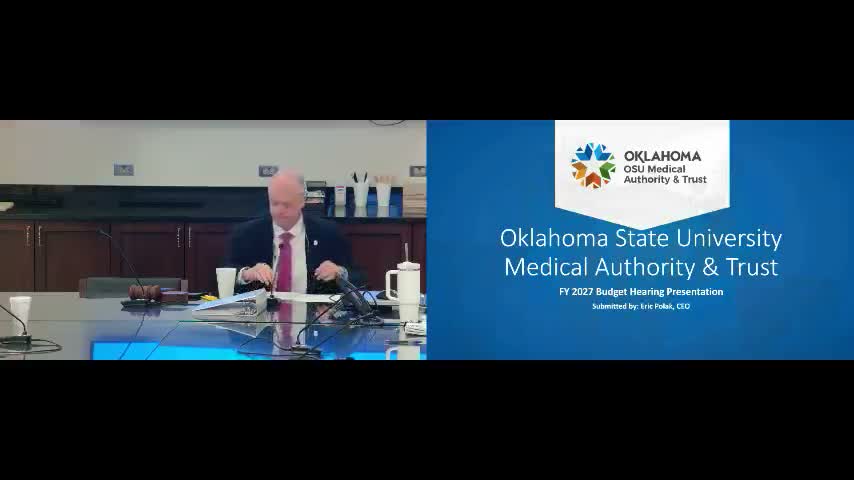
Eric Pollock, CEO of the Oklahoma State University Medical Authority Trust, told the House Appropriations and Budget Subcommittee on Health that the $8 million the Legislature provided for level‑1 trauma training is sitting in the authority’s account and will be used as the state match to draw supplemental Medicaid payments to Saint Francis Health System once approvals are in place. "We haven't spent any of the 8,000,000 yet. It's still sitting in the account," Pollock said.
Pollock framed the choice the authority faced as one between building a standalone level‑1 trauma hospital and partnering with an existing trauma provider. "We'd spend $2,000,000,000 over the next 10 years trying to get there," he told lawmakers, describing the authority’s analysis of the costs and volume required to reach level‑1 status. Pollock said the Legislature’s appropriation would instead support a partnership that embeds residency training at Saint Francis and allows the state to claim supplemental payments through the Oklahoma Health Care Authority (OHCA).
The authority described itself as primarily a pass‑through entity that supports OSU Center for Health Sciences activities, including the Hardesty Center for Clinical Research and Neurosciences. Pollock highlighted recent research successes and capital projects: completed cesarean suites, a new parking garage, nursing logistics centers, and an OSU Medical Center expansion currently estimated at about $200,000,000 that uses multiple funding sources (about $50,000,000 in ARPA funds, $30,000,000 in legacy capital, and $30,000,000 from TSET, with the balance from medical center revenues).
Pollock said the authority is finalizing an affiliation agreement with the U.S. Department of Veterans Affairs around the James Mountain Inhofe VA Medical Center and expects the VA relationship and the medical center expansion to improve training and clinical flow in Tulsa. He also described a psychiatric care center funded in part by ARPA and about $22,000,000 in philanthropy and said the authority is adding psychiatry residency slots tied to the new psychiatric hospital.
Committee members pressed for detail. Representative Stark said she was concerned the appropriation had shifted from the expectation that OSU would itself become a trauma center to a model that uses a partnership at another hospital. Pollock said the decision followed a cost and capacity study and that the partnership model builds training slots more quickly and at much lower public cost.
Pollock told the committee OHCA had not yet received final CMS approval for the supplemental payment pathway and that payments will be made only after statutory requirements and federal approvals are satisfied. He said continuing the program in FY27 would require additional appropriations to maintain the match and keep supplemental payments flowing.
The subcommittee did not vote on any motion during the presentation. Next steps identified by staff and pollock include final OSU Board of Regents approval of affiliation agreements and confirmation from OHCA and CMS before match payments begin.
Pollock framed the choice the authority faced as one between building a standalone level‑1 trauma hospital and partnering with an existing trauma provider. "We'd spend $2,000,000,000 over the next 10 years trying to get there," he told lawmakers, describing the authority’s analysis of the costs and volume required to reach level‑1 status. Pollock said the Legislature’s appropriation would instead support a partnership that embeds residency training at Saint Francis and allows the state to claim supplemental payments through the Oklahoma Health Care Authority (OHCA).
The authority described itself as primarily a pass‑through entity that supports OSU Center for Health Sciences activities, including the Hardesty Center for Clinical Research and Neurosciences. Pollock highlighted recent research successes and capital projects: completed cesarean suites, a new parking garage, nursing logistics centers, and an OSU Medical Center expansion currently estimated at about $200,000,000 that uses multiple funding sources (about $50,000,000 in ARPA funds, $30,000,000 in legacy capital, and $30,000,000 from TSET, with the balance from medical center revenues).
Pollock said the authority is finalizing an affiliation agreement with the U.S. Department of Veterans Affairs around the James Mountain Inhofe VA Medical Center and expects the VA relationship and the medical center expansion to improve training and clinical flow in Tulsa. He also described a psychiatric care center funded in part by ARPA and about $22,000,000 in philanthropy and said the authority is adding psychiatry residency slots tied to the new psychiatric hospital.
Committee members pressed for detail. Representative Stark said she was concerned the appropriation had shifted from the expectation that OSU would itself become a trauma center to a model that uses a partnership at another hospital. Pollock said the decision followed a cost and capacity study and that the partnership model builds training slots more quickly and at much lower public cost.
Pollock told the committee OHCA had not yet received final CMS approval for the supplemental payment pathway and that payments will be made only after statutory requirements and federal approvals are satisfied. He said continuing the program in FY27 would require additional appropriations to maintain the match and keep supplemental payments flowing.
The subcommittee did not vote on any motion during the presentation. Next steps identified by staff and pollock include final OSU Board of Regents approval of affiliation agreements and confirmation from OHCA and CMS before match payments begin.
View the Full Meeting & All Its Details
This article offers just a summary. Unlock complete video, transcripts, and insights as a Founder Member.
✓
Watch full, unedited meeting videos
✓
Search every word spoken in unlimited transcripts
✓
AI summaries & real-time alerts (all government levels)
✓
Permanent access to expanding government content
30-day money-back guarantee
