Aerospace agency asks legislature to preserve PREP funds, highlights statewide hangar and terminal gains
January 20, 2026 | 2026 Legislature OK, Oklahoma
This article was created by AI summarizing key points discussed. AI makes mistakes, so for full details and context, please refer to the video of the full meeting. Please report any errors so we can fix them. Report an error »
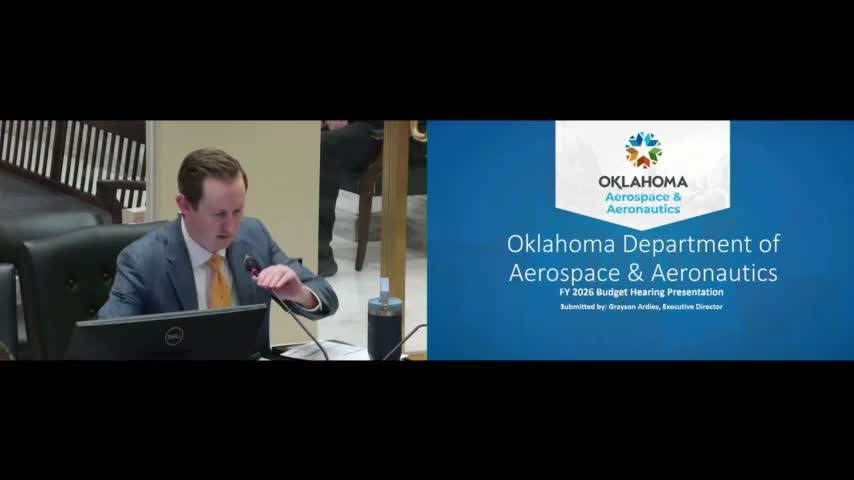
Director Ardies, head of the Oklahoma Department of Aerospace and Aeronautics, told a legislative appropriations subcommittee that the agency is seeking a flat FY26 appropriation but asked lawmakers to move certain one‑time FY25 and PREP funds into a long‑term infrastructure revolving fund to finish multi‑year airport and UAS projects. "It's not my money. It's not your money. It is the taxpayers' money," the chair said in opening remarks, and Ardies repeatedly framed the request as stewardship of public dollars.
Ardies reviewed the department's four priorities—airport infrastructure, industry support, aerospace education and workforce development, and technology integration for unmanned aircraft systems and advanced air mobility—and highlighted recent grant and construction activity. He said the agency awarded $820,000 through its traditional aerospace education grant program to 102 entities as part of an annual $2,000,000 investment in aero education and workforce development. Other recent one‑time investments cited included $16,000,000 for an engine test cell program and $41,000,000 in FY25 for nine airport projects across the state.
On capital work, Ardies listed a string of completed and ongoing projects at airports statewide and at the Oklahoma Air and Space Port in Western Oklahoma: runway and taxiway reconstruction, new and expanded terminal buildings, and 175 hangar units totaling about 610,000 square feet of new hangar space constructed or planned over the past five years. He said 97 of the 175 hangars are T‑hangars and 78 are box hangars, and noted the Will Rogers International Airport MRO facility and an AAR hangar opening among upcoming events.
Ardies also described federal funding dynamics that affect scheduling: FAA grants typically roll in after Congress finalizes appropriations, often in March–May, which can compress construction seasons in states with limited warm months. He explained typical cost‑share arrangements for FAA partnership projects and defined the DBE (disadvantaged business enterprise) requirement for federally funded projects.
Members pressed Ardies on recurring funding. He said the department's recurring appropriations are about $15.05 million, which Ardies broke down as roughly $1.0 million for aerospace education (matched to statutory revenue), $2.5 million for UAS/AAM infrastructure, and about $11.0 million for pro‑growth aviation infrastructure. He asked that certain FY25 one‑time appropriations be placed into a revolving account without expiration so longer‑lead projects could be completed without repeated reauthorization.
Ardies emphasized ongoing efforts to build the aerospace workforce—citing roughly 7,000–8,000 students in aviation curricula statewide and a top ranking for AOPA high school programs—and previewed an updated statewide economic‑impact study he expects to release later in the year.
The subcommittee did not take a formal vote on any appropriation during the hearing; Ardies said staff and members would have follow‑up opportunities to review PREP and pro‑growth project lists in more detail at a subsequent meeting. The hearing adjourned after the OSIDA/spaceport presentation concluded.
Ardies reviewed the department's four priorities—airport infrastructure, industry support, aerospace education and workforce development, and technology integration for unmanned aircraft systems and advanced air mobility—and highlighted recent grant and construction activity. He said the agency awarded $820,000 through its traditional aerospace education grant program to 102 entities as part of an annual $2,000,000 investment in aero education and workforce development. Other recent one‑time investments cited included $16,000,000 for an engine test cell program and $41,000,000 in FY25 for nine airport projects across the state.
On capital work, Ardies listed a string of completed and ongoing projects at airports statewide and at the Oklahoma Air and Space Port in Western Oklahoma: runway and taxiway reconstruction, new and expanded terminal buildings, and 175 hangar units totaling about 610,000 square feet of new hangar space constructed or planned over the past five years. He said 97 of the 175 hangars are T‑hangars and 78 are box hangars, and noted the Will Rogers International Airport MRO facility and an AAR hangar opening among upcoming events.
Ardies also described federal funding dynamics that affect scheduling: FAA grants typically roll in after Congress finalizes appropriations, often in March–May, which can compress construction seasons in states with limited warm months. He explained typical cost‑share arrangements for FAA partnership projects and defined the DBE (disadvantaged business enterprise) requirement for federally funded projects.
Members pressed Ardies on recurring funding. He said the department's recurring appropriations are about $15.05 million, which Ardies broke down as roughly $1.0 million for aerospace education (matched to statutory revenue), $2.5 million for UAS/AAM infrastructure, and about $11.0 million for pro‑growth aviation infrastructure. He asked that certain FY25 one‑time appropriations be placed into a revolving account without expiration so longer‑lead projects could be completed without repeated reauthorization.
Ardies emphasized ongoing efforts to build the aerospace workforce—citing roughly 7,000–8,000 students in aviation curricula statewide and a top ranking for AOPA high school programs—and previewed an updated statewide economic‑impact study he expects to release later in the year.
The subcommittee did not take a formal vote on any appropriation during the hearing; Ardies said staff and members would have follow‑up opportunities to review PREP and pro‑growth project lists in more detail at a subsequent meeting. The hearing adjourned after the OSIDA/spaceport presentation concluded.
Don't Miss a Word: See the Full Meeting!
Go beyond summaries. Unlock every video, transcript, and key insight with a Founder Membership.
✓
Get instant access to full meeting videos
✓
Search and clip any phrase from complete transcripts
✓
Receive AI-powered summaries & custom alerts
✓
Enjoy lifetime, unrestricted access to government data
30-day money-back guarantee
