West Linn council reviews marijuana ban, staff recommends informal outreach before any repeal
January 20, 2026 | West Linn, Clackamas County, Oregon
This article was created by AI summarizing key points discussed. AI makes mistakes, so for full details and context, please refer to the video of the full meeting. Please report any errors so we can fix them. Report an error »
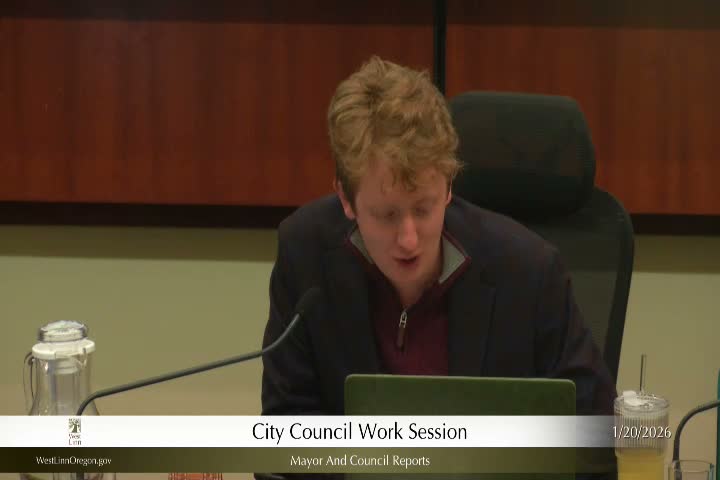
City Manager John opened a work-session briefing on West Linn's prohibition on marijuana facilities on Jan. 20, saying the item was requested during recent budget discussions as the council weighs potential revenue options.
Dylan, a staff analyst, summarized the legal history: Oregon's Measure 91 legalized recreational marijuana in 2014 and the implementing legislation known in the packet as HB 3400 established the state regulatory framework. West Linn passed Ordinance 1644 in 2016, which, after a voter referral, prohibited marijuana facilities in the city. Dylan said that prohibition makes West Linn ineligible for certain state-shared marijuana tax distributions and for local tax revenue from sales until the ban is repealed.
Staff laid out options for council: repeal the prohibition by ordinance, refer the issue to voters at the next statewide general election, or conduct public outreach first to gauge sentiment. Dylan gave a revenue-range example: the state's per-capita distribution could be roughly $40,000 per year for the city (about $1.50 per resident under the staff's estimate), plus a modest annual share-per-license amount and the possibility of a local sales tax if the city chose to adopt one (state law allows up to 3% local tax on recreational marijuana sales). Staff noted these figures are estimates tied to facility sales and population shares and can vary widely by market.
Council members asked detailed questions about past polling, whether the 2016 vote was binding (staff said it was conducted under state law and was the final step then), how many potential sites exist given state setbacks from schools, and whether preexisting local taxes might be grandfathered. Councilor Groner and Councilor Bonnington both said they had spoken with many residents and heard a range of views; Councilor Bright and others noted that local demand and market conditions make new facilities less lucrative in some places.
Dylan and legal staff recommended beginning with low-cost, informal public outreach (SurveyMonkey links, utility-bill outreach, social-media questions, and the city newsletter with QR codes to more information) rather than an immediate ordinance or an expensive statistically valid poll. Council members generally favored testing public sentiment first and asked staff to draft outreach language and return with recommended next steps for a February business meeting.
Because this item was a work-session briefing, no repeal or ordinance vote was taken. The council's direction was to proceed with informal outreach and return formal options to the February packet.
Dylan, a staff analyst, summarized the legal history: Oregon's Measure 91 legalized recreational marijuana in 2014 and the implementing legislation known in the packet as HB 3400 established the state regulatory framework. West Linn passed Ordinance 1644 in 2016, which, after a voter referral, prohibited marijuana facilities in the city. Dylan said that prohibition makes West Linn ineligible for certain state-shared marijuana tax distributions and for local tax revenue from sales until the ban is repealed.
Staff laid out options for council: repeal the prohibition by ordinance, refer the issue to voters at the next statewide general election, or conduct public outreach first to gauge sentiment. Dylan gave a revenue-range example: the state's per-capita distribution could be roughly $40,000 per year for the city (about $1.50 per resident under the staff's estimate), plus a modest annual share-per-license amount and the possibility of a local sales tax if the city chose to adopt one (state law allows up to 3% local tax on recreational marijuana sales). Staff noted these figures are estimates tied to facility sales and population shares and can vary widely by market.
Council members asked detailed questions about past polling, whether the 2016 vote was binding (staff said it was conducted under state law and was the final step then), how many potential sites exist given state setbacks from schools, and whether preexisting local taxes might be grandfathered. Councilor Groner and Councilor Bonnington both said they had spoken with many residents and heard a range of views; Councilor Bright and others noted that local demand and market conditions make new facilities less lucrative in some places.
Dylan and legal staff recommended beginning with low-cost, informal public outreach (SurveyMonkey links, utility-bill outreach, social-media questions, and the city newsletter with QR codes to more information) rather than an immediate ordinance or an expensive statistically valid poll. Council members generally favored testing public sentiment first and asked staff to draft outreach language and return with recommended next steps for a February business meeting.
Because this item was a work-session briefing, no repeal or ordinance vote was taken. The council's direction was to proceed with informal outreach and return formal options to the February packet.
View the Full Meeting & All Its Details
This article offers just a summary. Unlock complete video, transcripts, and insights as a Founder Member.
✓
Watch full, unedited meeting videos
✓
Search every word spoken in unlimited transcripts
✓
AI summaries & real-time alerts (all government levels)
✓
Permanent access to expanding government content
30-day money-back guarantee
