Hundreds tell Milwaukee Fire and Police Commission to probe chief's Israel training, ban exchanges and surveillance tech
January 22, 2026 | Milwaukee , Milwaukee County, Wisconsin
This article was created by AI summarizing key points discussed. AI makes mistakes, so for full details and context, please refer to the video of the full meeting. Please report any errors so we can fix them. Report an error »
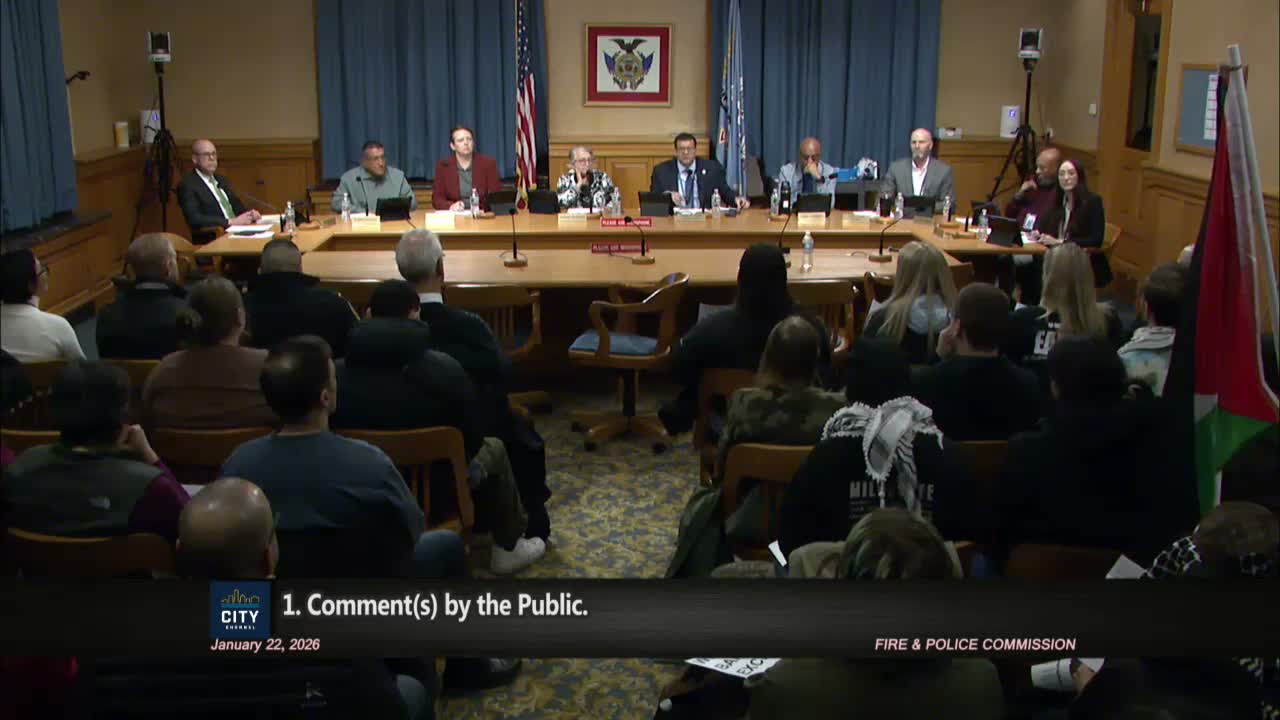
Members of the public packed the Milwaukee Fire and Police Commission meeting on Jan. 22, demanding answers about Milwaukee Police Chief Jeffrey Norman's participation in a counterterrorism training exchange in Israel and calling for limits on police surveillance and vehicle pursuits.
Emilio del Toro, executive director of the Milwaukee Turners at Turner Hall, opened public comment by saying, "Trust in our police department is eroding," and urged the commission to heed residents who say the department has prioritized surveillance and militarized tactics over community safety. Dozens of others echoed his call: organizers, faith leaders and residents described the Israel trip as morally and politically fraught and said it risks importing harsh policing techniques to Milwaukee.
Speakers asked the commission to clarify who recruited and paid for the chief's travel, requested a public itinerary and demanded a policy change to forbid training exchanges and technology transfers with Israeli military or security agencies. "We are demanding an immediate and permanent end to all the policy trainings, technology sharing, and exchanges between MPD and Israeli military forces," said Heba Mohammed of Milwaukee for Palestine.
Several residents tied the training and surveillance concerns to local policing practices. Tiffany Stark, a mental health social worker, described a family tragedy connected to a police vehicle pursuit and urged the commission to change SOP 660 so that high-speed chases end except in extreme life-threatening situations. Community organizers warned that Flock Safety cameras and facial recognition raise privacy and civil-rights risks and could be used by federal agencies such as ICE.
In brief responses, the commission's staff said the chief provided advance out-of-office notice; the chair added, "My understanding is that public funds were not used for that trip." Commissioners acknowledged gaps in notice content and oversight and said they would look into how travel and training notifications are documented and made public. The director said the notification is a public record and will be provided to requesters.
The meeting record shows a sustained public demand for formal action: calls for a ban on exchanges with Israeli forces, detailed public disclosure of the chief's trip, and stronger limits on pursuit policy and surveillance purchases. Several speakers asked the commission to forward formal recommendations to the common council.
Emilio del Toro, executive director of the Milwaukee Turners at Turner Hall, opened public comment by saying, "Trust in our police department is eroding," and urged the commission to heed residents who say the department has prioritized surveillance and militarized tactics over community safety. Dozens of others echoed his call: organizers, faith leaders and residents described the Israel trip as morally and politically fraught and said it risks importing harsh policing techniques to Milwaukee.
Speakers asked the commission to clarify who recruited and paid for the chief's travel, requested a public itinerary and demanded a policy change to forbid training exchanges and technology transfers with Israeli military or security agencies. "We are demanding an immediate and permanent end to all the policy trainings, technology sharing, and exchanges between MPD and Israeli military forces," said Heba Mohammed of Milwaukee for Palestine.
Several residents tied the training and surveillance concerns to local policing practices. Tiffany Stark, a mental health social worker, described a family tragedy connected to a police vehicle pursuit and urged the commission to change SOP 660 so that high-speed chases end except in extreme life-threatening situations. Community organizers warned that Flock Safety cameras and facial recognition raise privacy and civil-rights risks and could be used by federal agencies such as ICE.
In brief responses, the commission's staff said the chief provided advance out-of-office notice; the chair added, "My understanding is that public funds were not used for that trip." Commissioners acknowledged gaps in notice content and oversight and said they would look into how travel and training notifications are documented and made public. The director said the notification is a public record and will be provided to requesters.
The meeting record shows a sustained public demand for formal action: calls for a ban on exchanges with Israeli forces, detailed public disclosure of the chief's trip, and stronger limits on pursuit policy and surveillance purchases. Several speakers asked the commission to forward formal recommendations to the common council.
View the Full Meeting & All Its Details
This article offers just a summary. Unlock complete video, transcripts, and insights as a Founder Member.
✓
Watch full, unedited meeting videos
✓
Search every word spoken in unlimited transcripts
✓
AI summaries & real-time alerts (all government levels)
✓
Permanent access to expanding government content
30-day money-back guarantee
