Housing Authority review recommends clearer lines between HACM and Treveaux, proposes HR and COO changes
January 21, 2026 | Milwaukee , Milwaukee County, Wisconsin
This article was created by AI summarizing key points discussed. AI makes mistakes, so for full details and context, please refer to the video of the full meeting. Please report any errors so we can fix them. Report an error »
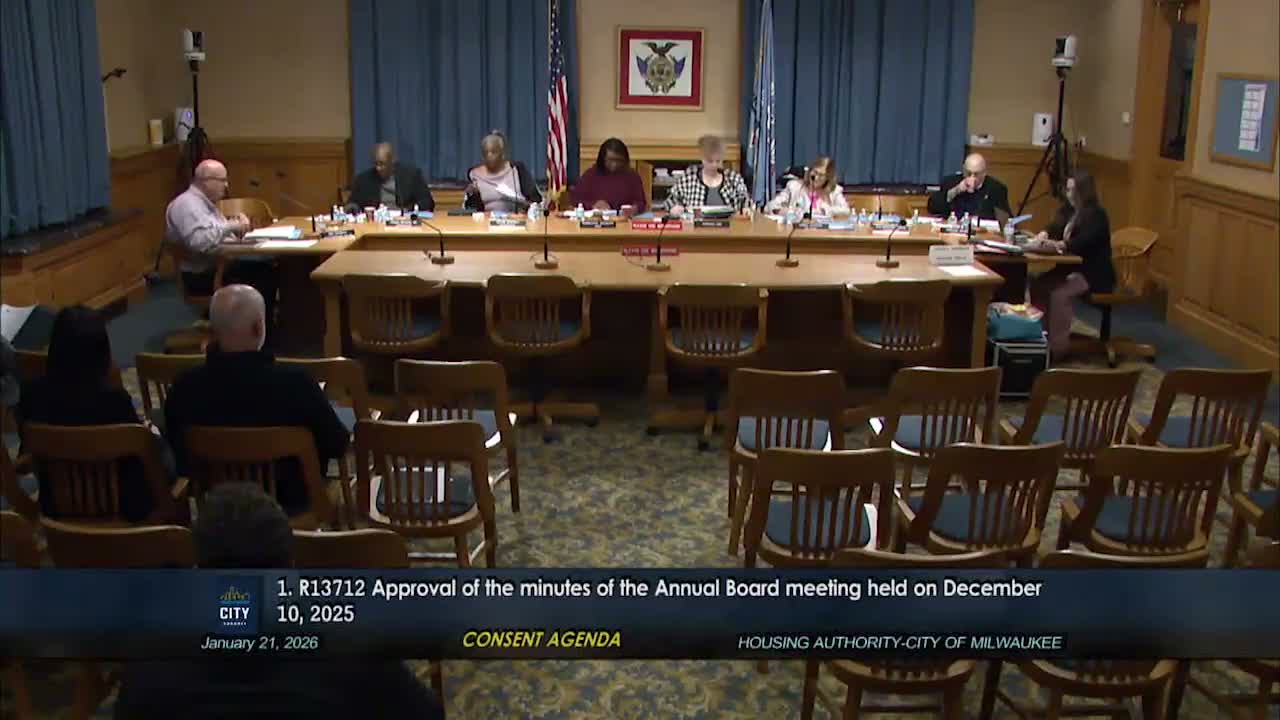
Ken Barbot, acting secretary/executive director (as identified in the record) presented initial findings from an organizational-structure review conducted by Management Resources Associates (MRA), saying the study was contracted in April 2025 under HACM’s HUD sustainability-plan corrective actions. Barbot told commissioners MRA identified “blurred lines of authority” where Treveaux employees and HACM employees perform similar duties under different pay and benefit structures.
The report singled out Treveaux — the authority’s instrumentality that employs a substantial share of on-the-ground staff — as a principal source of confusion. “When you hire people, there are people that are employees of HACM and people that are employees of Treveaux, and sometimes they’re doing the exact same thing with the same title,” Barbot said, summarizing MRA’s findings and noting that the arrangement has complicated payroll and accounting.
Why it matters: Commissioners were told the overlap has produced inconsistent titles and workload distribution across property management, leasing, compliance and maintenance, and that payroll and cost-allocation issues can distort central-office cost percentages under HUD asset-management rules.
Main recommendations and staff response: MRA recommended several steps for the board to consider, including 1) evaluating whether to assign most employees to a single entity rather than split payrolls, 2) expanding the Human Resources team (staff said HR currently has two employees and MRA suggested at least three), 3) revamping executive reporting by creating or clarifying a chief operating officer position to supervise property management, leasing, compliance, maintenance and voucher-contract oversight, and 4) strengthening maintenance oversight by centralizing supervision and using Yardi’s work-order tools to measure productivity and properly charge work to developments.
Barbot and Todd Slusser, HACM’s senior HR business partner, cautioned that moving all staff to a single employer would be complex and should be phased in only after careful study of titles, salary bands, benefit enrollment windows and cost-allocation implications. “That is a complicated procedure as well,” Barbot said, noting the need to anticipate job titles, salary structure and benefit impacts before “flipping that switch.”
Commissioner reactions and follow-up: Commissioners pressed for additional detail. Commissioner Snyder said detailed org-chart work is best handled by a small committee rather than the full board, asking staff and a vice chair to vet options and return recommendations. Commissioner Nelson — who identified himself in the record as a resident of Arlington Court — framed the organizational discussion in resident-service terms, urging remedies for inconsistent cleanliness and maintenance delivery at specific developments.
Immediate staff actions: Management said it will circulate MRA’s materials to commissioners for review and will follow up with specific property managers about resident complaints. Staff also committed to share the ambassador-program selection criteria and a list of developments with active ambassador programs; the board asked for that data to identify gaps.
Next steps: Barbot asked commissioners to review MRA’s report over the next two weeks and return feedback to staff; some changes will be implemented promptly while others may await appointment of a new executive director or alignment with an open benefits-enrollment period. Barbot said the authority intends to incorporate commissioner feedback and submit final responses to HUD as part of the sustainability-plan process.
Ending: The board did not take a formal vote on the MRA recommendations at the meeting but approved a process for staff and a small group of commissioners to refine options and return with recommended implementation steps.
The report singled out Treveaux — the authority’s instrumentality that employs a substantial share of on-the-ground staff — as a principal source of confusion. “When you hire people, there are people that are employees of HACM and people that are employees of Treveaux, and sometimes they’re doing the exact same thing with the same title,” Barbot said, summarizing MRA’s findings and noting that the arrangement has complicated payroll and accounting.
Why it matters: Commissioners were told the overlap has produced inconsistent titles and workload distribution across property management, leasing, compliance and maintenance, and that payroll and cost-allocation issues can distort central-office cost percentages under HUD asset-management rules.
Main recommendations and staff response: MRA recommended several steps for the board to consider, including 1) evaluating whether to assign most employees to a single entity rather than split payrolls, 2) expanding the Human Resources team (staff said HR currently has two employees and MRA suggested at least three), 3) revamping executive reporting by creating or clarifying a chief operating officer position to supervise property management, leasing, compliance, maintenance and voucher-contract oversight, and 4) strengthening maintenance oversight by centralizing supervision and using Yardi’s work-order tools to measure productivity and properly charge work to developments.
Barbot and Todd Slusser, HACM’s senior HR business partner, cautioned that moving all staff to a single employer would be complex and should be phased in only after careful study of titles, salary bands, benefit enrollment windows and cost-allocation implications. “That is a complicated procedure as well,” Barbot said, noting the need to anticipate job titles, salary structure and benefit impacts before “flipping that switch.”
Commissioner reactions and follow-up: Commissioners pressed for additional detail. Commissioner Snyder said detailed org-chart work is best handled by a small committee rather than the full board, asking staff and a vice chair to vet options and return recommendations. Commissioner Nelson — who identified himself in the record as a resident of Arlington Court — framed the organizational discussion in resident-service terms, urging remedies for inconsistent cleanliness and maintenance delivery at specific developments.
Immediate staff actions: Management said it will circulate MRA’s materials to commissioners for review and will follow up with specific property managers about resident complaints. Staff also committed to share the ambassador-program selection criteria and a list of developments with active ambassador programs; the board asked for that data to identify gaps.
Next steps: Barbot asked commissioners to review MRA’s report over the next two weeks and return feedback to staff; some changes will be implemented promptly while others may await appointment of a new executive director or alignment with an open benefits-enrollment period. Barbot said the authority intends to incorporate commissioner feedback and submit final responses to HUD as part of the sustainability-plan process.
Ending: The board did not take a formal vote on the MRA recommendations at the meeting but approved a process for staff and a small group of commissioners to refine options and return with recommended implementation steps.
Don't Miss a Word: See the Full Meeting!
Go beyond summaries. Unlock every video, transcript, and key insight with a Founder Membership.
✓
Get instant access to full meeting videos
✓
Search and clip any phrase from complete transcripts
✓
Receive AI-powered summaries & custom alerts
✓
Enjoy lifetime, unrestricted access to government data
30-day money-back guarantee
