HACM board receives five finalists for executive director search, votes to go into closed session
January 21, 2026 | Milwaukee , Milwaukee County, Wisconsin
This article was created by AI summarizing key points discussed. AI makes mistakes, so for full details and context, please refer to the video of the full meeting. Please report any errors so we can fix them. Report an error »
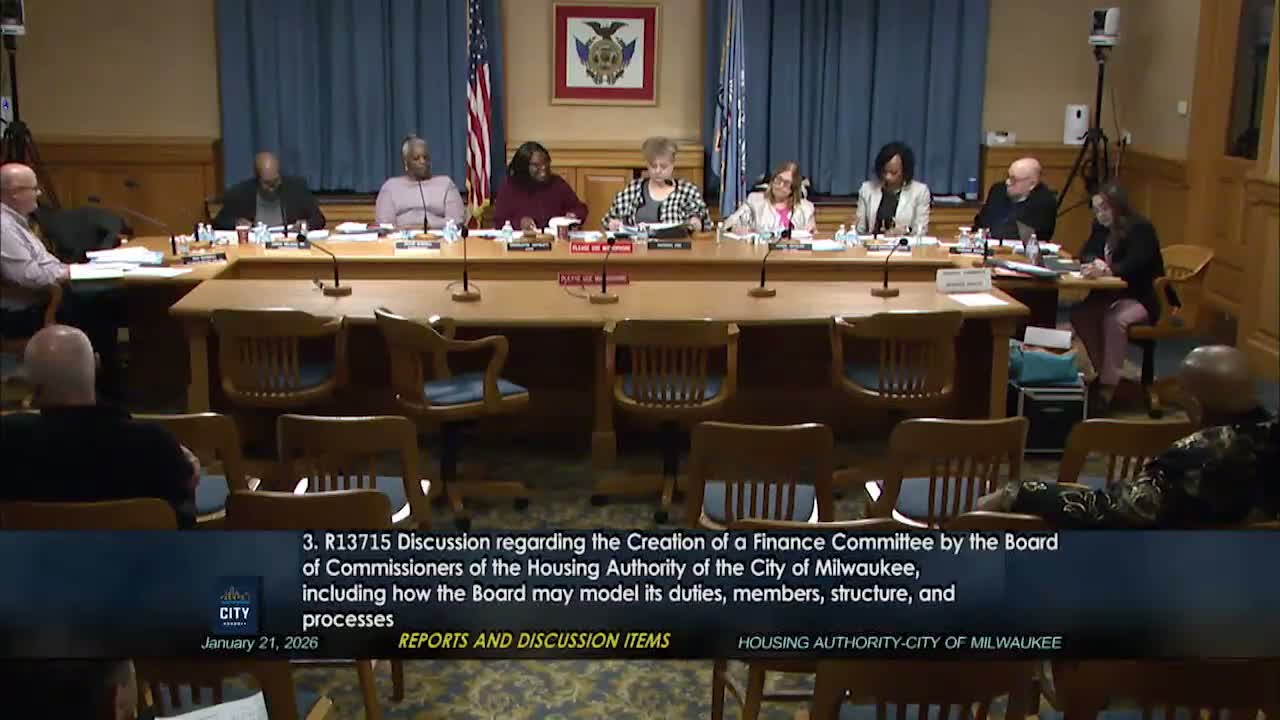
The Housing Authority’s executive-search committee told commissioners it screened 19 applicants and recommended five finalists for board consideration: Bertie Couser, Harold Insay, Keon Jackson, Ralph Jordan and Rick Toney. Patty (staff) and recruiter Stan Quay briefed the board on process, timeline and background checks.
Stan Quay, the search consultant, told commissioners that the typical finalist process includes reference interviews, employment and academic verifications and criminal/credit screening through a professional screening firm. Quay said two situations previously reported in local media — disagreements or lawsuits at prior employers involving one or two applicants — were shared with the committee and discussed; Quay said the committee had varying comfort levels depending on the context and that detailed background checks would follow before any final selection.
Legal guidance and board action: City Attorney Greg Cruz advised the board on the appropriate use of the closed-session exception for discussing individual candidates under Wisconsin Statutes 19.85(1)(c) and said the committee’s role is advisory while final hiring authority rests with the board. Following that guidance, commissioners moved and voted to convene in closed session to evaluate applicants; roll-call votes to enter closed session were recorded.
Process next steps: In open session after the closed-session period, staff and the recruiter described a planned second-round process: bring finalists to Milwaukee for community engagement (stakeholder focus groups, staff/resident meetings), a portfolio tour, a time-limited action-plan exercise about HUD recovery-agreement priorities, and a 1.5–2 hour board interview with scored questions. Commissioners discussed budgetary constraints and whether to narrow the list of finalists (some favored two or three finalists to reduce travel costs). Several commissioners requested background checks on the finalists prior to final selection; the city attorney noted public-records requests for background checks would require legal review and a public-policy balancing test under Wisconsin law.
Timing and schedule: Staff asked commissioners to send availability for a special meeting within about a week to decide which finalists to advance; staff stated a goal of making an offer by mid-February if the process proceeds quickly but acknowledged candidate notice periods could delay start dates.
Ending: The board moved to amend a draft resolution to list all five finalist names, voted to receive the committee’s recommendations, and tasked staff to schedule the special meeting and to provide the packet materials, background-check procedures and suggested stakeholder lists ahead of finalist community visits.
Stan Quay, the search consultant, told commissioners that the typical finalist process includes reference interviews, employment and academic verifications and criminal/credit screening through a professional screening firm. Quay said two situations previously reported in local media — disagreements or lawsuits at prior employers involving one or two applicants — were shared with the committee and discussed; Quay said the committee had varying comfort levels depending on the context and that detailed background checks would follow before any final selection.
Legal guidance and board action: City Attorney Greg Cruz advised the board on the appropriate use of the closed-session exception for discussing individual candidates under Wisconsin Statutes 19.85(1)(c) and said the committee’s role is advisory while final hiring authority rests with the board. Following that guidance, commissioners moved and voted to convene in closed session to evaluate applicants; roll-call votes to enter closed session were recorded.
Process next steps: In open session after the closed-session period, staff and the recruiter described a planned second-round process: bring finalists to Milwaukee for community engagement (stakeholder focus groups, staff/resident meetings), a portfolio tour, a time-limited action-plan exercise about HUD recovery-agreement priorities, and a 1.5–2 hour board interview with scored questions. Commissioners discussed budgetary constraints and whether to narrow the list of finalists (some favored two or three finalists to reduce travel costs). Several commissioners requested background checks on the finalists prior to final selection; the city attorney noted public-records requests for background checks would require legal review and a public-policy balancing test under Wisconsin law.
Timing and schedule: Staff asked commissioners to send availability for a special meeting within about a week to decide which finalists to advance; staff stated a goal of making an offer by mid-February if the process proceeds quickly but acknowledged candidate notice periods could delay start dates.
Ending: The board moved to amend a draft resolution to list all five finalist names, voted to receive the committee’s recommendations, and tasked staff to schedule the special meeting and to provide the packet materials, background-check procedures and suggested stakeholder lists ahead of finalist community visits.
View the Full Meeting & All Its Details
This article offers just a summary. Unlock complete video, transcripts, and insights as a Founder Member.
✓
Watch full, unedited meeting videos
✓
Search every word spoken in unlimited transcripts
✓
AI summaries & real-time alerts (all government levels)
✓
Permanent access to expanding government content
30-day money-back guarantee
