Commission debates outcome‑based performance metrics and resident dashboard; city manager says foundation exists
January 21, 2026 | Hallandale Beach, Broward County, Florida
This article was created by AI summarizing key points discussed. AI makes mistakes, so for full details and context, please refer to the video of the full meeting. Please report any errors so we can fix them. Report an error »
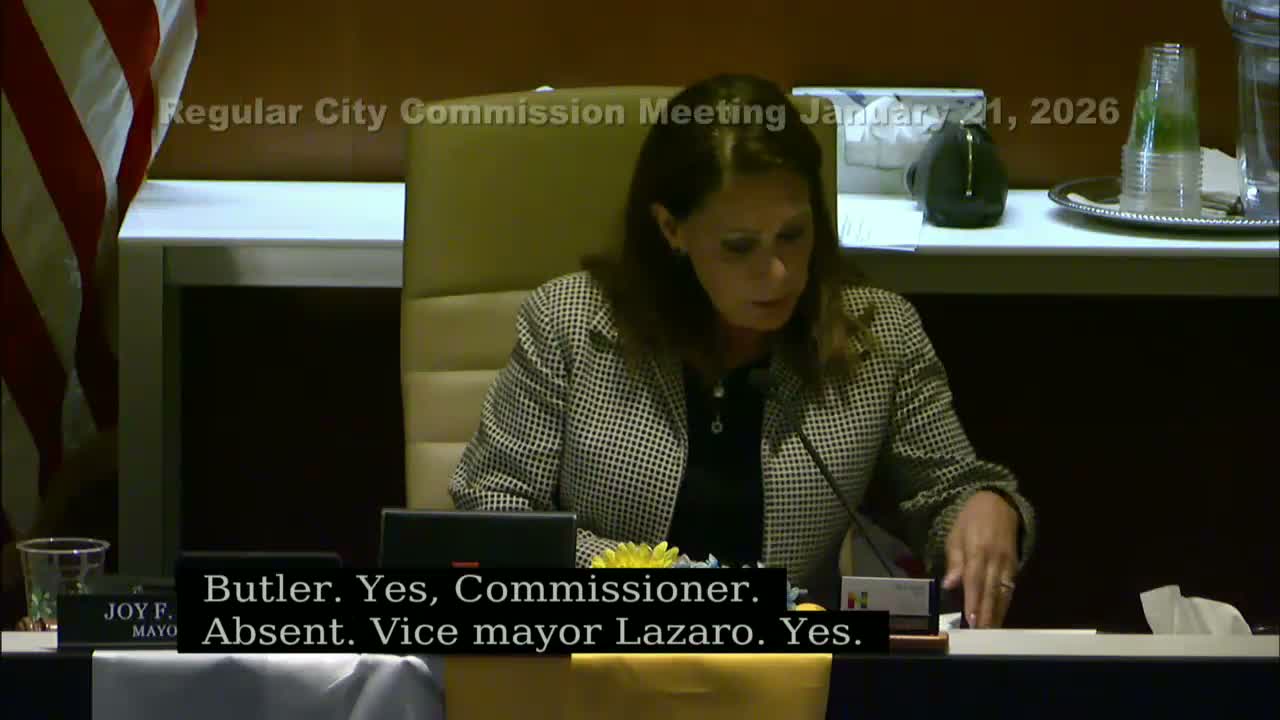
Commissioner Blake Butler opened a broad discussion asking the city to define outcome‑based performance metrics so residents can see how activity translates into measurable results. He said residents consistently name traffic, flooding (stormwater) and city appearance as top priorities and asked for metrics that translate projects into visible outcomes.
City Manager Doctor Earl said the city had used KPIs previously (until 2020), has resumed resident surveys to create a baseline, and has begun work on updating KPIs tied to the strategic plan. He described recent work on signalization along U.S. 1 and Hallandale Beach Boulevard and noted that some base data are still being gathered: "We are now into year 5 of a program in which we have been fixing all the legacy issues... While we are fixing those legacy issues... we began to then... do things like strategic plans that we could begin to tie metrics and data to."
Commissioners discussed practical examples — measuring decreased wait times at priority intersections, tree‑cover targets tied to tree plantings, and marketing/public information to help residents notice results. Commissioner Butler said a one‑year demonstration of measurable improvement in the three priority areas was a reasonable expectation and noted that many of the data points exist but must be presented accessibly. Several commissioners suggested pilot efforts, vendor partnerships, or outsourcing marketing if the city cannot immediately fill a PIO vacancy.
Dr. Earl and staff said they would continue work on the KPIs and dashboard, coordinate with departments, explore procurement (RFP) or outside support where necessary, and use resident surveys as a baseline for measuring progress. No formal policy vote or budget appropriation for a new KPI program was recorded in the meeting; commissioners asked staff for follow‑up and clearer targets.
City Manager Doctor Earl said the city had used KPIs previously (until 2020), has resumed resident surveys to create a baseline, and has begun work on updating KPIs tied to the strategic plan. He described recent work on signalization along U.S. 1 and Hallandale Beach Boulevard and noted that some base data are still being gathered: "We are now into year 5 of a program in which we have been fixing all the legacy issues... While we are fixing those legacy issues... we began to then... do things like strategic plans that we could begin to tie metrics and data to."
Commissioners discussed practical examples — measuring decreased wait times at priority intersections, tree‑cover targets tied to tree plantings, and marketing/public information to help residents notice results. Commissioner Butler said a one‑year demonstration of measurable improvement in the three priority areas was a reasonable expectation and noted that many of the data points exist but must be presented accessibly. Several commissioners suggested pilot efforts, vendor partnerships, or outsourcing marketing if the city cannot immediately fill a PIO vacancy.
Dr. Earl and staff said they would continue work on the KPIs and dashboard, coordinate with departments, explore procurement (RFP) or outside support where necessary, and use resident surveys as a baseline for measuring progress. No formal policy vote or budget appropriation for a new KPI program was recorded in the meeting; commissioners asked staff for follow‑up and clearer targets.
View the Full Meeting & All Its Details
This article offers just a summary. Unlock complete video, transcripts, and insights as a Founder Member.
✓
Watch full, unedited meeting videos
✓
Search every word spoken in unlimited transcripts
✓
AI summaries & real-time alerts (all government levels)
✓
Permanent access to expanding government content
30-day money-back guarantee
