Bill Would Give Local Budget Authorities a Final Say on 287(g) Agreements; Lawmakers Split on Fiscal Control vs. Operational Impact
January 22, 2026 | Criminal Justice and Public Safety, House of Representatives, Committees , Legislative, New Hampshire
This article was created by AI summarizing key points discussed. AI makes mistakes, so for full details and context, please refer to the video of the full meeting. Please report any errors so we can fix them. Report an error »
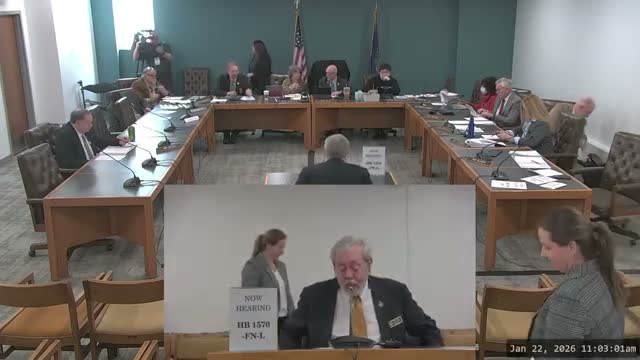
Representative Buzz Schur (Rockingham 26) introduced HB1570, which would make a municipality’s final budget authority — whether a board of selectmen, city council, or county commissioners — the deciding body for whether local law enforcement funds participation in a 287(g) agreement with ICE. Schur emphasized the proposal is fiscal in purpose: towns should not be required to subsidize federal immigration enforcement.
The committee heard extensive testimony from legislators, municipal officials and residents both for and against the proposal. Supporters argued that local budgetary control gives residents and elected local bodies the power to decline funding for activities they do not want the town to subsidize. Representative Paige Beauchampagne (Nashua Ward 4) and residents described fear in immigrant communities and urged local control to reduce community tension.
Opponents — including some members of law enforcement and committee members — cautioned that 287(g) participation, reimbursement practices and roles vary by agreement. Representative Shurer and others said some agencies have received equipment or other benefits and that recent changes have introduced reimbursements that could alter the bill’s practical effects. The chair noted there are roughly a dozen agencies in the state that participate in some form of 287(g), and some county agreements may carry municipal obligations. Several members suggested the bill may be best pursued with targeted language that accounts for existing county‑level arrangements and reimbursement practices.
During the day’s executive sessions the committee later voted to move the bill forward on an expedited legislative timetable (see actions), indicating that members want further work but also timely movement through committee.
What’s next: Committee staff and the sponsor indicated they will prepare a report and possible language to clarify fiscal scope and interactions with county and vendor reimbursements before further floor action.
The committee heard extensive testimony from legislators, municipal officials and residents both for and against the proposal. Supporters argued that local budgetary control gives residents and elected local bodies the power to decline funding for activities they do not want the town to subsidize. Representative Paige Beauchampagne (Nashua Ward 4) and residents described fear in immigrant communities and urged local control to reduce community tension.
Opponents — including some members of law enforcement and committee members — cautioned that 287(g) participation, reimbursement practices and roles vary by agreement. Representative Shurer and others said some agencies have received equipment or other benefits and that recent changes have introduced reimbursements that could alter the bill’s practical effects. The chair noted there are roughly a dozen agencies in the state that participate in some form of 287(g), and some county agreements may carry municipal obligations. Several members suggested the bill may be best pursued with targeted language that accounts for existing county‑level arrangements and reimbursement practices.
During the day’s executive sessions the committee later voted to move the bill forward on an expedited legislative timetable (see actions), indicating that members want further work but also timely movement through committee.
What’s next: Committee staff and the sponsor indicated they will prepare a report and possible language to clarify fiscal scope and interactions with county and vendor reimbursements before further floor action.
View the Full Meeting & All Its Details
This article offers just a summary. Unlock complete video, transcripts, and insights as a Founder Member.
✓
Watch full, unedited meeting videos
✓
Search every word spoken in unlimited transcripts
✓
AI summaries & real-time alerts (all government levels)
✓
Permanent access to expanding government content
30-day money-back guarantee
