Committee hears detailed testimony on bill to license massage establishments as tool against trafficking
January 21, 2026 | Executive Departments and Administration, House of Representatives, Committees , Legislative, New Hampshire
This article was created by AI summarizing key points discussed. AI makes mistakes, so for full details and context, please refer to the video of the full meeting. Please report any errors so we can fix them. Report an error »
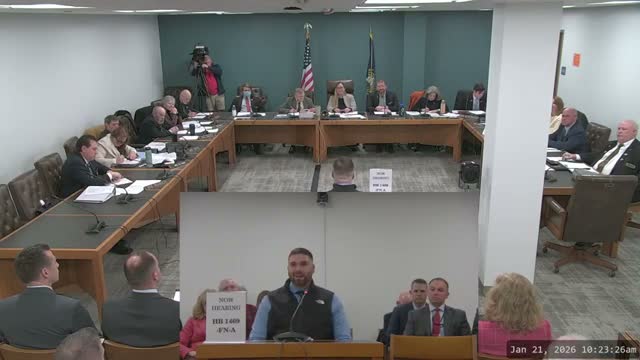
CONCORD, N.H. — Lawmakers on the House Executive Departments and Administration Committee heard hours of testimony Jan. 21 on House Bill 1469, which would require the state to license massage establishments and give regulators inspection and enforcement authority to address illicit massage businesses that investigators say are frequently fronts for sexual exploitation and human trafficking.
Representative Charlie Foote (R-Rockingham) opened the hearing by calling the measure "a human trafficking bill," saying New Hampshire currently licenses individual massage therapists but not the businesses where some victims are exploited. "Right now in New Hampshire, we only license individual massage therapists. We do not license the business themselves. This is a major gap in enforcement," Foote said. "This bill will require massage establishments to be licensed by OPLC. It will give the state the authority to inspect these businesses for health, safety, and legal compliance." (Representative Charlie Foote)
The bill proposes establishment licensure and inspection by the Office of Professional Licensure and Certification, new enforcement tools and penalties for operating without a license, and funding for an investigative position to support enforcement. Foote said the measure would also protect legitimate therapists by creating uniform standards statewide.
Law-enforcement witnesses described how illicit operations evade criminal prosecution and how licensing could help. Detective Sergeant Charlie Pendleberry of the Merrimack County Sheriff's Office, a former member of the state's human-trafficking task force, told the committee that current misdemeanor penalties are insufficient and that illicit shops routinely rotate workers, operate behind blackout windows and advertise on online platforms to avoid detection. "A misdemeanor crime for facilitating a house of prostitution, it's a joke," Pendleberry said. "They're just going to keep popping up and putting shops wherever they can." (Detective Sergeant Charlie Pendleberry)
Derry town officials and police described local experience shutting multiple shops. Michael Fowler, Derry town administrator, said the town used a local ordinance adopted in 2023 to close six of eight active facilities in 2025 but that operators quickly refile under new names or move locations. "They go through the back door to try to become somebody else's issue," Fowler said, citing vendors rotating personnel and re-forming under new LLCs. (Michael Fowler)
Lieutenant Jonathan Breen of the Derry Police Department testified that establishment licensure would create an additional administrative pathway for inspectors to identify irregularities and refer suspected criminal activity to law enforcement. "Providing licensing and regulated oversight to massage establishments would give inspectors a critical tool in identifying fraudulent and illegal activity," Breen testified on behalf of the Derry Police Chief and the New Hampshire Association of Chiefs of Police. (Lieutenant Jonathan Breen)
The Attorney General's office urged a multi-pronged approach. Assistant Attorney General Alex Kellerman told lawmakers that Department of Justice efforts such as a landlord-engagement program already closed roughly 40% of suspected illicit businesses the department had identified. Kellerman said licensure would add information and inspection access that would aid criminal investigators. "This legislation would be an important step, but it would be an important tool," Kellerman said. (Alex Kellerman)
The Office of Professional Licensure and Certification (OPLC) did not take a formal position but raised technical concerns about statutory alignment and funding; Executive Director Deanna Juris urged changes so the bill fits the office's existing statutory structure and recommended that any new positions be funded through licensing fees rather than the general fund. Juris also asked for clarity on whether municipal ordinances such as Derry's would be grandfathered and on renewal and grandfathering mechanics. (Deanna Juris)
Advocacy groups and survivors spoke in favor of the bill. Testimony included national and local victim-services leaders who described exploitation patterns and urged regulatory tools to increase victim identification and safety. "This bill's strength is that it creates a regulatory presence before harm occurs, allowing concerns to be identified early and referred appropriately," Representative Jody Nelson said in support. Survivor advocates said stronger regulation deters buyers and helps victims access services.
Committee members asked repeatedly how establishment licensure would interact with criminal investigations and whether administrative inspections could improperly substitute for police searches. Law-enforcement witnesses said inspectors could refer findings to police and that investigators still must meet constitutional probable-cause standards for warrants. Several representatives signaled interest in sending the bill to subcommittee to resolve statutory and funding questions.
What happens next: The committee recessed the hearing after testimony and questions; sponsors and OPLC staff signaled willingness to work on technical fixes and subcommittee review. No final committee vote on HB 1469 was recorded in this hearing.
Sources: Testimony Jan. 21 before the House Executive Departments and Administration Committee; Representative Charlie Foote; Detective Sergeant Charlie Pendleberry; Lieutenant Jonathan Breen; Michael Fowler; Assistant Attorney General Alex Kellerman; Deanna Juris, OPLC.
Ending: The committee will consider technical clarifications and may refer HB 1469 to subcommittee for drafting changes addressing statutory fit, grandfathering language and the funding mechanism for new enforcement positions.
Representative Charlie Foote (R-Rockingham) opened the hearing by calling the measure "a human trafficking bill," saying New Hampshire currently licenses individual massage therapists but not the businesses where some victims are exploited. "Right now in New Hampshire, we only license individual massage therapists. We do not license the business themselves. This is a major gap in enforcement," Foote said. "This bill will require massage establishments to be licensed by OPLC. It will give the state the authority to inspect these businesses for health, safety, and legal compliance." (Representative Charlie Foote)
The bill proposes establishment licensure and inspection by the Office of Professional Licensure and Certification, new enforcement tools and penalties for operating without a license, and funding for an investigative position to support enforcement. Foote said the measure would also protect legitimate therapists by creating uniform standards statewide.
Law-enforcement witnesses described how illicit operations evade criminal prosecution and how licensing could help. Detective Sergeant Charlie Pendleberry of the Merrimack County Sheriff's Office, a former member of the state's human-trafficking task force, told the committee that current misdemeanor penalties are insufficient and that illicit shops routinely rotate workers, operate behind blackout windows and advertise on online platforms to avoid detection. "A misdemeanor crime for facilitating a house of prostitution, it's a joke," Pendleberry said. "They're just going to keep popping up and putting shops wherever they can." (Detective Sergeant Charlie Pendleberry)
Derry town officials and police described local experience shutting multiple shops. Michael Fowler, Derry town administrator, said the town used a local ordinance adopted in 2023 to close six of eight active facilities in 2025 but that operators quickly refile under new names or move locations. "They go through the back door to try to become somebody else's issue," Fowler said, citing vendors rotating personnel and re-forming under new LLCs. (Michael Fowler)
Lieutenant Jonathan Breen of the Derry Police Department testified that establishment licensure would create an additional administrative pathway for inspectors to identify irregularities and refer suspected criminal activity to law enforcement. "Providing licensing and regulated oversight to massage establishments would give inspectors a critical tool in identifying fraudulent and illegal activity," Breen testified on behalf of the Derry Police Chief and the New Hampshire Association of Chiefs of Police. (Lieutenant Jonathan Breen)
The Attorney General's office urged a multi-pronged approach. Assistant Attorney General Alex Kellerman told lawmakers that Department of Justice efforts such as a landlord-engagement program already closed roughly 40% of suspected illicit businesses the department had identified. Kellerman said licensure would add information and inspection access that would aid criminal investigators. "This legislation would be an important step, but it would be an important tool," Kellerman said. (Alex Kellerman)
The Office of Professional Licensure and Certification (OPLC) did not take a formal position but raised technical concerns about statutory alignment and funding; Executive Director Deanna Juris urged changes so the bill fits the office's existing statutory structure and recommended that any new positions be funded through licensing fees rather than the general fund. Juris also asked for clarity on whether municipal ordinances such as Derry's would be grandfathered and on renewal and grandfathering mechanics. (Deanna Juris)
Advocacy groups and survivors spoke in favor of the bill. Testimony included national and local victim-services leaders who described exploitation patterns and urged regulatory tools to increase victim identification and safety. "This bill's strength is that it creates a regulatory presence before harm occurs, allowing concerns to be identified early and referred appropriately," Representative Jody Nelson said in support. Survivor advocates said stronger regulation deters buyers and helps victims access services.
Committee members asked repeatedly how establishment licensure would interact with criminal investigations and whether administrative inspections could improperly substitute for police searches. Law-enforcement witnesses said inspectors could refer findings to police and that investigators still must meet constitutional probable-cause standards for warrants. Several representatives signaled interest in sending the bill to subcommittee to resolve statutory and funding questions.
What happens next: The committee recessed the hearing after testimony and questions; sponsors and OPLC staff signaled willingness to work on technical fixes and subcommittee review. No final committee vote on HB 1469 was recorded in this hearing.
Sources: Testimony Jan. 21 before the House Executive Departments and Administration Committee; Representative Charlie Foote; Detective Sergeant Charlie Pendleberry; Lieutenant Jonathan Breen; Michael Fowler; Assistant Attorney General Alex Kellerman; Deanna Juris, OPLC.
Ending: The committee will consider technical clarifications and may refer HB 1469 to subcommittee for drafting changes addressing statutory fit, grandfathering language and the funding mechanism for new enforcement positions.
Don't Miss a Word: See the Full Meeting!
Go beyond summaries. Unlock every video, transcript, and key insight with a Founder Membership.
✓
Get instant access to full meeting videos
✓
Search and clip any phrase from complete transcripts
✓
Receive AI-powered summaries & custom alerts
✓
Enjoy lifetime, unrestricted access to government data
30-day money-back guarantee
