Committee Hears Push to Loosen CPA Pathway as Firms Struggle to Replace Retirements
January 22, 2026 | Executive Departments and Administration, House of Representatives, Committees , Legislative, New Hampshire
This article was created by AI summarizing key points discussed. AI makes mistakes, so for full details and context, please refer to the video of the full meeting. Please report any errors so we can fix them. Report an error »
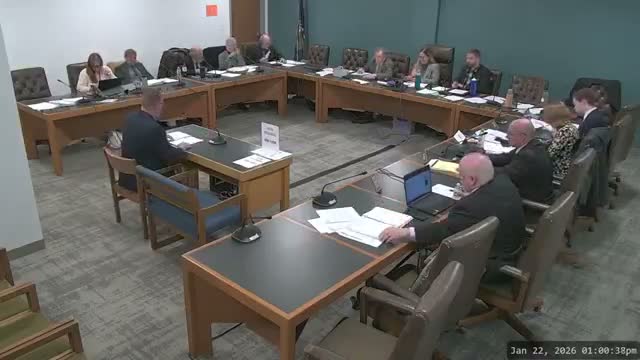
Representative Eric Johnson introduced House Bill 1259 to add alternative pathways to become a certified public accountant in New Hampshire, including options that would reduce the additional education burden (for example, allowing a bachelor's degree plus two years of public accounting experience in lieu of a fifth year of coursework).
Industry witnesses and educators described a long‑running recruitment problem. John Nash, an accounting professor at the University of New Hampshire, told the committee that the 150‑hour requirement contributed to a 36% decrease in CPA applications nationwide and only a modest increase in pass rates, arguing the net effect was a substantial drop in workforce entrants. "There was a 36% decrease in CPA applications following the rules adoption," Nash said.
Speakers from the New Hampshire Society of CPAs and practitioner groups supported the bill as a way to attract students and early career professionals. Testimony outlined three alternative paths proposed in the bill (post‑baccalaureate with experience; bachelor's plus additional semester hours plus one year experience; or bachelor's plus two years of public accounting experience) and urged enabling candidates to sit for the uniform CPA exam earlier so exam content is fresh.
Committee members and OPLC staff asked technical questions about cross‑state mobility language, references to the Uniform Accountancy Act and whether the bill's text should be updated to match recent statutory reorganizations; witnesses offered to provide additional documentation and model language.
The committee closed the hearing after taking written testimony and letters from firms and asked for clarifying materials prior to executive session.
Industry witnesses and educators described a long‑running recruitment problem. John Nash, an accounting professor at the University of New Hampshire, told the committee that the 150‑hour requirement contributed to a 36% decrease in CPA applications nationwide and only a modest increase in pass rates, arguing the net effect was a substantial drop in workforce entrants. "There was a 36% decrease in CPA applications following the rules adoption," Nash said.
Speakers from the New Hampshire Society of CPAs and practitioner groups supported the bill as a way to attract students and early career professionals. Testimony outlined three alternative paths proposed in the bill (post‑baccalaureate with experience; bachelor's plus additional semester hours plus one year experience; or bachelor's plus two years of public accounting experience) and urged enabling candidates to sit for the uniform CPA exam earlier so exam content is fresh.
Committee members and OPLC staff asked technical questions about cross‑state mobility language, references to the Uniform Accountancy Act and whether the bill's text should be updated to match recent statutory reorganizations; witnesses offered to provide additional documentation and model language.
The committee closed the hearing after taking written testimony and letters from firms and asked for clarifying materials prior to executive session.
Don't Miss a Word: See the Full Meeting!
Go beyond summaries. Unlock every video, transcript, and key insight with a Founder Membership.
✓
Get instant access to full meeting videos
✓
Search and clip any phrase from complete transcripts
✓
Receive AI-powered summaries & custom alerts
✓
Enjoy lifetime, unrestricted access to government data
30-day money-back guarantee
