NH lawmaker seeks insurance-department study to make prior-authorization rules easier to find
January 21, 2026 | Commerce and Consumer Affairs, House of Representatives, Committees , Legislative, New Hampshire
This article was created by AI summarizing key points discussed. AI makes mistakes, so for full details and context, please refer to the video of the full meeting. Please report any errors so we can fix them. Report an error »
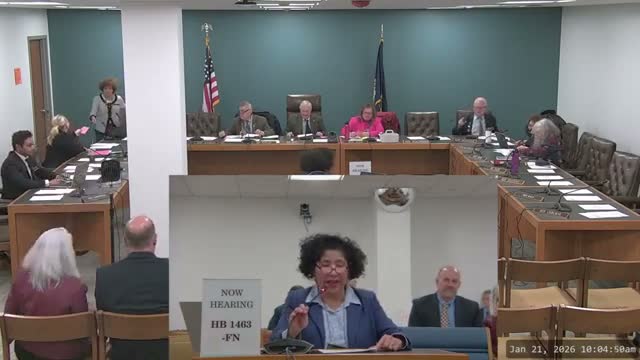
Representative Trinidad Tejas, prime sponsor of the bill, asked the House Commerce and Consumer Affairs Committee to direct the New Hampshire Insurance Department to assess how well carriers are meeting an existing legal requirement to make prior-authorization criteria "readily accessible" to enrollees and health care professionals. "I am Representative Trinidad Tejas, the prime sponsor, requiring the insurance department to conduct an analysis and produce a report detailing compliance with the state's managed care and medical utilization review laws," Tejas said.
The bill builds on 2024 reforms enacted in SB 561, which shortened insurer decision timelines, expanded peer-to-peer review access and required carrier reporting of prior-authorization metrics. Tejas and physician witnesses told the committee the numerical reporting template the department released (an Excel form carriers will use to submit 2025 metrics) captures counts of requests and denials but not whether the written clinical criteria and step-wise requirements are easy for clinicians and patients to find and understand.
Why it matters: doctors and office staff report high administrative burden and avoidable delays when prior-auth rules are opaque. Dr. Travis Harker and others described cases where an administrative reviewer denied a request because the clinician's note used a descriptive synonym rather than the insurer's named test; a later peer reviewer approved the request once the clinician used the insurer's proprietary term. "If the information is not readily accessible, clinicians are left guessing," Tejas said.
Supporters—including the New Hampshire Medical Society and practicing clinicians—favored a narrowly scoped assessment such as a targeted provider survey or a modest amendment to the department's reporting template that would ask carriers to link to the exact web pages where criteria are posted. Michelle Heaton, director of life and health at the New Hampshire Insurance Department, said the department is implementing SB 561 and will post carrier-reported metrics after April 1 but cautioned that the bill's cross-reference to broad managed-care statutes (RSA 420-J) as drafted could expand the department's workload and fiscal exposure.
Insurers' trade group AHIP and individual carriers urged clarity on scope to avoid a large unfunded mandate. AHIP's Paula Rogers said the statute's reference to managed-care law is expansive and suggested working with stakeholders and the department to identify a narrowly tailored path forward.
What would change: the bill directs the Insurance Department to assess whether carriers are meeting the existing statutory requirement that prior-authorization criteria be made readily accessible and understandable, and to gather provider and consumer feedback on the practical usability of posted criteria. Sponsors emphasized low-cost options—surveying a sample of licensed clinicians or adding a "link" field to the department's Excel template—as practical first steps.
Next steps: committee members signaled interest in subcommittee work to craft technical language and to tighten scope so the department can implement the study within existing resources or a modest fiscal allocation. Representative Tejas said she will submit written examples and an amendment for the committee working session.
Ending: The public hearing closed with agreement among members, the sponsor and the Insurance Department to work on technical fixes in subcommittee.
The bill builds on 2024 reforms enacted in SB 561, which shortened insurer decision timelines, expanded peer-to-peer review access and required carrier reporting of prior-authorization metrics. Tejas and physician witnesses told the committee the numerical reporting template the department released (an Excel form carriers will use to submit 2025 metrics) captures counts of requests and denials but not whether the written clinical criteria and step-wise requirements are easy for clinicians and patients to find and understand.
Why it matters: doctors and office staff report high administrative burden and avoidable delays when prior-auth rules are opaque. Dr. Travis Harker and others described cases where an administrative reviewer denied a request because the clinician's note used a descriptive synonym rather than the insurer's named test; a later peer reviewer approved the request once the clinician used the insurer's proprietary term. "If the information is not readily accessible, clinicians are left guessing," Tejas said.
Supporters—including the New Hampshire Medical Society and practicing clinicians—favored a narrowly scoped assessment such as a targeted provider survey or a modest amendment to the department's reporting template that would ask carriers to link to the exact web pages where criteria are posted. Michelle Heaton, director of life and health at the New Hampshire Insurance Department, said the department is implementing SB 561 and will post carrier-reported metrics after April 1 but cautioned that the bill's cross-reference to broad managed-care statutes (RSA 420-J) as drafted could expand the department's workload and fiscal exposure.
Insurers' trade group AHIP and individual carriers urged clarity on scope to avoid a large unfunded mandate. AHIP's Paula Rogers said the statute's reference to managed-care law is expansive and suggested working with stakeholders and the department to identify a narrowly tailored path forward.
What would change: the bill directs the Insurance Department to assess whether carriers are meeting the existing statutory requirement that prior-authorization criteria be made readily accessible and understandable, and to gather provider and consumer feedback on the practical usability of posted criteria. Sponsors emphasized low-cost options—surveying a sample of licensed clinicians or adding a "link" field to the department's Excel template—as practical first steps.
Next steps: committee members signaled interest in subcommittee work to craft technical language and to tighten scope so the department can implement the study within existing resources or a modest fiscal allocation. Representative Tejas said she will submit written examples and an amendment for the committee working session.
Ending: The public hearing closed with agreement among members, the sponsor and the Insurance Department to work on technical fixes in subcommittee.
View the Full Meeting & All Its Details
This article offers just a summary. Unlock complete video, transcripts, and insights as a Founder Member.
✓
Watch full, unedited meeting videos
✓
Search every word spoken in unlimited transcripts
✓
AI summaries & real-time alerts (all government levels)
✓
Permanent access to expanding government content
30-day money-back guarantee
