Bill would require third-party checks of insurers' mental-health networks after witnesses describe "ghost networks"
January 21, 2026 | Commerce and Consumer Affairs, House of Representatives, Committees , Legislative, New Hampshire
This article was created by AI summarizing key points discussed. AI makes mistakes, so for full details and context, please refer to the video of the full meeting. Please report any errors so we can fix them. Report an error »
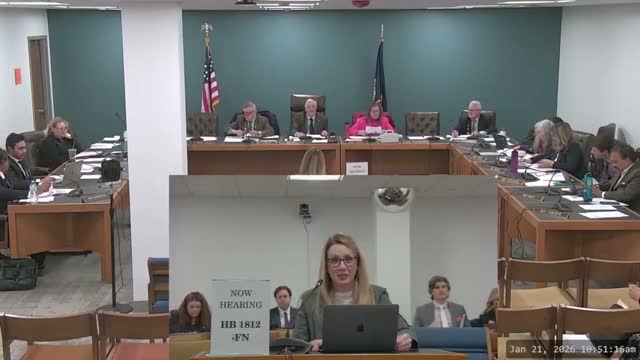
Representative Alicia Gregg opened the public hearing on House Bill 18 12 by describing a recurring problem: insurance directories and carrier self-reports can overstate the availability of behavioral-health providers. "Too many of our constituents are struggling to find mental health providers who are actually available to see them," she said.
The bill would require independent third-party evaluations every three years to test real-world access: whether listed providers are accepting new patients, whether appointments are available within specified windows (7 and 14 days in the sponsor's presentation), and whether county-level standards are met. Gregg proposed excluding from directories providers who are not accepting new patients or are beyond a reasonable travel time, and a 30-minute maximum drive-time standard in at least some settings.
Supporters—including NAMI New Hampshire, New Futures and clinicians—argued the measures are necessary to identify "ghost networks" (directories that look compliant on paper but fail in practice). Sam Hawkins of NAMI and Sam Burgess of New Futures described widespread reports of unreachable providers and high out-of-network use for behavioral health; Burgess cited peer-reviewed research showing New Hampshire ranks poorly in in-network behavioral-health access.
The Insurance Department's Michelle Heaton said New Hampshire already has detailed network adequacy rules (INS 2701), uses an all-payer claims database to validate directory listings, and is revising rules and enforcement tools. She warned the bill as drafted contains technical defects (narrowing and broadening language in different places) and that secret-shopper protocols can be difficult to implement reliably. Insurers warned the bill as drafted could impose large penalties for circumstances beyond their control (provider shortages, failure of providers to notify carriers when they stop accepting patients, limits on including out-of-state providers for proximity). Peter Bragdon of Harvard Pilgrim and Anthem's Sabrina Dunlap urged working with the department and stakeholders on precise definitions and remedies.
What to watch: committee members questioned the 30-minute standard's rural impact and whether penalties could be triggered by provider behavior outside carriers' control. The department and sponsors signaled willingness to work on technical fixes and rule amendments.
Ending: The committee closed the public hearing with widespread stakeholder interest in technical amendments and department collaboration; no vote was taken.
The bill would require independent third-party evaluations every three years to test real-world access: whether listed providers are accepting new patients, whether appointments are available within specified windows (7 and 14 days in the sponsor's presentation), and whether county-level standards are met. Gregg proposed excluding from directories providers who are not accepting new patients or are beyond a reasonable travel time, and a 30-minute maximum drive-time standard in at least some settings.
Supporters—including NAMI New Hampshire, New Futures and clinicians—argued the measures are necessary to identify "ghost networks" (directories that look compliant on paper but fail in practice). Sam Hawkins of NAMI and Sam Burgess of New Futures described widespread reports of unreachable providers and high out-of-network use for behavioral health; Burgess cited peer-reviewed research showing New Hampshire ranks poorly in in-network behavioral-health access.
The Insurance Department's Michelle Heaton said New Hampshire already has detailed network adequacy rules (INS 2701), uses an all-payer claims database to validate directory listings, and is revising rules and enforcement tools. She warned the bill as drafted contains technical defects (narrowing and broadening language in different places) and that secret-shopper protocols can be difficult to implement reliably. Insurers warned the bill as drafted could impose large penalties for circumstances beyond their control (provider shortages, failure of providers to notify carriers when they stop accepting patients, limits on including out-of-state providers for proximity). Peter Bragdon of Harvard Pilgrim and Anthem's Sabrina Dunlap urged working with the department and stakeholders on precise definitions and remedies.
What to watch: committee members questioned the 30-minute standard's rural impact and whether penalties could be triggered by provider behavior outside carriers' control. The department and sponsors signaled willingness to work on technical fixes and rule amendments.
Ending: The committee closed the public hearing with widespread stakeholder interest in technical amendments and department collaboration; no vote was taken.
View the Full Meeting & All Its Details
This article offers just a summary. Unlock complete video, transcripts, and insights as a Founder Member.
✓
Watch full, unedited meeting videos
✓
Search every word spoken in unlimited transcripts
✓
AI summaries & real-time alerts (all government levels)
✓
Permanent access to expanding government content
30-day money-back guarantee
