Two bills would change auto-insurance rules; supporters cite constituent safety, opponents warn of market effects
January 21, 2026 | Commerce and Consumer Affairs, House of Representatives, Committees , Legislative, New Hampshire
This article was created by AI summarizing key points discussed. AI makes mistakes, so for full details and context, please refer to the video of the full meeting. Please report any errors so we can fix them. Report an error »
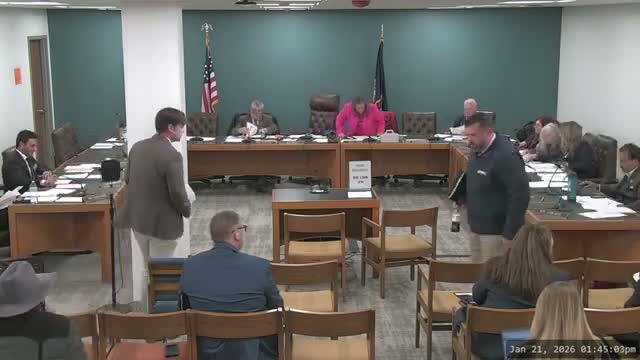
The committee heard two related proposals on motor-vehicle insurance and proof of financial responsibility. Representative Joe Barton introduced HP1568, describing it as a constituent-driven bill that would require minimum motor-vehicle insurance—he said the proposed minimum in the draft is $25,000 of coverage. Representative Veil Walsh introduced HB1558, which would require proof of financial responsibility at registration (insurance, a bond or a certificate of deposit) and authorize immediate suspension for failure to produce proof.
Supporters argued mandatory minimums protect victims and reduce uncompensated harms when uninsured motorists cause injury or damage. Opponents, including Mike McLaughlin for Allstate and other witnesses, said New Hampshire's system—where registration and license are not conditioned on mandatory insurance—has historically yielded a low uninsured-driver rate (cited at about 7.8% in testimony). They warned that mandating purchase and attaching penalties could increase premiums, distort markets and create perverse incentives.
Committee members discussed practical consequences, including how uninsured/underinsured motorist coverage functions and the interplay with health insurance for pedestrians. Representative Sullivan asked how a person without any auto insurance or health insurance would be covered if hit by an uninsured driver; committee members acknowledged limits and suggested litigation and health insurance as potential remedies in those cases.
Ending: The public hearing closed with committee members noting the longstanding policy trade-offs and expecting further consideration in subcommittee.
Supporters argued mandatory minimums protect victims and reduce uncompensated harms when uninsured motorists cause injury or damage. Opponents, including Mike McLaughlin for Allstate and other witnesses, said New Hampshire's system—where registration and license are not conditioned on mandatory insurance—has historically yielded a low uninsured-driver rate (cited at about 7.8% in testimony). They warned that mandating purchase and attaching penalties could increase premiums, distort markets and create perverse incentives.
Committee members discussed practical consequences, including how uninsured/underinsured motorist coverage functions and the interplay with health insurance for pedestrians. Representative Sullivan asked how a person without any auto insurance or health insurance would be covered if hit by an uninsured driver; committee members acknowledged limits and suggested litigation and health insurance as potential remedies in those cases.
Ending: The public hearing closed with committee members noting the longstanding policy trade-offs and expecting further consideration in subcommittee.
View the Full Meeting & All Its Details
This article offers just a summary. Unlock complete video, transcripts, and insights as a Founder Member.
✓
Watch full, unedited meeting videos
✓
Search every word spoken in unlimited transcripts
✓
AI summaries & real-time alerts (all government levels)
✓
Permanent access to expanding government content
30-day money-back guarantee
