Delaware State Police show decade of retail-theft growth, request 2 sergeants, 10 troopers and 2 analysts
January 20, 2026 | 2026 Legislature DE, Legislative, Delaware
This article was created by AI summarizing key points discussed. AI makes mistakes, so for full details and context, please refer to the video of the full meeting. Please report any errors so we can fix them. Report an error »
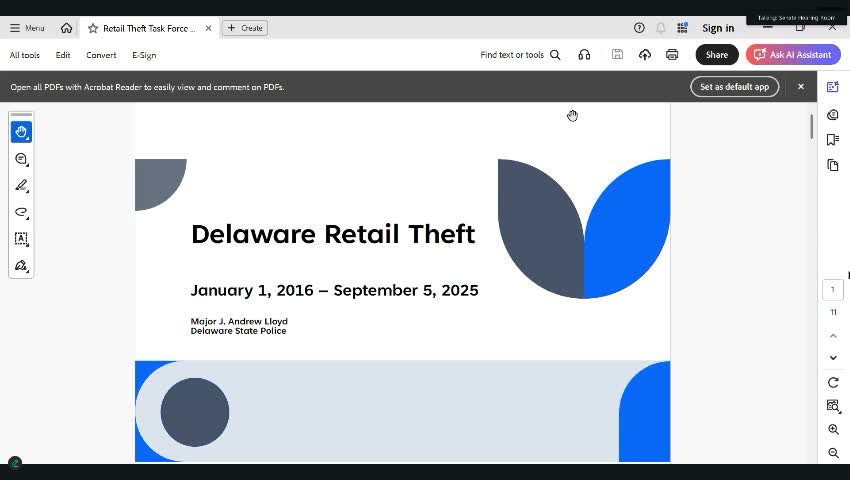
Delaware State Police presented a 10-year snapshot to a legislative task force, saying retail-theft reports have risen and that concentrating investigative resources would improve clearance and prosecution rates. "There were 56,790 reports of misdemeanor shoplifting, 2,691 felony shoplifting, and 1,838 organized retail theft incidences reported," Andrew Lloyd of the Delaware State Police told the group, citing data from Jan. 1, 2016 to Sept. 5, 2025.
Lloyd said New Castle County accounts for the largest share of incidents: "New Castle County, when it says statewide, that means all jurisdictions… 29,499 incidences," and that Troop 6 handled roughly 9,498 of the state police cases in that county. He said organized retail-theft incidents and felony shoplifting counts are concentrated in New Castle and that nearly all organized-retail cases there were investigated by DSP.
The presentation included clearance and arrest breakdowns: misdemeanor shoplifting cases were cleared at about 55.8% (31,672 cleared with arrest), with adults making up roughly 72% of those arrestees and juveniles about 27%; felony shoplifting had a clearance rate near 35.5% and about 151 total arrestees, with adults comprising 90% of those arrests and juveniles about 9%.
To sustain long-term investigative work, Lloyd said the state police would need additional staff: "that would be 2 sergeants, 10 troopers, and 2 crime analysts." He said the proposed unit would concentrate personnel in New Castle County and combine resources for Kent and Sussex to form a multi-county team; analysts would produce actionable intelligence to guide deployments.
Task force members and law-enforcement partners described benefits seen where dedicated units were piloted: more consistent case-building, better cooperation with prosecutors and loss-prevention teams, and faster identification of repeat offenders through shared video and analytic tools. DSP cited a multi-jurisdiction pawnshop investigation (Middletown Gold Fever) that used a wiretap and federal partners to trace stolen goods across states as an example of what a focused investigative team can achieve.
Delaware Department of Justice representatives cautioned that arrest counts do not always reflect final case outcomes because plea agreements, consolidated indictments and restorative dispositions affect reported resolutions. DOJ also flagged that improved discovery and timely evidence transfer to prosecutors are critical to converting arrests into pleas or convictions.
Chair Ryan Townsend said the task force would follow up on coordination with other legislators after noting a separate bill circulated by colleagues; members signaled interest in tracking the new DSP unit's effects on prosecution rates over the next six to nine months.
The task force did not take a formal vote on new funding or legislation during the meeting; DSP and task force members agreed to continue examining operational and prosecution metrics before making formal budget or legislative requests.
Lloyd said New Castle County accounts for the largest share of incidents: "New Castle County, when it says statewide, that means all jurisdictions… 29,499 incidences," and that Troop 6 handled roughly 9,498 of the state police cases in that county. He said organized retail-theft incidents and felony shoplifting counts are concentrated in New Castle and that nearly all organized-retail cases there were investigated by DSP.
The presentation included clearance and arrest breakdowns: misdemeanor shoplifting cases were cleared at about 55.8% (31,672 cleared with arrest), with adults making up roughly 72% of those arrestees and juveniles about 27%; felony shoplifting had a clearance rate near 35.5% and about 151 total arrestees, with adults comprising 90% of those arrests and juveniles about 9%.
To sustain long-term investigative work, Lloyd said the state police would need additional staff: "that would be 2 sergeants, 10 troopers, and 2 crime analysts." He said the proposed unit would concentrate personnel in New Castle County and combine resources for Kent and Sussex to form a multi-county team; analysts would produce actionable intelligence to guide deployments.
Task force members and law-enforcement partners described benefits seen where dedicated units were piloted: more consistent case-building, better cooperation with prosecutors and loss-prevention teams, and faster identification of repeat offenders through shared video and analytic tools. DSP cited a multi-jurisdiction pawnshop investigation (Middletown Gold Fever) that used a wiretap and federal partners to trace stolen goods across states as an example of what a focused investigative team can achieve.
Delaware Department of Justice representatives cautioned that arrest counts do not always reflect final case outcomes because plea agreements, consolidated indictments and restorative dispositions affect reported resolutions. DOJ also flagged that improved discovery and timely evidence transfer to prosecutors are critical to converting arrests into pleas or convictions.
Chair Ryan Townsend said the task force would follow up on coordination with other legislators after noting a separate bill circulated by colleagues; members signaled interest in tracking the new DSP unit's effects on prosecution rates over the next six to nine months.
The task force did not take a formal vote on new funding or legislation during the meeting; DSP and task force members agreed to continue examining operational and prosecution metrics before making formal budget or legislative requests.
Don't Miss a Word: See the Full Meeting!
Go beyond summaries. Unlock every video, transcript, and key insight with a Founder Membership.
✓
Get instant access to full meeting videos
✓
Search and clip any phrase from complete transcripts
✓
Receive AI-powered summaries & custom alerts
✓
Enjoy lifetime, unrestricted access to government data
30-day money-back guarantee
