Superintendent outlines midyear academic gains and formally moves district office to underused building to expand alternative programs
February 15, 2025 | Coos Bay SD 9, School Districts, Oregon
This article was created by AI summarizing key points discussed. AI makes mistakes, so for full details and context, please refer to the video of the full meeting. Please report any errors so we can fix them. Report an error »
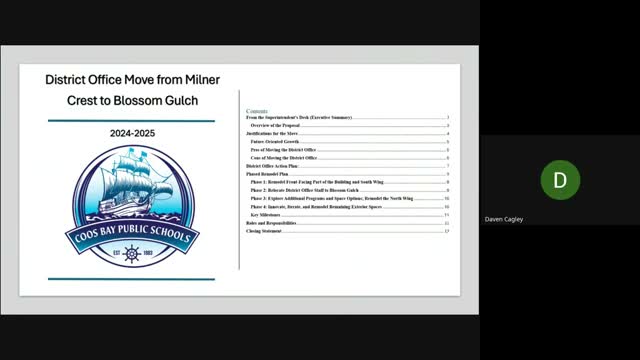
Dr. Ainsworth, the district superintendent, told the Coos Bay School District 9 board that the district has decided to move its central office into an underused building this spring and that the board will be asked to ratify a new calendar that shifts instructional time to prioritize students. The relocation is intended to free up space at the current Milner Press site so the district can expand alternative education programs and other student-facing offerings.
The move followed a needs assessment Dr. Ainsworth said had been under way for “several years.” He said the decision was driven by a desire to use existing district-owned space rather than ask voters for a new bond. “We will move the district office from the current location to this building,” he said, and described a phased plan to remodel the south/front of the building, relocate staff over the summer (or sooner, depending on progress), and then start adding student programs on the north side in later phases.
Dr. Ainsworth framed the decision with academic context: the midyear review presented to the board shows growth in reading and math at several schools, and he emphasized that calendar choices are intended to maximize instructional time while preserving staff professional time. “More time is better than less time in school,” he said when describing goals behind the proposed calendar changes.
Key details about the district office move and calendar proposal
• Move rationale and phases: The superintendent said the district wants adults (district staff) to relocate so campus space at the current office can host expanded student programs (alternative education, Little Pirates, online program). He described a four‑phase plan: (1) remodel front/south offices, (2) relocate district staff, (3) explore new student programs, (4) remodel the north side and expand innovative student uses.
• Building condition and systems: Staff said they consulted an engineer (referenced in the discussion) and an electrical contractor; the engineer reportedly found the building structurally sound albeit settled, and electrical review showed an abundance of existing circuitry in the south hallway. The district will seek targeted, low‑cost upgrades (carpet, paint, wiring, lighting) rather than a full overhaul.
• Cost and timing: The administration said an estimated $250,000 would cover initial classroom and office upgrades to support the move. The district will include a supplemental budget request in March to cover capital project allocations. The board asked for itemized classroom quotes; staff said they will bring quotes back and prioritize projects so work can begin this spring and continue into next summer.
• Staff to move: Most district office personnel, including curriculum, some technology staff, special programs, the business office, HR and the superintendent’s office, were listed as planned to relocate. Destination and Little Pirates programs will remain where appropriate due to technology/server constraints.
Midyear academic highlights and calendar proposals
Dr. Ainsworth reviewed midyear data showing measurable growth in several schools, particularly at the elementary level. He said:
• Eastside kindergartners: the percentage at or above ELA proficiency rose to the low‑60s from about 28% earlier in the year, and math proficiency also improved.
• Madison: composite reading gains and increases in students decoding at or above benchmark; staff‑led interventions reduced the share of students in the lowest categories.
• Millecoma and other elementary schools: double‑digit increases in third and fourth grade math and reading in some grades.
• Junior high/high school: the district reported increased dual‑credit and career‑tech participation and a generally solid pass rate; the tenth‑grade failure rate was noted as a concern (above target) and slated for further study.
Calendar: Dr. Ainsworth said the board will be asked to ratify a calendar that emphasizes more instructional time at the start of the year, 173 instructional days and 190 contract days, with Fridays off to support staff professional time. He also proposed keeping school on Monday and Tuesday of Thanksgiving week (with the remainder of the week off) to minimize loss of instruction for students who do not travel.
Board questions and next steps
Board members asked about foundation/settling issues, electrical capacity, the building’s history as the district operations center and sentimental value of the Milner Press location. Staff said they had engaged an engineer and a local electrical firm for assessments and that quotes for incremental work are being collected.
Administrative staff said the district will present more detailed cost estimates in the supplemental budget packet next month and will sequence moves to avoid disruption to students and programs. The superintendent said moving adults into the underused building will create space where more student programs can operate, and that he prefers using district property rather than ask voters for a bond.
The superintendent also asked the board for direction on calendar ratification at a future meeting; the board did not adopt the calendar during the meeting but heard the recommendation and scheduled follow‑up budget and timeline items.
Ending
Administration said it will return with itemized cost estimates for remodeling, a supplemental budget request in March, and a more detailed timeline for staff relocation and program expansion. The district emphasized that program changes — including any expansion of alternative education — will proceed only after the board reviews the cost estimates and ratifies any required budget changes.
The move followed a needs assessment Dr. Ainsworth said had been under way for “several years.” He said the decision was driven by a desire to use existing district-owned space rather than ask voters for a new bond. “We will move the district office from the current location to this building,” he said, and described a phased plan to remodel the south/front of the building, relocate staff over the summer (or sooner, depending on progress), and then start adding student programs on the north side in later phases.
Dr. Ainsworth framed the decision with academic context: the midyear review presented to the board shows growth in reading and math at several schools, and he emphasized that calendar choices are intended to maximize instructional time while preserving staff professional time. “More time is better than less time in school,” he said when describing goals behind the proposed calendar changes.
Key details about the district office move and calendar proposal
• Move rationale and phases: The superintendent said the district wants adults (district staff) to relocate so campus space at the current office can host expanded student programs (alternative education, Little Pirates, online program). He described a four‑phase plan: (1) remodel front/south offices, (2) relocate district staff, (3) explore new student programs, (4) remodel the north side and expand innovative student uses.
• Building condition and systems: Staff said they consulted an engineer (referenced in the discussion) and an electrical contractor; the engineer reportedly found the building structurally sound albeit settled, and electrical review showed an abundance of existing circuitry in the south hallway. The district will seek targeted, low‑cost upgrades (carpet, paint, wiring, lighting) rather than a full overhaul.
• Cost and timing: The administration said an estimated $250,000 would cover initial classroom and office upgrades to support the move. The district will include a supplemental budget request in March to cover capital project allocations. The board asked for itemized classroom quotes; staff said they will bring quotes back and prioritize projects so work can begin this spring and continue into next summer.
• Staff to move: Most district office personnel, including curriculum, some technology staff, special programs, the business office, HR and the superintendent’s office, were listed as planned to relocate. Destination and Little Pirates programs will remain where appropriate due to technology/server constraints.
Midyear academic highlights and calendar proposals
Dr. Ainsworth reviewed midyear data showing measurable growth in several schools, particularly at the elementary level. He said:
• Eastside kindergartners: the percentage at or above ELA proficiency rose to the low‑60s from about 28% earlier in the year, and math proficiency also improved.
• Madison: composite reading gains and increases in students decoding at or above benchmark; staff‑led interventions reduced the share of students in the lowest categories.
• Millecoma and other elementary schools: double‑digit increases in third and fourth grade math and reading in some grades.
• Junior high/high school: the district reported increased dual‑credit and career‑tech participation and a generally solid pass rate; the tenth‑grade failure rate was noted as a concern (above target) and slated for further study.
Calendar: Dr. Ainsworth said the board will be asked to ratify a calendar that emphasizes more instructional time at the start of the year, 173 instructional days and 190 contract days, with Fridays off to support staff professional time. He also proposed keeping school on Monday and Tuesday of Thanksgiving week (with the remainder of the week off) to minimize loss of instruction for students who do not travel.
Board questions and next steps
Board members asked about foundation/settling issues, electrical capacity, the building’s history as the district operations center and sentimental value of the Milner Press location. Staff said they had engaged an engineer and a local electrical firm for assessments and that quotes for incremental work are being collected.
Administrative staff said the district will present more detailed cost estimates in the supplemental budget packet next month and will sequence moves to avoid disruption to students and programs. The superintendent said moving adults into the underused building will create space where more student programs can operate, and that he prefers using district property rather than ask voters for a bond.
The superintendent also asked the board for direction on calendar ratification at a future meeting; the board did not adopt the calendar during the meeting but heard the recommendation and scheduled follow‑up budget and timeline items.
Ending
Administration said it will return with itemized cost estimates for remodeling, a supplemental budget request in March, and a more detailed timeline for staff relocation and program expansion. The district emphasized that program changes — including any expansion of alternative education — will proceed only after the board reviews the cost estimates and ratifies any required budget changes.
Don't Miss a Word: See the Full Meeting!
Go beyond summaries. Unlock every video, transcript, and key insight with a Founder Membership.
✓
Get instant access to full meeting videos
✓
Search and clip any phrase from complete transcripts
✓
Receive AI-powered summaries & custom alerts
✓
Enjoy lifetime, unrestricted access to government data
30-day money-back guarantee
