After Colorado Supreme Court ruling, Denver staff to revise municipal sentences to match state law
January 12, 2026 | Denver (Consolidated County and City), Colorado
This article was created by AI summarizing key points discussed. AI makes mistakes, so for full details and context, please refer to the video of the full meeting. Please report any errors so we can fix them. Report an error »
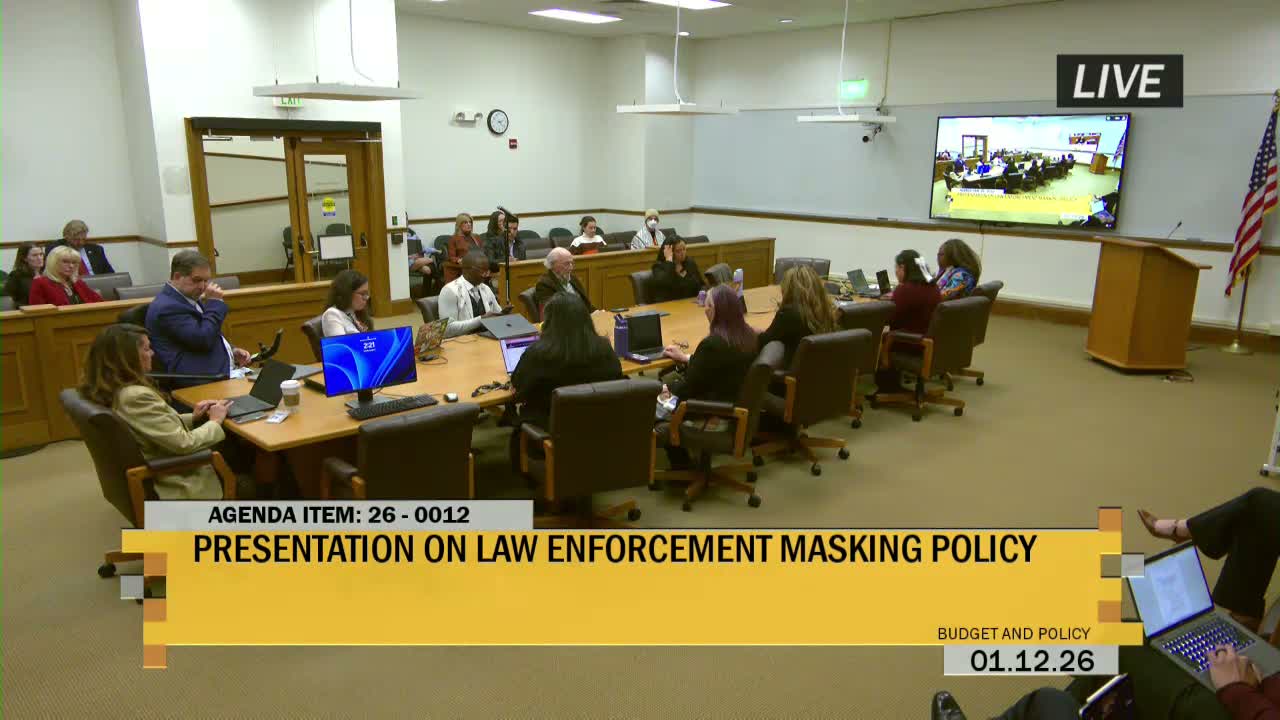
Denver councilmembers on the Budget & Policy Committee received an urgent briefing on Dec. 23, 2025 about the Colorado Supreme Court’s recent rulings in City of Westminster v. Camp and City of Aurora v. Simon and their effect on Denver municipal sentencing.
Colette Tevet, chief municipal public defender, told the committee that the Colorado Supreme Court found municipal ordinances imposing higher penalties for the same conduct as state statutes are preempted by state law and must be aligned. “State law prohibits cities like Denver from imposing harsher sentences for the same conduct,” Tevet said, and added that the ruling means many Denver municipal penalties on the books are now inconsistent with state caps.
Tevet and other municipal public defenders gave concrete examples: Denver’s current trespass ordinance carries a maximum penalty listed on the books of up to 300 days in jail and a $999 fine, while the comparable state petty‑offense cap is 10 days in jail and a $300 fine. The city’s current single‑tier petty theft penalty also conflicts with the state’s tiered approach (under state law, theft under $300 is a petty offense capped at 10 days/$300, while theft between $300 and $1,000 may carry higher limits such as 120 days/$750).
Officials warned that the discrepancy creates immediate courtroom complications including unclear advisals to defendants and the risk of invalid guilty pleas. The city attorney’s office said municipal courts remain able to charge offenses but must ensure sentences do not exceed state caps; the office pointed to Boulder’s short ordinance that instructs the municipal code to default to the state maximum when conduct is identical as one interim approach.
Staff proposed an implementation bill to amend the Denver Revised Municipal Code (DRMC) so sentences for comparable offenses match state maximums, to identify municipal‑only petty offenses that should retain lower penalties, and to add catch‑all language for rare or uncategorized violations. Councilmembers asked for the offense‑comparison chart and a draft ordinance to be circulated before one‑on‑one briefings and committee follow‑ups; no formal vote was taken.
Colette Tevet, chief municipal public defender, told the committee that the Colorado Supreme Court found municipal ordinances imposing higher penalties for the same conduct as state statutes are preempted by state law and must be aligned. “State law prohibits cities like Denver from imposing harsher sentences for the same conduct,” Tevet said, and added that the ruling means many Denver municipal penalties on the books are now inconsistent with state caps.
Tevet and other municipal public defenders gave concrete examples: Denver’s current trespass ordinance carries a maximum penalty listed on the books of up to 300 days in jail and a $999 fine, while the comparable state petty‑offense cap is 10 days in jail and a $300 fine. The city’s current single‑tier petty theft penalty also conflicts with the state’s tiered approach (under state law, theft under $300 is a petty offense capped at 10 days/$300, while theft between $300 and $1,000 may carry higher limits such as 120 days/$750).
Officials warned that the discrepancy creates immediate courtroom complications including unclear advisals to defendants and the risk of invalid guilty pleas. The city attorney’s office said municipal courts remain able to charge offenses but must ensure sentences do not exceed state caps; the office pointed to Boulder’s short ordinance that instructs the municipal code to default to the state maximum when conduct is identical as one interim approach.
Staff proposed an implementation bill to amend the Denver Revised Municipal Code (DRMC) so sentences for comparable offenses match state maximums, to identify municipal‑only petty offenses that should retain lower penalties, and to add catch‑all language for rare or uncategorized violations. Councilmembers asked for the offense‑comparison chart and a draft ordinance to be circulated before one‑on‑one briefings and committee follow‑ups; no formal vote was taken.
Don't Miss a Word: See the Full Meeting!
Go beyond summaries. Unlock every video, transcript, and key insight with a Founder Membership.
✓
Get instant access to full meeting videos
✓
Search and clip any phrase from complete transcripts
✓
Receive AI-powered summaries & custom alerts
✓
Enjoy lifetime, unrestricted access to government data
30-day money-back guarantee
