Council members raise trust and equity concerns as DOTI reconsiders Alameda redesign
January 21, 2026 | Denver (Consolidated County and City), Colorado
This article was created by AI summarizing key points discussed. AI makes mistakes, so for full details and context, please refer to the video of the full meeting. Please report any errors so we can fix them. Report an error »
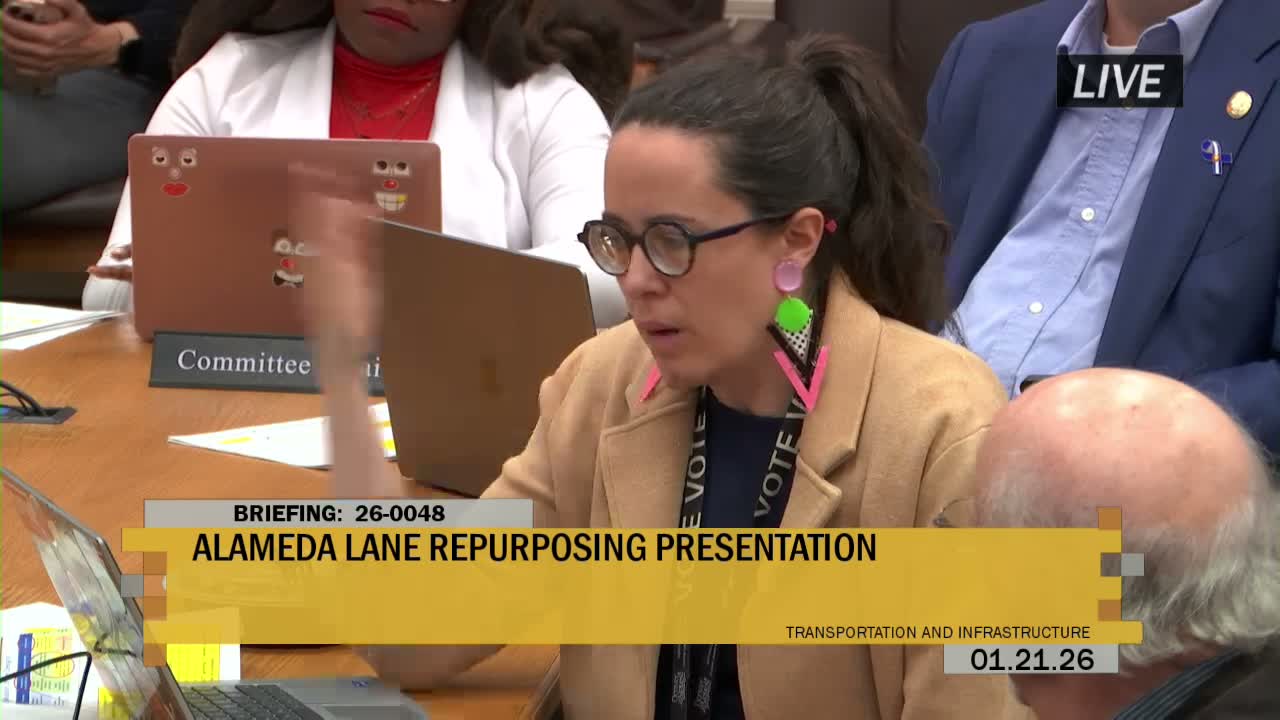
Council members used the Transportation and Infrastructure Committee hearing to press city transportation staff on public engagement, timing of the redesign recommendation, and equity across Denver neighborhoods.
Multiple council members expressed frustration that community engagement had broken down during a long design-to-implementation lag. Councilwoman Al Idris told the committee that outreach was ‘‘broken’’ and said she was concerned about weighing the voices of those most at risk: “Is it the person that's home got ran into or is it the person who's getting inconvenienced by a few minutes?”
Councilman Verdi pointed to internal correspondence and contested staff statements about whether a decision to pursue the partial lane reduction had already been made in August; he warned that accuracy matters for restoring public trust. Verdi cited an email he read aloud that said leadership ‘‘decided to move forward with a partial lane reduction,’’ and said, “At some point, we have to get out of spin and into talking about the substance of safety issues.” Staff replied that additional analysis continued after the email and that the department finalized its recommendation only after further internal work in mid‑October.
Several council members also framed the controversy as an equity issue. Councilmember Parody (as referenced in the record) and others said neighborhoods with fewer resources or less media attention may lose out when loud or well‑resourced advocates shape decisions. Councilwoman Parody and others asked staff to give similarly thorough outreach and follow-up in parts of the city with different needs, and to clarify how stakeholder input was used in later analysis.
Committee members asked staff to return with a collective briefing so all council offices receive the same updated crash and traffic data and to present a community-informed demonstration plan. The committee did not vote; staff tentatively agreed to return on Feb. 18 with a demonstration plan outline and requested data.
Multiple council members expressed frustration that community engagement had broken down during a long design-to-implementation lag. Councilwoman Al Idris told the committee that outreach was ‘‘broken’’ and said she was concerned about weighing the voices of those most at risk: “Is it the person that's home got ran into or is it the person who's getting inconvenienced by a few minutes?”
Councilman Verdi pointed to internal correspondence and contested staff statements about whether a decision to pursue the partial lane reduction had already been made in August; he warned that accuracy matters for restoring public trust. Verdi cited an email he read aloud that said leadership ‘‘decided to move forward with a partial lane reduction,’’ and said, “At some point, we have to get out of spin and into talking about the substance of safety issues.” Staff replied that additional analysis continued after the email and that the department finalized its recommendation only after further internal work in mid‑October.
Several council members also framed the controversy as an equity issue. Councilmember Parody (as referenced in the record) and others said neighborhoods with fewer resources or less media attention may lose out when loud or well‑resourced advocates shape decisions. Councilwoman Parody and others asked staff to give similarly thorough outreach and follow-up in parts of the city with different needs, and to clarify how stakeholder input was used in later analysis.
Committee members asked staff to return with a collective briefing so all council offices receive the same updated crash and traffic data and to present a community-informed demonstration plan. The committee did not vote; staff tentatively agreed to return on Feb. 18 with a demonstration plan outline and requested data.
View the Full Meeting & All Its Details
This article offers just a summary. Unlock complete video, transcripts, and insights as a Founder Member.
✓
Watch full, unedited meeting videos
✓
Search every word spoken in unlimited transcripts
✓
AI summaries & real-time alerts (all government levels)
✓
Permanent access to expanding government content
30-day money-back guarantee
