Eaton County staff outline budget shortfalls and potential cuts; $3 million reduction estimated for neutrality
May 17, 2025 | Eaton County, Michigan
This article was created by AI summarizing key points discussed. AI makes mistakes, so for full details and context, please refer to the video of the full meeting. Please report any errors so we can fix them. Report an error »
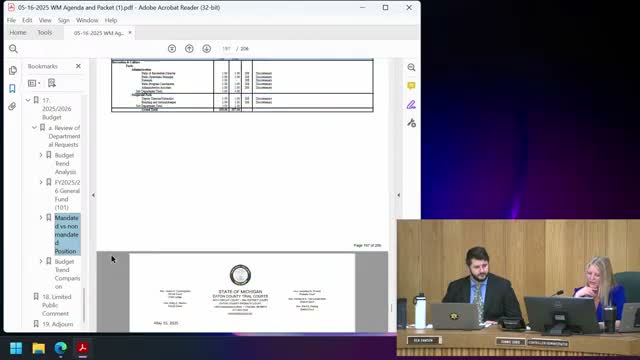
County administration presented a revised multi-year budget projection to the Ways and Means Committee on May 16 showing that, without new revenue, the general fund would face sustained deficits and that roughly $3 million in recurring reductions would be needed to arrive at a neutral operating position while preserving a policy fund balance target.
Administrators told the committee the numbers are preliminary and that several factors will change as the board finalizes priorities and considers which personnel and program reductions to make. Staff emphasized that cuts to positions create additional legacy costs—most notably changes to pension (MERS) and retiree-health liabilities—and that those transition costs must be modeled case-by-case. For planning purposes, administrators included a placeholder $3 million set-aside for potential MERS-related costs and added roughly $600,000 tied to retiree-health (OPEB) assumptions used in the annual valuation.
Staff noted the packet included a mandate inventory supplied by departments intended to show which positions perform state- or court-mandated services and which perform discretionary functions that could be consolidated or eliminated. County leaders said the exercise was difficult: many positions crosscut multiple services, and reductions can reduce service levels for residents. Administration asked commissioners to review materials and supply questions ahead of a May 30 follow-up meeting and cautioned that personnel reductions would likely reduce service availability in the months ahead even if formal layoffs are not implemented until the new fiscal year.
Administrators also summarized how previously levied public-safety and facilities millages that failed renewal in recent ballots affect projected revenue, and noted that capital projects and existing debt (including payments for leased solar equipment) remain obligations that consume resources. Staff said the capital improvement plan and any decisions to issue bonds would accelerate some projects but would not eliminate the underlying need for operating cuts if new revenue is not identified.
The committee did not vote to adopt cuts on May 16; staff asked commissioners to review the packet and return with priorities and questions at future budget hearings.
Administrators told the committee the numbers are preliminary and that several factors will change as the board finalizes priorities and considers which personnel and program reductions to make. Staff emphasized that cuts to positions create additional legacy costs—most notably changes to pension (MERS) and retiree-health liabilities—and that those transition costs must be modeled case-by-case. For planning purposes, administrators included a placeholder $3 million set-aside for potential MERS-related costs and added roughly $600,000 tied to retiree-health (OPEB) assumptions used in the annual valuation.
Staff noted the packet included a mandate inventory supplied by departments intended to show which positions perform state- or court-mandated services and which perform discretionary functions that could be consolidated or eliminated. County leaders said the exercise was difficult: many positions crosscut multiple services, and reductions can reduce service levels for residents. Administration asked commissioners to review materials and supply questions ahead of a May 30 follow-up meeting and cautioned that personnel reductions would likely reduce service availability in the months ahead even if formal layoffs are not implemented until the new fiscal year.
Administrators also summarized how previously levied public-safety and facilities millages that failed renewal in recent ballots affect projected revenue, and noted that capital projects and existing debt (including payments for leased solar equipment) remain obligations that consume resources. Staff said the capital improvement plan and any decisions to issue bonds would accelerate some projects but would not eliminate the underlying need for operating cuts if new revenue is not identified.
The committee did not vote to adopt cuts on May 16; staff asked commissioners to review the packet and return with priorities and questions at future budget hearings.
View the Full Meeting & All Its Details
This article offers just a summary. Unlock complete video, transcripts, and insights as a Founder Member.
✓
Watch full, unedited meeting videos
✓
Search every word spoken in unlimited transcripts
✓
AI summaries & real-time alerts (all government levels)
✓
Permanent access to expanding government content
30-day money-back guarantee
